
Genus Scomberomorus · Surmai · Kingfish · HS 0303.54 / 0304
Frozen Spanish Mackerel Supplier — Scomberomorus commerson
Frozen Spanish mackerel (Scomberomorus commerson) is the largest commercially traded species of the genus Scomberomorus and the only mackerel on this site with white, firm flesh that its buyers purchase in steaks rather than whole round. Known as surmai in India, thora in Sri Lanka and kingfish across Southeast Asia and the Pacific, frozen Scomberomorus commerson serves markets where texture and cut format matter as much as species identity. Global Mackerel supplies frozen Spanish mackerel whole round IQF and steak-cut IQF from India and Sri Lanka — the two commercial origins that together supply the majority of internationally traded frozen Scomberomorus commerson — to importers, processors and distributors in the Middle East, Southeast Asia and Australia.
Flesh
White · firm · low fat
Formats
WR IQF · Steaks IQF
HS Code
0303.54 (WR) · 0304 (steaks)
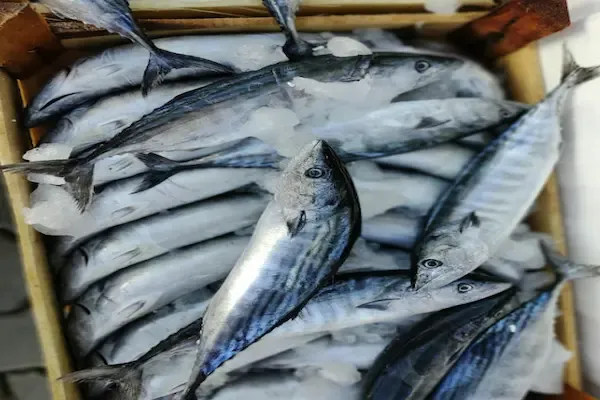
Scomberomorus commerson — The Solitary Hunter That No Seine Net Can Catch
Every other mackerel species on this site — Scomber scombrus, Scomber japonicus, Trachurus trachurus, Trachurus capensis, Trachurus murphyi, Rastrelliger kanagurta — forms dense, tightly packed schooling aggregations that purse-seine nets and pelagic trawls are specifically designed to exploit. A single set of a modern pelagic purse seine can encircle and haul 100–400 tonnes of schooling mackerel in a single operation. Scomberomorus commerson does not school. It hunts. A large S. commerson — the species reaches 240cm and over 70kg, though commercial fish run 2–15kg — is an ambush predator that attacks small pelagic fish at speeds exceeding 50km/h. It moves in loose, dispersed groups of 2–10 individuals that cover wide ranges and do not aggregate in the dense formations that make bulk netting economically viable. No commercial purse-seine fishery exists for S. commerson anywhere in the world.
The dominant commercial fishing methods for frozen Spanish mackerel are trolling (traîne), drift gillnets (filets maillants dérivants) and hook-and-line. In India — the world's largest producer of S. commerson — the bulk of commercial landings come from motorised artisanal vessels operating drift gillnets 20–60km offshore in the Arabian Sea and Bay of Bengal. Sri Lankan S. commerson is predominantly line-caught by hook-and-line operators working from small vessels out of the northern and eastern coast ports of Jaffna, Trincomalee and Batticaloa. The practical consequence of these fishing methods for frozen Spanish mackerel quality is direct: individual fish are handled one at a time, not in bulk hauls of tonnes. There is no crowding-induced stress, no bruising from net pressure, no delayed freezing caused by the sheer volume of a purse-seine haul. The baseline quality floor for line-caught frozen S. commerson is structurally higher than for any bulk-netted Scomber or Trachurus.
The solitary predator lifestyle has a physiological consequence that is immediately visible at the counter: Scomberomorus commerson has white, firm, low-fat flesh — the result of fast-twitch white muscle adapted for burst-speed predation, as opposed to the dark, oil-rich slow-twitch muscle of the migratory schooling Scomber species. Fat content in S. commerson typically runs 2–6%, compared to 8–30% in Scomber scombrus or 10–22% in Trachurus japonicus at peak. This is not a quality disadvantage — it is a different product for different applications. Buyers who specify frozen Spanish mackerel are not substituting for Atlantic or Pacific mackerel; they are purchasing a fundamentally different culinary product. When you need to confirm labelling against documentation for any Scombridae shipment, use our frozen mackerel species identification guide as a cross-reference for genus-level distinctions before signing off on customs paperwork.
Scomberomorus commerson — Solitary predator
- → Fishing method: trolling · hook-and-line · drift gillnet
- → Flesh: white · firm · fast-twitch muscle
- → Fat content: 2–6% (year-round stable)
- → Commercial format: whole round + steaks
- → Handling at sea: individual fish — no bulk crush
Scomber / Trachurus spp. — Schooling species
- → Fishing method: purse seine · pelagic trawl
- → Flesh: dark · oily · slow-twitch muscle
- → Fat content: 4–30% (highly seasonal)
- → Commercial format: whole round dominant
- → Handling: bulk haul — crowding stress possible
A spanish mackerel supplier serving curry houses, retail chains and reprocessing plants should quote both whole round and steak lines when the tender asks for Scomberomorus commerson export specifications, because the same end-buyer may split volume between formats within one season. Global Mackerel consolidates offers from approved Indian and Sri Lankan plants so importers can compare line-caught thora against mixed-method surmai in a single RFQ response.
Frozen Spanish Mackerel vs Frozen Kingfish — When the Same Fish Has Two Names and Two HS Codes
"Kingfish" is the dominant commercial name for Scomberomorus commerson in Australia, New Zealand, the Pacific Islands, Southeast Asia and parts of the Middle East. It appears on carton labels, customs invoices and import declarations as the primary product identifier — more prominently than the scientific name in many trading relationships. The commercial problem is precise: "kingfish" also refers to Seriola lalandi — the yellowtail kingfish — a premium aquaculture species from the family Carangidae produced in Australia, New Zealand, Japan and Norway that bears no biological relationship to Scomberomorus commerson and commands a CIF price 4–8 times higher per kilogram. Customs authorities in Australia, Japan and the European Union that classify on the basis of commercial name rather than scientific name have issued import documentation corrections and, in some cases, tariff reclassifications when the two species were confused on incoming declarations. For buyers moving frozen kingfish inventory that is actually narrow-barred Spanish mackerel, the fix is always documentary: align the scientific name, HS line and health certificate before the vessel sails.
Scomberomorus commerson is the only species on this site that can legitimately be classified under two different HS code headings depending on the processing format exported. Frozen whole round or headed-and-gutted S. commerson falls under HS 0303.54 — the same heading as Scomber scombrus, Scomber japonicus and Rastrelliger kanagurta. Frozen S. commerson steaks — cross-cut sections 2–5cm thick — fall under HS 0304.89 (other frozen fish fillets and other fish meat). The practical consequence: a buyer who imports frozen Spanish mackerel whole round and frozen Spanish mackerel steaks in the same container may be subject to two different tariff lines, two different import duty rates and two different regulatory inspection procedures at the same port of entry. Specifying the format in the proforma invoice and the letter of credit before shipment eliminates the risk of post-landing reclassification. Your broker can walk through chapter notes using our frozen mackerel HS codes and trade documentation guide.
Commercial name risk — what to specify on all documents
- → Scientific name: Scomberomorus commerson — mandatory on health cert and invoice
- → Never use "kingfish" alone — always qualify: "Spanish mackerel / Scomberomorus commerson (kingfish)"
- → HS code: state 0303.54 (WR/H&G) OR 0304.89 (steaks) — never both on same line item
- → Seriola lalandi (yellowtail kingfish) is a different species, HS 0303.89 — not a substitute
Listing the correct spanish mackerel HS code on the packing list is not a formality — it determines which customs chapter your broker files under and which reference laboratory method your destination may apply at border inspection. Whole round IQF stays in 0303.54; steak packs move to 0304.89. Mixed cartons need separate line items, not a blended description.
| Market | Local name | Risk of confusion with |
|---|---|---|
| India | Surmai / Seer fish | Other Scomberomorus spp. (S. guttatus, S. lineolatus) |
| Sri Lanka | Thora | S. lineolatus (dhathu thora) — lower commercial value |
| Australia / NZ | Kingfish / Spanish mackerel | Seriola lalandi (yellowtail kingfish) — HS 0303.89 |
| Malaysia / Indonesia | Tenggiri papan | S. guttatus (tenggiri batang) — smaller, lower value |
| Pacific Islands | Walu / Ono | Minimal — name is species-specific in Pacific trade |
| GCC / Middle East | Kanaad / Kanad | Other Scomberomorus spp. in Gulf waters |
Frozen Spanish Mackerel Steaks and H&G IQF — Wholesale Scomberomorus commerson Formats Explained
No other species on this site is commercially traded in steak format as a primary export product. The steak format for frozen Spanish mackerel (Scomberomorus commerson) exists because of the species' combination of large size, firm white flesh and the dominant consumption pattern in its primary markets. In South Asian cooking — Indian, Sri Lankan, Pakistani, Bangladeshi — S. commerson is the reference species for fish curry and fried fish preparations that call for a portion-sized piece of firm fish that holds its shape during cooking in sauce. A whole S. commerson of 3–8kg is impractical for retail or restaurant portions. The steak cut — a cross-section of the fish body 2–4cm thick, skin-on or skin-off, bone-in — is the format that matches the end consumer's preparation method and portion size in these markets. Retail and wholesale buyers searching for frozen spanish mackerel steak SKUs or wholesale kingfish H&G IQF are therefore asking for a supply chain that already includes portioning, IQF freezing and glaze — not a commodity whole round that still needs a bandsaw line at destination.
Producing frozen Spanish mackerel steaks rather than whole round requires a processing line with bandsaw or guillotine cutting capability, a separate IQF tunnel or plate freezing stage, and individual wrapping or loose pack capability. The cutting operation introduces specific quality management requirements that do not apply to whole round processing: the cutting blade must be maintained below 4°C to prevent surface temperature rise on cut faces, the time between cutting and freezing must be minimised to limit bacterial colonisation on the exposed muscle surface, and the frozen steaks must be glazed individually — rather than as a batch — to seal the cut surfaces against oxidative rancidity during cold storage. Processing plants that produce both whole round and steak-cut frozen Spanish mackerel maintain separate HACCP plans for each format. If your specification sheet only mentions glazing percentage for whole round, extend it before you buy frozen spanish mackerel in steak packs — cut-face glaze rules differ from whole-fish glaze rules.
| Format | HS Code | Typical weight | Primary market | Pack |
|---|---|---|---|---|
| Whole Round IQF | 0303.54 | 1–5 kg/fish | SE Asia, Pacific, processing | 10–20 kg carton |
| H&G IQF | 0303.54 | 0.8–4 kg/fish | Middle East, retail | 10–20 kg carton |
| Steaks IQF — skin on, bone in | 0304.89 | 150–300 g/steak | India, Sri Lanka diaspora, GCC | 1 kg retail / 10 kg bulk |
| Steaks IQF — skin off, bone in | 0304.89 | 120–250 g/steak | Premium retail, foodservice | 1 kg retail / 5 kg bulk |
Procurement teams comparing spanish mackerel whole round IQF against steak lines should request separate yield tables: the conversion from whole fish to steaks depends on head removal, collar trim and tail cut policy. Global Mackerel supplies both formats with plant-specific yield disclosures on request. For carton dimensions and master pack configurations shared across species, see frozen mackerel formats and product specifications.
Sri Lanka as the Premium Origin for Frozen Scomberomorus commerson
India is the world's largest producer of Scomberomorus commerson by volume, but Sri Lanka is consistently cited by frozen Spanish mackerel buyers in Japan, the Middle East and premium Southeast Asian retail as the preferred origin for quality-specification product. The structural reason is the fishing method. The majority of Sri Lankan S. commerson — sold domestically as "thora" — is line-caught by hook-and-line from small motorised boats operating out of the northern and eastern coast ports of Jaffna, Kankesanthurai, Trincomalee and Batticaloa. These vessels operate on day trips of 6–12 hours. The fish is landed, gutted and iced within hours of capture. Indian S. commerson, by contrast, is a mix of line-caught and drift gillnet product from vessels with sea times of 2–5 days, producing greater variation in freshness at the point of freezing. That split is why experienced importers still use the phrase spanish mackerel Sri Lanka as a quality signal in tender text — not as a political statement, but as a shorthand for day-boat line-caught raw material.
The quality difference between Sri Lankan line-caught frozen Spanish mackerel and Indian mixed-method frozen Spanish mackerel is measurable at three points. First, histamine levels: shorter sea-to-ice time in Sri Lankan day-boat operations produces systematically lower histamine levels in raw material — directly relevant for buyers exporting to the EU (histamine limit 200mg/kg for Scomberomorus species) and Japan. Second, flesh texture: line-caught fish are not subjected to the mechanical stress of gillnet entanglement, which causes bruising and pressure damage to the dorsal and lateral muscle in Spanish mackerel caught by net. Third, colour: the white flesh of line-caught S. commerson retains its characteristic translucent white appearance through freezing; net-caught product occasionally shows areas of haemorrhagic discolouration at net pressure points.
Sri Lankan frozen Spanish mackerel for export is documented under the fish and fishery product export regulations administered by the Department of Fisheries and Aquatic Resources (DFAR). DFAR’s Quality Control Division issues consignment health certificates recognised by the EU, Japan, the United States and all GCC member states for approved processing establishments. Since the restoration of Sri Lanka’s EU export approval in 2022, DFAR-issued certificates for approved plants have been accepted at EU border inspection posts without the enhanced inspection burden that applied during the suspension period. Buyers who previously sourced Sri Lankan frozen Spanish mackerel through re-export via third countries to access EU certification can now import direct from Sri Lanka under DFAR documentation. NAQDA (National Aquaculture Development Authority) regulates inland aquaculture separately from DFAR’s marine capture export certification — the health certificate on a frozen thora container should carry DFAR letterhead, not NAQDA. For a parallel discussion of another Indian Ocean Scombridae species handled under different competent-authority rules, read frozen Indian mackerel — Rastrelliger kanagurta — the page covers Rastrelliger documentation, not Scomberomorus, so the two supply chains remain analytically separate.
Importer takeaway: specify "Sri Lanka line-caught thora" versus "India mixed-method surmai" in the same RFQ when you want the factory to quote two distinct raw-material pools — the price spread and the histamine certificate language will differ even when both are frozen Spanish mackerel (Scomberomorus commerson) on the label.
Histamine Risk in Frozen Spanish Mackerel Steaks — What Buyers Must Specify Before Confirming the Order
Scomberomorus commerson is classified as a high-risk histamine species by both the US FDA and the European Food Safety Authority (EFSA). The species contains high concentrations of free histidine in its muscle tissue — the amino acid that bacteria convert to histamine post-mortem through the enzyme histidine decarboxylase. The regulatory limits are specific: the EU sets a maximum of 200mg/kg histamine for Scomberomorus species (the same family limit that applies to all Scombridae), the US FDA's defect action level is 50mg/kg, and Japan's standard is 200mg/kg. In whole round frozen S. commerson, the intact skin and body cavity provide a degree of natural protection against bacterial surface colonisation during the freezing process. In steak format, this protection disappears entirely: the cutting operation exposes fresh muscle surface on both sides of every steak — a surface area that is biologically vulnerable to histamine-producing bacteria from the moment of cutting until the core temperature reaches −18°C. That is why frozen Spanish mackerel steaks demand tighter time-and-temperature controls than whole round from the same species and the same plant.
A buyer of frozen Spanish mackerel steaks who does not specify the processing environment at order placement is accepting an undeclared histamine risk. The specifications that eliminate this risk are: (1) cutting room temperature maintained at 4°C or below throughout the slicing operation; (2) time from cutting to core temperature of −18°C not exceeding 90 minutes for steaks of 2–4cm thickness; (3) mandatory pre-export histamine testing by an accredited laboratory on each production lot, with results provided before shipment confirmation; (4) individual IQF glazing of cut steaks — not block freezing — to seal cut surfaces against oxidative and microbial activity during cold storage. These four specifications are not premium requirements — they are the minimum standard that competent processors of frozen Scomberomorus commerson steaks apply as routine HACCP control points. If a supplier cannot confirm them in writing, source elsewhere. Regulatory context for Scombridae more broadly is summarised on our histamine control overview — the page is genus-agnostic and complements the steak-specific controls listed here.
Frozen Spanish mackerel steaks — mandatory specifications to include in every PO
- → Cutting room temperature: ≤4°C throughout slicing operation
- → Cut-to-freeze time: ≤90 min for steaks 2–4cm (core to −18°C)
- → Pre-shipment histamine test: accredited lab, lot-specific certificate, results provided before L/C confirmation
- → Format: IQF individual glaze — not block frozen
- → EU market: max 200mg/kg histamine · US market: FDA action level 50mg/kg · specify applicable standard
Align those PO clauses with the certificate bundle you expect at discharge: COA, HACCP flow diagram for the steak line, and cold-store temperature charts. For third-party audit names and typical certification stacks on pelagic lines, see frozen mackerel quality and food safety certifications.
Frozen Spanish Mackerel — CIF Pricing, Reefer Logistics and Letter-of-Credit Structure
Frozen Scomberomorus commerson is typically traded at USD 2,800–4,200 per metric ton CIF Jebel Ali or Colombo-adjacent load for premium Sri Lankan line-caught whole round IQF in mainstream commercial grades, and USD 2,200–3,600 for Indian mixed-method whole round, with steak IQF lots carrying USD 150–400 per tonne premia when lot-level histamine certificates and cut-to-freeze time declarations accompany the documents. FOB Chennai or Negombo-stack pricing runs lower but shifts cold-chain risk earlier in the chain. Most importers book 40ft high-cube reefers at −18°C continuous set point; partial consolidations are possible for trial lots but rarely for first-time steak contracts where glaze integrity is part of the specification. Letters of credit for frozen Spanish mackerel should reference the exact format (whole round IQF, H&G IQF, or steaks IQF), the applicable HS subheading per line item, and the laboratory method for histamine (HPLC) on the certificate of analysis.
Global Mackerel routes frozen Spanish mackerel from both India and Sri Lanka into Middle Eastern redistribution hubs, Southeast Asian processing centres and Australian east-coast ports where kingfish nomenclature is everyday trade language. If your category team is building a mixed-Scomberomorus assortment, start from the all frozen mackerel and kingfish products index, then narrow to the exact Latin name on the health certificate before you fix distributor margin.
Related Origins and Markets for Frozen Spanish Mackerel Supply Chains
Procurement for Scomberomorus commerson sits at the intersection of Indian Ocean coastal fisheries, Japanese and Korean quality specifications, and GCC retail grading norms. Buyers planning vessel programmes or multi-origin tenders should map cold-chain handoffs against the same documentary checklist you use for other Scombridae — but always with the kingfish name collision and the steak-line histamine addendum in mind.
- → Indian Ocean fishing grounds and landing patterns — context for surmai and thora supply windows.
- → Middle East and North Africa frozen fish import channel — where kingfish retail naming is standard on carton fronts.
- → East Asia frozen seafood distribution — premium line-caught Sri Lankan lots often grade for Japan-bound air or reefer express.
- → Japan-origin pelagic documentation standards — useful comparator when your QA team audits Asian import paperwork for Scomberomorus shipments.
Frequently Asked Questions — Frozen Spanish Mackerel (Scomberomorus commerson)
- What is the difference between frozen Spanish mackerel (Scomberomorus commerson) and frozen Atlantic or Pacific mackerel?
- Scomberomorus commerson belongs to the genus Scomberomorus — separate from Scomber. Commercially, frozen Spanish mackerel has white, firm, low-fat flesh (2–6%) versus dark, oily Scomber flesh (8–30% depending on condition). It is caught individually by line or net methods suited to dispersed predators, not purse seine. Its dominant retail format is IQF steaks for South Asian and Middle Eastern kitchens — a cut programme Atlantic or Pacific mackerel rarely runs at export scale.
- Why does frozen Spanish mackerel have two different HS codes?
- Whole round or H&G frozen Spanish mackerel stays in HS 0303.54 with other frozen Scombridae. Portion-cut frozen Spanish mackerel steaks are separated products classified in HS 0304.89. Mixed containers need separate line items, duties and inspection references; your broker should file each heading independently to avoid post-entry rework.
- Why is Sri Lankan frozen Spanish mackerel considered higher quality than Indian origin?
- Sri Lankan production is dominated by short hook-and-line day trips with rapid icing. Indian landings mix longer gillnet trips with line-caught fish, increasing freshness variance. Line-caught thora typically shows lower histamine potential, cleaner white fillet faces after thaw, and fewer net-mark defects — attributes premium Japanese and GCC buyers pay for when the tender allows origin splitting.
- What histamine controls are required for frozen Spanish mackerel steaks?
- Treat Scomberomorus commerson steaks as high-risk Scombridae portions: enforce ≤4°C cutting rooms, ≤90 minutes cut-to-core −18°C for 2–4cm steaks, lot-level HPLC histamine COAs before shipment release, and IQF glaze on each steak. Quote EU (200mg/kg) or US FDA action level (50mg/kg) explicitly in the PO so the laboratory report matches the destination rule set.
Ready to source frozen mackerel?
Send your specs and get a competitive quote within 24h.