
Genus Scomber · Southern Hemisphere · Peak: March–June
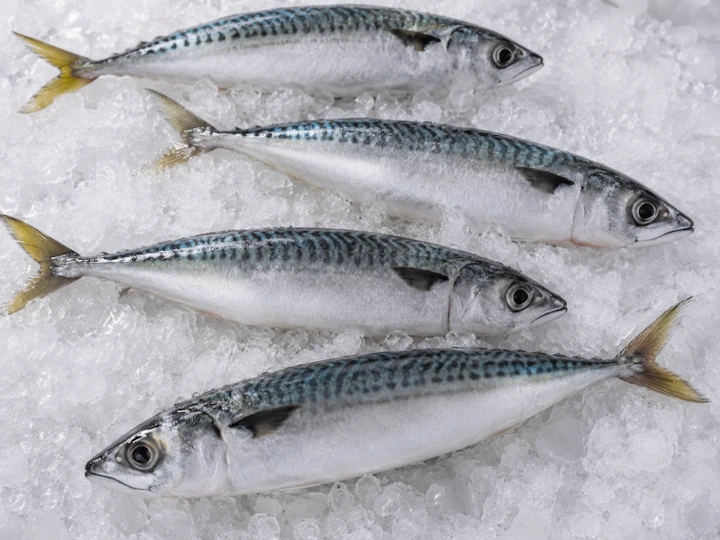
Frozen Blue Mackerel — Scomber australasicus
Frozen blue mackerel (Scomber australasicus) is the most commercially underestimated species in the genus Scomber. It is the only Scomber mackerel that peaks in March–June — precisely when Norwegian Atlantic mackerel and Japanese Pacific mackerel are in off-season or post-spawning lean phase. This counter-seasonal availability is its defining commercial value: frozen blue mackerel from Australia and New Zealand gives buyers who supply Scomber mackerel year-round the one sourcing tool that Northern Hemisphere origins cannot provide — a high-fat-content Scomber in Q2. Global Mackerel supplies frozen blue mackerel whole round IQF from Australia and New Zealand, the two primary commercial origins, to buyers in Japan, South Korea and the Pacific who understand the strategic value of Southern Hemisphere Scomber supply.
Southern Hemisphere
Exclusive production zone
March–June
Peak fat content season
14–20%
Peak fat content (austral autumn)
How to Identify Scomber australasicus — The Three-Species Belly Test
Blue mackerel (Scomber australasicus) is routinely confused with Pacific mackerel (Scomber japonicus) in trade, and less often with Atlantic mackerel (Scomber scombrus). The confusion is commercially consequential: Japanese and South Korean customs inspectors and quality control teams at receiving facilities identify species by visual inspection of the ventral surface — the belly of the fish — and misidentified product can be rejected, reclassified or subject to price renegotiation at destination. The single most reliable identification feature for all three Scomber species is the pattern of markings on the belly, and it can be checked in seconds on any frozen whole round fish after partial thawing.
The identification rule is absolute and has no exceptions across the three commercial Scomber species. Atlantic mackerel (Scomber scombrus) has a completely clean, unmarked belly — pure silvery-white from throat to tail, with no spots, blotches or markings of any kind on the ventral surface. Pacific mackerel (Scomber japonicus) has pale, diffuse spotting on the lower flanks that becomes indistinct toward the midline — present, but not dense. Blue mackerel (Scomber australasicus) has the most heavily spotted belly of the three: large, clearly defined dark spots extending well below the lateral line onto the ventral midline surface, creating a distinctive mottled appearance that is unmistakable once you know what to look for. In a mixed carton where Scomber japonicus and Scomber australasicus have been accidentally combined — an error that occasionally occurs in Taiwanese and southern Japanese processing plants where the two species' ranges overlap — the two can be separated by belly inspection in under a minute per fish.
A second identification feature specific to Scomber australasicus is its swim bladder, which is present and well-developed — a feature shared with Scomber japonicus but absent in Scomber scombrus. This anatomical detail has a direct commercial consequence that buyers should understand: the swim bladder increases buoyancy and reduces tissue density, which affects the rate of ice melt in whole round bulk cartons during long-haul transit to tropical markets. Frozen blue mackerel in 20kg bulk cartons shows faster ice melt rates in the upper layers of the carton during transit through equatorial shipping lanes compared to Scomber scombrus — a practical consideration for buyers shipping to West African or Pacific Island destinations with slow port clearance. Specifying adequate glazing (minimum 12% for tropical market shipments) and confirming cold storage conditions at destination port before shipment are the standard mitigation measures.
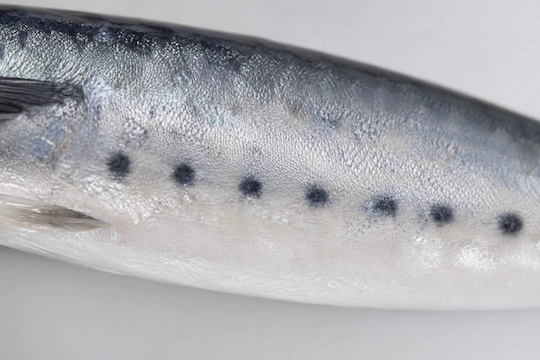
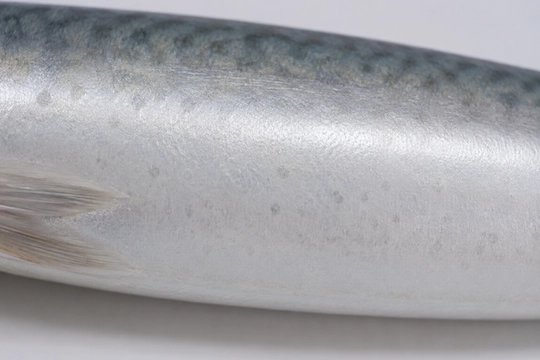
Scomber scombrus
Atlantic mackerel
Clean white bellyNo spots. No markings. Pure silvery-white ventral surface from throat to tail.
Scomber japonicus
Pacific mackerel
Faint spots — flanks onlyPale, diffuse spots on lower flanks. Indistinct toward midline. Partially visible.
Scomber australasicus
Blue mackerel
Dense spots — full bellyLarge, clearly defined dark spots extending well below lateral line onto ventral midline. Unmistakable mottled appearance.
The Slimy Mackerel Paradox — Why Australian Blue Mackerel Is Priced Below Its Quality
In Australian domestic trade, Scomber australasicus is sold under the name slimy mackerel. The name refers to the exceptionally abundant mucus coating that covers the fish when alive and freshly caught — biologically normal for the species, and irrelevant to the quality of properly processed and frozen product. But the name has caused lasting commercial damage to the species' domestic market positioning. Australian seafood retailers and foodservice operators consistently price slimy mackerel at the bottom of the fresh fish category, below both Atlantic salmon and even other mackerel species, because the name communicates unattractiveness to consumers who have no knowledge of the biology.
The consequence of this domestic undervaluation is commercially significant for export buyers: Australian frozen blue mackerel is priced against a domestic reference price set by a market that does not fully recognise the species' nutritional and culinary credentials. The omega-3 fatty acid content of Australian frozen blue mackerel (March–June, 14–20% fat) is directly comparable to Norwegian Atlantic mackerel at mid-season. The protein content — approximately 19–21g per 100g of edible flesh — is equivalent to Scomber scombrus. The flavour profile and texture when grilled or simmered are, according to Japanese chefs who work with the product, indistinguishable from Pacific mackerel at equivalent fat content. Yet the price at which Australian processors sell frozen blue mackerel for export reflects the suppressed domestic valuation, not the product's actual quality credentials. This creates a genuine price-quality gap that sophisticated buyers in Japan, South Korea and the Pacific Islands exploit systematically.
Global Mackerel presents Australian frozen blue mackerel to buyers not as a budget alternative to Scomber scombrus or Scomber japonicus but as a specifically timed procurement opportunity — peak fat content, Southern Hemisphere origin, AFMA-managed sustainable fishery, at a price that reflects a domestic market misnomer rather than the product's true quality. The name on the carton for export is frozen blue mackerel (Scomber australasicus). No buyer in Japan, South Korea or the Pacific Islands has ever encountered the name slimy mackerel on a commercial invoice, and none ever will on a Global Mackerel shipment.
The Counter-Seasonal Supply Window — Filling the Q2 Scomber Gap
The most powerful commercial argument for frozen blue mackerel is visible in a single calendar. The three main commercial Scomber species peak in fishing season at different times of year. Aligning these seasons side by side reveals a structural gap in Northern Hemisphere Scomber supply that Australian frozen blue mackerel was, as if by design, built to fill.
| Species / Origin | Jan | Feb | Mar | Apr | May | Jun | Jul | Aug | Sep | Oct | Nov | Dec |
|---|---|---|---|---|---|---|---|---|---|---|---|---|
| Norwegian Atlantic Mackerel | — | — | — | — | — | — | — | Peak | Peak | Peak | Peak | — |
| Japanese Pacific Mackerel | Peak | — | — | — | — | — | — | — | Peak | Peak | Peak | Peak |
| Australian Blue Mackerel | — | — | Peak ↑ | Peak ↑ | Peak ↑ | Peak ↑ | — | — | — | — | — | — |
The calendar makes the strategic argument without commentary: February, March, April and May are the four months in which neither Norwegian Atlantic mackerel nor Japanese Pacific mackerel is in peak production. Norwegian mackerel season closes in November-December. Japanese mackerel season runs September–January and is functionally complete by February. Australian frozen blue mackerel peaks in March–June. The overlap between Australian peak season and Northern Hemisphere off-season is not coincidental — it is a consequence of the hemisphere inversion of seasons, and it creates a recurring annual procurement window that buyers who supply Scomber mackerel year-round should be scheduling into their sourcing calendar twelve months in advance.
The procurement strategy that experienced Scomber buyers use is straightforward: contract Norwegian Atlantic mackerel for Q3–Q4 at competitive pre-season prices, contract Japanese or Korean Pacific mackerel for Q4–Q1, and contract Australian frozen blue mackerel for Q2. This three-origin rotation maintains year-round Scomber supply without gaps, reduces exposure to any single origin's seasonal price spike, and — critically — provides supply chain resilience against the recurring disruptions caused by the Northeast Atlantic mackerel quota dispute, which periodically creates supply shortfalls from Norwegian and Icelandic origins. For the background on that quota dispute and its supply implications, see our analysis of the Atlantic mackerel quota crisis.
The Austral Autumn Premium — 14–20% Fat in March–June
In the Northern Hemisphere, peak fat content in Scomber mackerel follows the boreal autumn feeding period — Norwegian mackerel reaches peak fat in September–November after a summer of feeding in the nutrient-rich Norwegian Sea. In the Southern Hemisphere, the same biological mechanism operates on an inverted calendar: Australian frozen blue mackerel (Scomber australasicus) reaches peak fat content in March–June — the austral autumn — after feeding intensively through the Australian summer (December–March) in the productive coastal upwelling zones off New South Wales, Victoria and South Australia. The result is that frozen blue mackerel caught in March–June from Australian waters consistently carries 14–20% fat by Soxhlet method — a range directly comparable to mid-season Norwegian Atlantic mackerel (typically 16–22% in September–October) and superior to year-round Peruvian Pacific mackerel (10–15%).
The practical significance of this fat content range for buyers is specific. Japanese and South Korean buyers who specify minimum fat content of 14% or 16% on Scomber mackerel purchase orders — a standard requirement for premium foodservice and retail applications — can meet their specification from Australian frozen blue mackerel during Q2 (March–June) when equivalent-fat Norwegian or Japanese product is either unavailable or priced at off-season premium. This is not a compromise specification: peak-season Australian frozen blue mackerel at 16–18% fat is indistinguishable from Norwegian Atlantic mackerel at 16–18% fat in application — the same texture, the same cooking behaviour, the same omega-3 yield per portion. The difference is the price, the origin name on the label, and the shipping lead time from southern Australia versus the North Atlantic.
Fat content outside the March–June peak drops to 8–13% as fish enter spawning (July–August) and the post-spawning recovery phase (September–February). Off-peak Australian frozen blue mackerel is suitable for markets that do not specify minimum fat content — bulk export to Pacific Island markets, for example — but should not be offered to Japanese or Korean buyers with fat content specifications. Global Mackerel provides pre-shipment fat content test reports (Soxhlet method, accredited laboratory) for all frozen blue mackerel shipments as standard. For a full comparative fat content dataset across all Scomber species and origins by month, see our frozen mackerel fat content specification guide.
The 300–400g Substitution Case — When Japanese Season Closes
Every year, in January and February, the same procurement problem repeats across Japanese mackerel importers and the MENA buyers who specify Japanese-origin Scomber: the Japanese Pacific mackerel season has closed, cold storage stocks from the September–January season are depleting, and the next Northern Hemisphere production window does not open until August in Norway. The 300–400g Scomber specification — the most demanded size grade in Japanese retail and premium MENA foodservice — becomes scarce and expensive for six months.
Australian frozen blue mackerel in the 300–400g grade, available from March, solves this problem with specific precision. Australian waters produce a favourable proportion of 300–400g fish during the austral autumn, from the Great Australian Bight and the waters off New South Wales where Scomber australasicus feeds to maximum body weight before the spawning migration. The size overlap with Japanese 300–400g Pacific mackerel is complete: the fish are the same genus, the same approximate size, processed by IQF to the same format, and at peak season (March–May) carry comparable fat content. The difference is the ventral spotting pattern — visible on inspection, documented on the shipping certificate, and irrelevant to the end consumer who is eating a grilled Scomber mackerel fillet.
Buyers who serve Japanese foodservice clients or premium MENA operators who specify Scomber — not specifically Scomber japonicus — can negotiate supply continuity agreements using Australian frozen blue mackerel for Q2 at contracted prices agreed before the Japanese season closes. Global Mackerel structures these three-origin annual procurement contracts — Japan for Q4–Q1, Australia for Q2–Q3, Norway for Q3–Q4 — for buyers who want year-round Scomber supply continuity without the price volatility that comes from relying on a single origin. Contact us to discuss a multi-origin Scomber procurement programme.
Year-round Scomber calendar
- Q4-Q1 (Sep–Jan) Japanese Pacific mackerel — peak fat content, premium specification
- Q1 (Jan–Feb) Norwegian cold storage — premium but depleting stock
- Q2 (Mar–Jun) Australian Blue Mackerel — counter-seasonal peak, 14–20% fat
- Q3-Q4 (Aug–Nov) Norwegian Atlantic mackerel — new season peak
Contact Global Mackerel to structure a three-origin Scomber annual contract.
Sustainability — AFMA Management vs the Atlantic Quota Dispute
The sustainability credentials of frozen blue mackerel from Australia and New Zealand represent the sharpest contrast in the entire commercial Scomber category — and the contrast is with the species that commands the highest prices. Norwegian Atlantic mackerel (Scomber scombrus) has been the subject of a protracted international quota dispute since 2009, when Iceland and the Faroe Islands unilaterally increased their catch allocations for the Northeast Atlantic mackerel stock beyond the limits agreed under the coastal states agreement with Norway and the EU. The dispute has never been fully resolved. Total catches from the Northeast Atlantic mackerel stock have exceeded scientifically recommended levels in most years since 2010, and the stock's MSC certification was suspended in 2019 precisely because agreed management measures were not being applied across all coastal states. The dispute — its current status, its supply implications and its price effects — is covered in full on our page on the Atlantic mackerel quota crisis.
Australian frozen blue mackerel operates under a completely different management framework. The South East Scalefish and Shark Fishery (SESSF), administered by the Australian Fisheries Management Authority (AFMA), applies science-based total allowable catches determined annually by independent stock assessments conducted by the Australian Bureau of Agricultural and Resource Economics and Sciences (ABARES). The 2023 ABARES assessment classified Scomber australasicus as not overfished and not subject to overfishing — the most favourable sustainability classification available under Australian Commonwealth fisheries law. This classification is publicly available, verifiable on the AFMA website, and can be cited without qualification in sustainability reports and retailer questionnaires. No equivalent assurance is currently available for the Northeast Atlantic mackerel stock.
New Zealand frozen blue mackerel is managed under the Quota Management System (QMS), which allocates individual transferable quota (ITQ) to licence holders for each managed species. The QMS is recognised internationally as one of the most effective rights-based fisheries management systems in existence and forms the basis of New Zealand's extensive MSC certification track record across multiple species. Several major European and North American supermarket chains accept New Zealand QMS-managed seafood as satisfying their internal sustainable sourcing policies without requiring additional MSC certification. Buyers who face sustainability audit requirements from retail customers or institutional buyers should specifically request New Zealand-origin frozen blue mackerel and request AFMA or QMS management documentation as part of the standard document package. For the full landscape of frozen mackerel sustainability certifications by species and origin, see our frozen mackerel sustainability guide.
The Pacific Island Proximity Advantage — Lowest Transit Cost for a Critical Market
Pacific Island nations — Fiji, Papua New Guinea, Solomon Islands, Vanuatu, Tonga, Samoa — depend on imported frozen fish as a primary protein source for populations that cannot afford locally caught deepwater species. These markets are price-sensitive, volume-consistent and critically underserved by Northern Hemisphere frozen fish exporters due to the high cost of transoceanic shipping from Norway, Iceland or Peru compared to the landed cost achievable from Australia.
The transit distance from Australian ports to Pacific Island destinations ranges from 2,000km (Brisbane to Fiji) to 4,500km (Sydney to Papua New Guinea). The equivalent distance from Oslo to Fiji via the Suez Canal is approximately 25,000km — more than five times greater. For frozen fish shipped in reefer containers, transit distance directly affects landed cost through freight rates, insurance, and the time-value of capital tied up in transit inventory. Australian frozen blue mackerel can reach Fiji or Papua New Guinea at a landed cost that is structurally lower than any Northern Hemisphere origin, regardless of FOB price differences. This geographic advantage is permanent — it does not depend on freight market cycles or canal fee structures.
Several Pacific Island governments operate subsidised fish distribution programmes that create institutional demand for affordable frozen whole round fish at predictable volumes. Australian frozen blue mackerel in the 200–300g whole round IQF format is well-suited to these programmes — the size grade is appropriate for household-scale consumption, the IQF format allows easy portioning without full carton thawing, and the AFMA certification satisfies the import requirements of Pacific Island government procurement agencies. For buyers operating in Pacific Island distribution channels — whether commercially or under aid and development programme structures — Australian frozen blue mackerel is the specification that optimises landed cost, documentation compliance and supply consistency simultaneously.
Formats, HS Code & Certifications — Reference Data
Full format specifications are on our formats and specifications page. Full certification details are on our quality page. Full HS code guidance is in our trade guide. This section provides quick-reference data for buyers who are already familiar with the category.
Available Formats
- Whole Round IQF — 10kg carton — Australia & NZ
- Whole Round BQF — 10kg block — Australia
- H&G IQF — 10kg carton — Australia
- IQF Fillet — 10kg carton — Australia (limited)
HS Classification
0303.54
Same subheading as Scomber scombrus and Scomber japonicus. Species-specific identification on all documents.
Certifications
AFMA stock status: Not overfished (ABARES 2023). NZ QMS managed. Halal on request.
Blue Mackerel Size Grades — Australian Stock Profile
Australian frozen blue mackerel runs larger than Peruvian Pacific mackerel at commercial market weight, with a favourable proportion of 300–400g and 400–500g fish during peak season — the critical size grades for Japanese and Korean buyers. Size distribution is seasonal: March–June catch produces the best large-grade yield; off-season cold storage product tends toward smaller grades.
- 100–200g
Minimal commercial export volume. Primarily used for bait and aquaculture feed in domestic Australian market.
- 200–300g
Standard grade. Available year-round from cold storage. Pacific Island markets and price-sensitive buyers.
- 300–400g
Primary export grade. Peak season (March–June). Direct substitution candidate for Japanese Pacific mackerel 300–400g when Northern Hemisphere season is closed. High demand from Japan and South Korea.
- 400–500g
Large grade. Peak season only. Selected Australian regions (Great Australian Bight). Preferred for whole-fish presentation in Japanese foodservice. Premium over standard grade.
- 500g+
Rare. New Zealand deep-water operations, exceptional seasons only. Not a standard commercial specification.
AFMA Catch Documentation and Australian Export Certificates — What Buyers Receive with Every Scomber australasicus Shipment
Australian frozen blue mackerel is exported under a documentation regime that reflects the AFMA quota management system and produces one of the most traceable catch certificate chains of any commercially traded Scomber species. Every consignment of frozen Scomber australasicus exported from Australia carries a Fish Health Certificate issued by the Australian Department of Agriculture, Fisheries and Forestry (DAFF) — a competent authority document recognised by the European Union, Japan, the United States and all major destination markets. The DAFF Fish Health Certificate references the AFMA Commonwealth fishing licence number of the catching vessel, the fishing zone within the SESSF where the catch was taken, and the HACCP-certified processing establishment number. This three-level traceability chain — vessel, fishing zone, processing plant — is the document buyers should request as standard for any Australian frozen blue mackerel shipment and is what distinguishes AFMA-managed product from origins where catch-to-freezer traceability is less systematically documented.
The seasonal production pattern of Australian frozen blue mackerel creates a specific forward contracting dynamic that buyers who source the product year-round must plan around. Peak production runs March–June (austral autumn), during which Australian processing plants in Port Lincoln, Mooloolaba and Eden are actively freezing fresh-caught Scomber australasicus and cold stores fill with peak-fat-content IQF product. From July onwards, production slows as the fish enter spawning migration and processors shift to cold store drawdown rather than fresh production. By October–November, the high-quality March–June peak product in Australian cold stores is 4–7 months old — still well within the 18–24 month shelf life at constant −18°C, but approaching the point where fat oxidation becomes a quality management consideration for buyers with demanding end-market specifications. Buyers who require maximum freshness should contract Australian frozen blue mackerel for March–May production and specify air or sea freight within 60 days of production date. Buyers who are less specification-sensitive can source from cold storage drawdown through the Australian winter and spring at potentially more competitive prices.
New Zealand frozen blue mackerel carries MPI (Ministry for Primary Industries) export certification — a different competent authority from DAFF, producing different certificate formats with different registration numbers. Buyers who source from both Australian and New Zealand origins in the same year should maintain separate customs templates for each, as the two certificate formats are not interchangeable in EU import procedures or Japanese customs pre-notification systems. The MPI certificate references the New Zealand QMS quota share number of the fishing operation, which is the documentary evidence that the catch was made within the lawful ITQ allocation — a specific traceability feature that buyers facing sustainability audits from retail customers should highlight in their supply chain documentation.
Frequently Asked Questions — Frozen Blue Mackerel
- How do I identify Scomber australasicus versus Scomber japonicus at delivery?
- Check the belly. Scomber australasicus has large, clearly defined dark spots extending well below the lateral line onto the ventral midline surface — a dense mottled pattern. Scomber japonicus has faint, diffuse spotting on the lower flanks that becomes indistinct toward the midline. Scomber scombrus (Atlantic mackerel) has a completely clean white belly with no markings. This visual test can be performed in seconds on any partially thawed whole round fish and is the standard identification method used by Japanese customs inspectors and quality control teams at receiving facilities.
- What is the peak season for Australian frozen blue mackerel and what fat content can I expect?
- Australian frozen blue mackerel peaks in production March–June (austral autumn) when fish reach their highest annual fat content of 14–20% by Soxhlet method. This is counter-seasonal to Norwegian Atlantic mackerel (August–November) and Japanese Pacific mackerel (September–January), making Australian frozen blue mackerel the only high-fat-content Scomber available in Q2. Outside peak season (July–February) fat content drops to 8–13%. Global Mackerel provides pre-shipment fat content test reports for all shipments.
- Can Australian frozen blue mackerel substitute for Japanese frozen Pacific mackerel in foodservice applications?
- Yes, for buyers who specify Scomber mackerel rather than a specific species. At equivalent fat content and size grade, Scomber australasicus and Scomber japonicus are functionally interchangeable in Japanese and Korean cooking applications including saba shioyaki (salt-grilled), saba no misoni (miso-simmered) and saba-zushi (pressed sushi). The distinction is the ventral spotting pattern — visible on inspection and documented on the shipping certificate — and the Australian origin on the carton label. For foodservice applications where end-consumers do not see the label, the substitution is commercially straightforward. For retail applications with species-specific labelling requirements, confirm with your regulatory advisor before substituting.
- Why are the sustainability credentials of Australian frozen blue mackerel stronger than Atlantic mackerel from Norway?
- Australian frozen blue mackerel is managed by AFMA under the SESSF. The 2023 ABARES stock assessment classified it as not overfished and not subject to overfishing — the most favourable classification under Australian fisheries law, publicly verifiable on the AFMA website. Norwegian Atlantic mackerel (Scomber scombrus) has been subject to an unresolved international quota dispute since 2009 in which total catches have exceeded scientifically recommended levels in most years, leading to suspension of MSC certification in 2019. New Zealand frozen blue mackerel is managed under the QMS, internationally recognised as one of the most rigorous rights-based fishery management systems in existence. See our analysis of the Atlantic mackerel quota crisis for full details.
Ready to source frozen mackerel?
Send your specs and get a competitive quote within 24h.