
Poland · Ukraine · Baltic States · Romania · Balkans · Gdańsk · Klaipėda · Constanța
Frozen Mackerel for Eastern Europe — Smoking Industry Spec, Poland, Ukraine and Balkan Bulk Suppliers
Frozen mackerel Eastern Europe is defined by one industrial reality that separates it from every other region in this catalogue: the frozen mackerel smoking industry specification. Polish factories producing makrela wędzona (smoked mackerel) for German supermarkets, Ukrainian plants smoking скумбрія копчена (skumbriya kopchena) for domestic retail, and Bulgarian processors creating скумрия (skumrija) for the Black Sea coast market — all require frozen Scomber scombrus with a minimum fat content of 18%, measured by Soxhlet method, from Norwegian or Icelandic autumn catch (September–December). At less than 18% fat, the fish dries during hot smoking and the product fails quality inspection. Customs paperwork across the EU single market and neighbouring states still lists the species as Scomber — the Latin label buyers see on health certificates. No other sourcing arc in this catalogue reliably fills that smoked-grade arc for premium lines — only Norway and Iceland, in the autumn window, in the scomber scombrus 400-600g bulk suppliers band that processors actually quote. Global Mackerel supplies CIF Gdańsk, CIF Klaipėda and CIF Constanța with full Soxhlet certificates on every smoked-grade shipment. If your RFQ says makrela wedzona frozen mackerel supplier poland or skumbriya frozen mackerel ukraine bulk, anchor the incoterm to the smoking plant cluster first — then open species pages second.
Buyers who type high fat autumn catch frozen mackerel eastern europe without a contractual Soxhlet minimum still receive lean September lots that fail at the smoker. This page maps how frozen atlantic mackerel for smoking industry procurement differs from generic frozen pelagic RFQs — including why fat content 20%+ frozen atlantic mackerel wholesale contracts need explicit lab method clauses, not slogans.
Grade
400–600g · 500–700g
Season
Hub ports
Gdańsk · Klaipėda · Constanța
Frozen Atlantic Mackerel for the Smoking Industry — Fat 18%+ Specification for Makrela Wędzona and Скумбрія Skumbriya
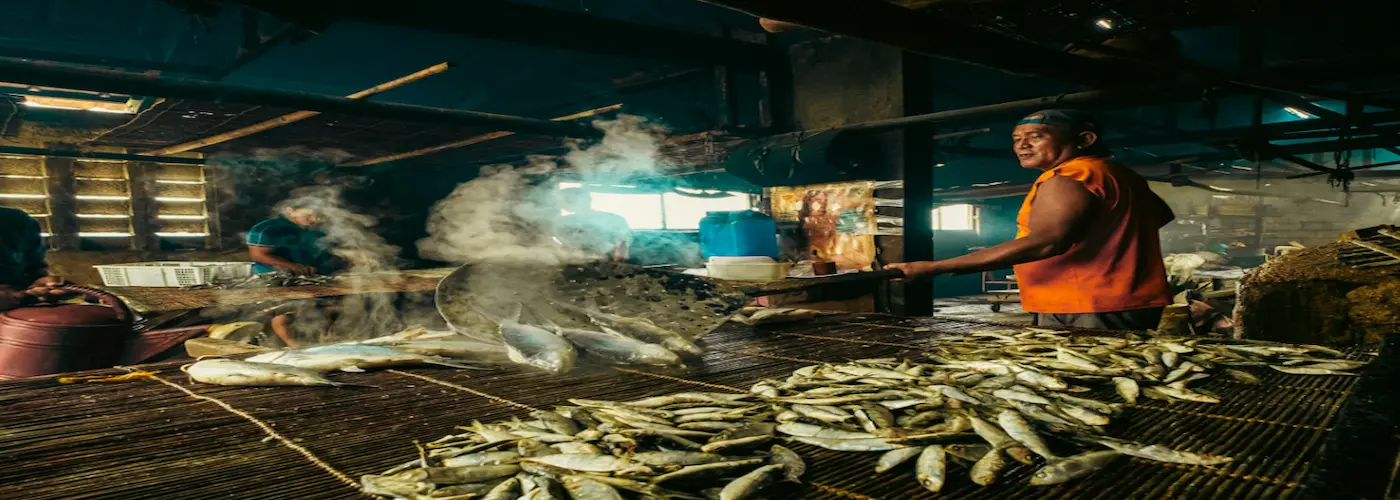
Hot smoking of whole Atlantic mackerel — the process that produces makrela wędzona (Poland), скумбрія копчена (Ukraine), скумрия (Bulgaria) and Räuchermakrèle (Germany, re-exported from Polish plants) — requires a minimum fat content of 18% by Soxhlet method in the raw material. At 160–180°C over 2–3 hours in a continuous-flow hot smoker, the fish loses 20–30% of its weight as water vapour. At fat content below 18%, this moisture loss results in dry, fibrous flesh that fails sensory evaluation — the smoked fillet separates from the skin, the colour is uneven, and the yield (post-smoke weight / pre-smoke weight) falls below the 60% minimum threshold required for commercial profitability. At 20–28% fat (Norwegian peak autumn catch, October–November), yield is 65–72%, texture is moist and firm, colour is uniformly golden, and the product holds shelf life under vacuum packaging for 21–28 days at 4°C. That engineering floor is why wholesale frozen mackerel for processing plants eastern europe RFQs for smokehouses are written differently from canned-fish or poke-grade RFQs: the line stops if the raw fish cannot carry heat.
The finished smoked mackerel products from Eastern European factories move through specific distribution channels: Polish makrela wędzona — vacuum-packed 200–400g portions — is exported to German, Dutch ( makreel gerookt) and Scandinavian retail under private label. Ukrainian скумбрія копчена supplies the domestic Ukrainian retail market and CIS country distribution. Bulgarian скумрия (skumrija) and Serbian скуша (skuša) are consumed domestically as a protein-accessible alternative to fresh sea fish in inland regions far from the coast. Every tonne of smoked mackerel sold in these markets began as frozen whole-round or HGT Scomber scombrus arriving at Gdańsk, Gdynia or Klaipėda. Premium hot-smoke lines cannot substitute lean whole rounds or BQF blocks meant for other processes — the smoker simply rejects the texture outcome.
| Application | Local name | Required fat % | Grade / size | Format input | Origin |
|---|---|---|---|---|---|
| Hot-smoked whole export | Makrela wędzona (PL) · Räuchermakrèle (DE) | Min 20%+ | 400–600g · 500–700g | IQF WR or HGT | Norway Oct–Nov only |
| Hot-smoked domestic Ukraine | Скумбрія копчена | Min 18% | 300–500g · 400–600g | IQF WR or HGT | Norway Sep–Dec · Iceland Aug–Nov |
| Hot-smoked Balkans | Скумрия (BG) · Скуша (SR) | Min 16–18% | 300–500g | IQF WR | Norway Sep–Nov · Iceland |
| Cold-smoked fillet export | Makreel gerookt (NL) · Geräucherte Makrele | Min 18–20% | 400–600g (fillet 180–250g) | IQF WR (filleted at plant) | Norway Oct–Nov peak |
| Marinated / pickle bulk | Makrela marynowana (PL) | Min 14% | 200–400g | WR · HGT · H&G | Morocco · Iceland · Norway off-peak |
| Fat content values are for the raw frozen input. Post-smoking fat concentration is approximately 25–35% higher due to water loss. All fat content specifications should be confirmed by pre-shipment Soxhlet test certificate from an accredited laboratory (EUROFINS, SGS, Bureau Veritas). Do not accept NMR fat content readings as the sole specification confirmation — NMR variance can be ±2%. | |||||
frozen Atlantic mackerel — Scomber scombrus Norway premium · frozen mackerel fat content specification guide
CIF Gdańsk and Gdynia — Poland as the Hub for Eastern European Smoked Mackerel Processing
Gdańsk and its twin port Gdynia form the largest container and bulk cargo port complex on the Baltic Sea — and the primary entry point for frozen Scomber scombrus destined for Poland's smoked mackerel industry. The Short Sea Shipping route from Ålesund (Norway) to Gdańsk takes 3–5 days aboard reefer vessels or in reefer containers on regular Roll-on/Roll-off services — making Gdańsk the fastest-connected Eastern European port to Norwegian mackerel fishing grounds. The Pomeranian hinterland — Gdańsk, Gdynia, Koszalin and Słupsk within a 200km radius — concentrates approximately 60–70% of Poland's smoked seafood processing capacity. For buyers benchmarking cif gdansk port frozen mackerel price per ton, that liquidity is structural: most frozen mackerel hgt suppliers for poland and ukraine offers are discussed as Gdańsk-plus-truck, not as isolated port silos.
Major smoked mackerel processors operating in the Gdańsk region: Koszałek Food (Koszalin) — one of the largest continuous-flow hot-smoking operations in Eastern Europe, supplying private-label smoked mackerel to German and Dutch retail chains. Graal SA (Wejherowo) — combined smoking and canning, export to Scandinavia and Eastern European retail. Morpol-related plants in the Gdańsk metropolitan area — large-scale IQF fillet and smoked mackerel production. All operate on Norwegian autumn-catch input with fat content specification minimum 18% confirmed by Soxhlet certificate. That cluster is the backbone of norwegian frozen mackerel export to eastern europe in smokehouse-grade packs — not the same flow as commodity canned-fish lines.
Wholesale buyers and document bundles
Plants that only mention FOB Norway still land cost discussions at CIF Gdańsk because insurance, ocean freight and discharge terms are where Polish and Ukrainian buyers lock the spreadsheet. If your tender is for wholesale frozen mackerel for processing plants eastern europe, ask for a Gdańsk CIF column even when the exporter quotes FOB Ålesund first.
| Destination port | From Ålesund (Norway) | From Reykjavik (Iceland) | From Morocco (Agadir) | Overland from Gdańsk |
|---|---|---|---|---|
| Gdańsk / Gdynia (Poland) | 3–5 days (Short Sea Ship.) | 5–7 days | 10–14 days (Atlantic) | — (origin hub) |
| Klaipėda (Lithuania) | 4–6 days | 6–8 days | 11–15 days | 6–8h road (500km) |
| Riga (Latvia) | 5–7 days (via Klaipėda feeder) | 7–9 days | 12–16 days | 8–10h road (700km) |
| Tallinn (Estonia) | 5–7 days (direct reefer) | 6–8 days | 12–16 days | 10–12h road (1,000km) |
| Constanța (Romania) | 18–22 days (via Atlantic + Bosphorus) | 18–22 days | 14–18 days | 20–24h road (1,600km) |
| Varna (Bulgaria) | 18–22 days (via Black Sea) | 18–22 days | 14–18 days | 22–26h road (1,800km) |
| Rijeka (Croatia, Adriatic) | 8–12 days (via Gibraltar) | 8–12 days | 8–12 days | 14–16h road (1,100km) |
| SSS services Ålesund–Gdańsk/Klaipėda/Tallinn run weekly on Ro-Ro reefer vessels. Overland refrigerated truck from Gdańsk is often faster and more flexible than maritime routing for Romania, Bulgaria and Balkans. CIF Gdańsk is the primary benchmark price for frozen mackerel in Eastern Europe — all other Eastern European CIF prices are derived from CIF Gdańsk plus overland freight. | ||||
frozen mackerel from Norway — autumn catch season guide · frozen mackerel from Iceland — premium fat content
CIF Klaipėda — Baltic Cold Storage Consolidation for Lithuania, Latvia, Estonia and Ukraine
Klaipėda — Lithuania's only seaport — plays three distinct roles in the Eastern European frozen mackerel supply chain, all of which are commercially relevant to B2B buyers in the region. First, it is a direct import port for Norwegian and Icelandic mackerel (Short Sea Shipping, 4–6 days from Ålesund), receiving reefer containers and refrigerated bulk carriers year-round. Second, it is the largest cold storage hub in the Baltic states — with multiple bonded cold stores holding 10,000–50,000 m³ each — allowing importers to buy full Norwegian season production (September–December) and drawdown into local markets across 12 months without seasonal price spikes. Third, it is the primary re-export gateway toward Ukraine and, before 2022, toward Russia and Belarus. Where MSC chain-of-custody applies to the raw lot, carry the same lot IDs into bonded drawdown so the cold-store release paperwork still matches the certificate stack. The search pattern cif klaipeda frozen seafood cold storage consolidation maps directly onto that second role: bonded space plus drawdown economics, not a single-spot discharge.
The cold storage consolidation model at Klaipėda works as follows: an importer contracts Norwegian mackerel during the October–November peak, takes delivery of 500–1,000 tonnes into Klaipėda cold stores, and draws down into monthly deliveries to Lithuania, Latvia and Estonia (all within 2–8 hours driving distance from Klaipėda) throughout the year. The annual cost saving versus buying spot at each quarter is typically 8–15% on landed price — the discount at peak-season Norwegian FOB versus post-season premium-priced cold store lots. Where buyers require chain-of-custody marks on exit paperwork, align those clauses on the purchase order; third-party certifiers audit the plant stack separately from the logistics stack.
Klaipėda cold storage consolidation — how Baltic importers structure annual procurement
- → When to contract: September–October (Norwegian season opening) — pre-peak pricing before October demand surge
- → Volume to contract: Full annual requirement (12 months) — minimum 100 tonnes for dedicated cold store space
- → Cold store cost: Approximately €0.20–0.40/tonne/day in Klaipėda bonded cold stores (verify current rates)
- → Annual saving vs spot: Typically 8–15% on landed price versus buying quarterly spot in off-peak cold store drawdown periods
- → Drawdown: Weekly or bi-weekly reefer truck departures Klaipėda → Vilnius, Riga, Tallinn and Ukraine border
- → Documents: Norwegian health cert + EU catch certificate + EUR.1 (Norway–EU / EEA preference) — all valid at Klaipėda customs clearance
frozen mackerel season calendar — autumn buy window for Baltic importers
How to Specify Fat Content 20%+ for Frozen Atlantic Mackerel Wholesale — Soxhlet, Season and Size Grade
Eastern European processors who specify "high fat autumn mackerel" without a contractual fat content minimum and a Soxhlet test certificate requirement in their purchase order routinely receive product that fails their production specification. "Autumn catch" is not a fat content guarantee: mackerel caught in September in Norwegian waters may carry 12–16% fat (early season, fish still feeding but reserves not yet at peak) — technically "autumn catch" but below the 18–20% minimum required for premium smoked mackerel production. "October catch" from Ålesund is a much stronger indicator, but even this is not a contractual guarantee without a Soxhlet certificate. This section is the operational bridge between marketing language and enforceable fat content 20%+ frozen atlantic mackerel wholesale clauses.
| PO element | Wrong specification | Correct specification |
|---|---|---|
| Fat content minimum | "High fat" / "autumn catch" / "premium quality" | "Minimum 18% fat content by Soxhlet method, AOCS Ce 1-62 or ISO 1443" |
| Test certificate | "Fat content per exporter's QC report" | "Pre-shipment Soxhlet fat certificate from accredited lab (EUROFINS, SGS or BV) — LC not confirmed without certificate" |
| Catch date | "Autumn 2025" | "Catch date October 1 – November 30 2025, Norwegian origin" |
| Size grade | "Large mackerel" | "400–600g WR equivalent · 5–7 pcs/kg · size distribution report provided pre-shipment" |
| Rejection clause | (none) | "Buyer reserves right to reject lots where pre-shipment Soxhlet certificate shows less than 18% fat — seller bears cost of replacement or credit" |
Norwegian mackerel fat content by catch period — expected ranges
August
10–15% fat
Too lean for smoking
September
14–20% fat
Borderline — test each lot
October
20–26% fat
★ Best smoking grade
November
18–25% fat
Excellent · season closing
Icelandic mackerel: equivalent fat content, catch period July–November. Always confirm with pre-shipment Soxhlet certificate — these ranges are indicative.
frozen mackerel fat content specification guide — full Soxhlet methodology
Frozen Mackerel for the Balkan Region — Romania, Bulgaria and the Adriatic Coast
The Balkan region — Romania, Bulgaria, Serbia, Croatia, Bosnia and Herzegovina, North Macedonia — represents a heterogeneous frozen mackerel market united by one shared reality: geographic distance from the Atlantic fishing grounds means that frozen mackerel is almost always cheaper than fresh equivalents, and the smoked format produced from Polish imported raw material is often the primary form of mackerel consumed domestically. Local names reflect this consumption pattern: Скумрия (skumrija — Bulgaria and North Macedonia), Скуша (skuša — Serbia and Bosnia), Šnjur (šnjur — Croatia, for horse mackerel Trachurus trachurus) — all refer to distinct commercial realities that B2B suppliers must understand to match species to destination. Constanța remains the natural maritime pivot for bulk frozen pelagic fish import to romania and neighbouring landlocked processors; Varna mirrors that pattern on the Bulgarian coast. For frozen horse mackerel suppliers for balkan region programmes, the species switch at the border is not cosmetic — it changes customs species codes and plant intake specs.
Frozen mackerel constanta port romania tenders often pair Atlantic mackerel with horse mackerel in the same cold-store project finance model: two HS lines, two sensory targets, one port appointment window. Overland ex-Gdańsk competes with Black Sea routing on smaller lots because trucks can pivot faster than a liner schedule through the Turkish Straits — the economics are case-by-case, not ideological.
Slovak and Czech trade labels
Inland distributors sometimes file retail-facing names as makreľa / makrela on bilingual cartons while the customs line still reads Scomber scombrus. Keep Latin on the invoice, local language on the secondary label, and one English technical sheet for the cold chain manager.
| Country | Local name | Primary species | Import port | Primary route |
|---|---|---|---|---|
| Romania | Macrou (mackerel) · Stavrid (horse mackerel) | S. scombrus 300–500g · T. trachurus 200–300g | Constanța | Sea (via Bosphorus) or overland from Gdańsk (20–24h) |
| Bulgaria | Скумрия (skumrija) | S. scombrus smoked (import PL) · T. capensis | Varna · Burgas | Sea (Black Sea via Bosphorus) or overland from Constanța (3–4h) |
| Serbia | Скуша (skuša) · лоцань | S. scombrus smoked · T. trachurus fresh/frozen | Landlocked — truck from Constanța or Koper (SL) | Overland from Constanța (5–6h) or Gdańsk (16–18h) |
| Croatia | Šnjur (horse mackerel) · Skuša (Atlantic mackerel) | T. trachurus Mediterranean local · S. scombrus import | Rijeka · Split | Sea from Norway 8–12 days (via Gibraltar) · overland from Gdańsk 14h |
| North Macedonia | Скумрија (skumrija) | S. scombrus smoked (import) · T. trachurus | Landlocked — truck from Thessaloniki (GR) or Varna (BG) | Overland 3–4h from Thessaloniki |
| CIF Gdańsk is the price reference for all Eastern European markets. Other destinations are priced as CIF Gdańsk plus overland freight. For Balkans bulk orders under 20 tonnes, Gdańsk overland is typically more cost-effective than maritime routing. | ||||
frozen horse mackerel — T. trachurus bulk processing for Balkans
Frequently Asked Questions — Frozen Mackerel for Eastern Europe
- Why does the smoking industry require at least 18% fat content in frozen Atlantic mackerel?
- Hot smoking at 160–180°C for 2–3 hours drives off 20–30% of weight as vapour. Below 18% Soxhlet fat, flesh goes chalky, fillets detach from skin, colour bands, and smoked yield drops under the ~60% floor plants use for margin. At 20–28% fat on peak autumn Norwegian or Icelandic raw material, yields reach roughly 65–72%, texture stays moist, colour evens out, and vacuum retail codes at 4°C hold for roughly three to four weeks. That is why makrela wędzona and skumbriya kopchena lines insist on lab-backed minima — not marketing adjectives.
- How should I specify fat content on a purchase order for smoked mackerel raw material?
- Write five enforceable lines: Soxhlet minimum with AOCS Ce 1-62 or ISO 1443 reference; accredited pre-shipment lab (Eurofins, SGS, Bureau Veritas) with payment conditional on certificate; catch window tied to Norwegian or Icelandic origin instead of the word "autumn" alone; size band such as 400–600g WR equivalent with pcs/kg; and a rejection clause shifting replacement cost to the seller if the certificate prints under 18%. Anything less is a price discussion, not a smokehouse specification.
- Why is CIF Gdańsk the price benchmark for frozen mackerel in Eastern Europe?
- Gdańsk sits closest to Norwegian grounds for regular Baltic Ro-Ro reefer strings, so landed offers clear faster than at almost any other Eastern hub. Pomeranian smokehouse capacity consumes a dominant share of Polish imports, which concentrates bid-ask transparency. Other ports are routinely quoted as Gdańsk plus truck or feeder differential — importers mentally translate every sheet that way even when the bill of lading shows another discharge port.
- What are the local names for mackerel in Balkan and Eastern European markets and which species do they refer to?
- Makrela wędzona is smoked Atlantic mackerel in Polish trade speech. Skumbriya covers Ukrainian and Russian whole or smoked Atlantic mackerel. Skumrija in Bulgarian and Macedonian retail often implies Polish-processed smoked fillets as well as local intake. Skuša is Atlantic mackerel in Serbian and Bosnian contexts, whereas Croatian šnjur is horse mackerel — a different species, different HS line, different plant intake. Mislabel those on the PO and the truck gets rejected at the ramp even if the temperature logger is perfect.
Eastern Europe Frozen Mackerel — Related Pages
Ready to source frozen mackerel?
Send your specs and get a competitive quote within 24h.