
FOB price benchmarks — all species — 2025–2026
Price intelligence · All species · FOB & CIF · 2026
Frozen Mackerel Price per Ton —
How Prices Form and What Moves Them
Frozen mackerel prices are not a single number. They vary by species, size grade, fat content, fishing date, origin and destination port — by factors of three to four between the cheapest commodity grade and the most premium specification. This page explains the structure behind those variations: the six variables that drive price, how the Norwegian auction mechanism transmits to CIF offers, the annual buying calendar, how species compete on price, and where to find free public market data. For a current FOB or CIF indication on your specific grade and destination, request a quote below.
What drives your price — quick checklist
Species
Scomber vs Trachurus vs Scomberomorus — family determines the price tier
Origin
Norway · Iceland · Morocco · Peru · Namibia · Japan — each has a distinct position
Size grade
Larger = fatter = more expensive. 200g vs 600g from same origin: major spread
Fat content
Above 18% fat: non-linear premium. Below 10%: commodity floor regardless of origin
Processing
FAS vs land-processed: consistent premium for FAS from Norway and Mauritania
Season
Norwegian peak (Sep–Nov) = most competitive. Cold-store drawdown = premium
ICES advisory
Published June. A TAC cut spikes Norwegian forward prices immediately
Section 1
The Frozen Mackerel Price Hierarchy — Who Sits Where and Why
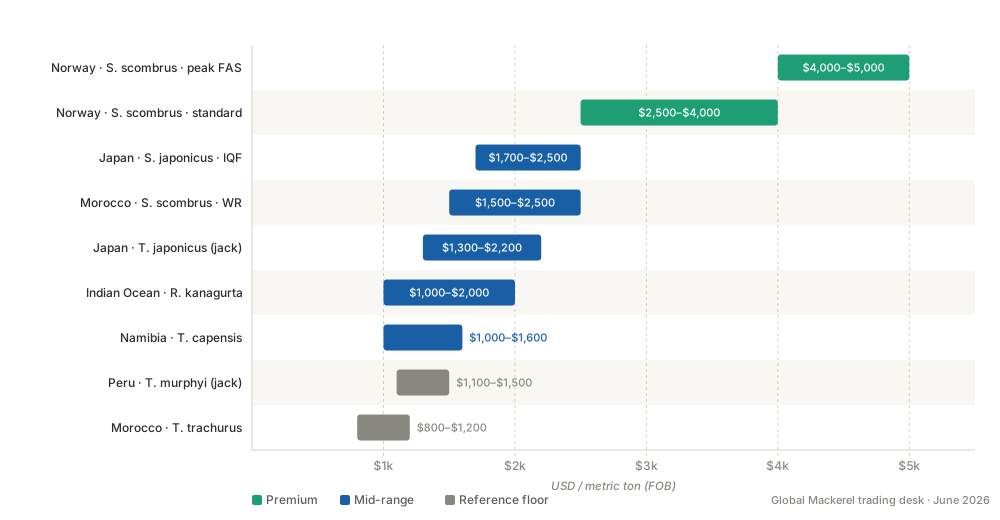
Before comparing offers, you need to know which species and grade belongs in which price tier. The table below positions each commercially traded mackerel specification relative to the others — without publishing live prices, which change weekly. These positional relationships are structural and stable over time, even as absolute price levels move with supply and demand.
| Specification | Position | Why it prices here | Primary market | FOB benchmark 2025–2026 |
|---|---|---|---|---|
| S. scombrus Norway FAS — 500–700g — 20%+ fat | Highest | Maximum fat content, largest grade, FAS cold-chain premium, limited October–November window only. Scarcest specification in global mackerel trade. | Japan premium, Korea top-grade, premium EU retail | $4,000–$5,000 /MT |
| S. scombrus Norway land-proc. — 400–600g — 18–22% fat | Premium | High fat, large grade, but land-processed — lower FAS premium. Still seasonal (Sep–Nov). | Eastern Europe smoking, Japan standard, Korea retail | $3,000–$4,500 /MT |
| S. scombrus Norway — 300–500g — 14–18% fat | Mid-premium | Good fat, standard traded grade. Competes with Iceland at equivalent spec. Most common Norwegian export grade. | Eastern Europe, MENA premium, East Asia standard | $2,500–$3,500 /MT |
| S. australasicus Australia — peak season | Mid-premium | Counter-seasonal premium — the only high-fat Scomber available Q2 (March–June). Scarcity premium vs Moroccan lean-season product. | Japan Q2, Korea Q2, premium retailers needing year-round high-fat Scomber | $1,800–$2,800 /MT |
| S. japonicus Japan — Kesennuma peak — 300–500g | Mid-premium | Premium Japanese saba, good fat (16–22% peak), MHLW documentation. Slightly below Norwegian equivalent due to species and origin positioning. | Japan domestic premium, Korea retail, MENA high-spec | $1,700–$2,500 /MT |
| T. capensis Namibia — 250–450g peak season | Mid-range | Larger grade than T. trachurus Morocco, higher fat (10–14%). Premium over Peruvian jack mackerel but below Scomber equivalents. | Eastern Europe (min fat spec Trachurus), premium East Africa | $1,000–$1,600 /MT |
| S. scombrus Morocco — Oct–Jan peak | Mid-range | Same species as Norwegian but smaller grade (200–400g), lower fat (8–16%). Year-round availability is the structural advantage — premium over lean season. | West Africa, MENA bulk, Egypt, year-round supply continuity | $1,500–$2,500 /MT |
| T. trachurus Mauritania FAS — 200–300g | Mid-range | FAS premium over Moroccan T. trachurus shore-processed. Short transit to West Africa and EU. Lower histamine risk = documentation premium for EU buyers. | West Africa, EU BIP-sensitive buyers, MENA | $900–$1,400 /MT |
| T. trachurus Morocco — 150–250g | Lower | Lean fish (3–8% fat), small grade. Competes closely with Peruvian jack mackerel on CIF West Africa basis — transit advantage offsets FOB parity or slight premium. | West Africa bulk, MENA budget, low-cost protein markets | $800–$1,200 /MT |
| S. japonicus / T. murphyi Peru BQF — 150–300g | Reference floor | Peruvian jack mackerel BQF is the global reference price floor for human-consumption-grade Trachurus. All other origins price in relation to Callao FOB. Highest volume in the category. | West Africa bulk, MENA budget, institutional, fishmeal adjacent | $1,100–$1,500 /MT |
FOB benchmarks based on public market data (Sildesalgslaget, Norwegian Seafood Council, Tridge). Ranges reflect variation by fat grade, size and season. Last updated June 2026. Request a live quote for your specific grade and destination.
Need a current FOB or CIF indication?
We provide current price indications on any specification — species, grade, origin, format and destination port. Response within 24 hours.
Section 2
The Six Variables That Move Frozen Mackerel Prices
These six factors are specific to mackerel — not generic commodity price drivers. Understanding each one tells you whether an offer is at the right level and whether the price is likely to move before your container ships.
Variable 01
ICES TAC advisory — June publication date
High · immediate price move
ICES publishes its annual Total Allowable Catch recommendation for Northeast Atlantic mackerel each June. A large recommended cut spikes Norwegian forward prices immediately — before a single fish is caught. A stable or rising TAC softens the forward market. Buyers who have not locked Norwegian autumn volume before the advisory publication face a price step-change that cannot be undone by waiting. Read the full ICES working group report, not just the headline TAC number. See the full analysis in our Atlantic mackerel quota crisis guide.
Variable 02
Fat content — the non-linear premium
High · built into every offer
Fat content is the single strongest predictor of price variation for Norwegian and Icelandic mackerel. The premium is non-linear: between 10% and 18% fat, price rises moderately with each percentage point. Above 18%, the premium accelerates. Below 10%, product trades at commodity price regardless of other specifications. An offer for "autumn Norwegian mackerel" without a fat content specification is not a fat specification — it is a guess. The fat content specification guide explains the Soxhlet method and why NMR is not contractually equivalent.
Variable 03
FAS vs land-processed — the cold-chain premium
Medium · consistent premium
Frozen At Sea (FAS) mackerel commands a consistent premium over equivalent land-processed product from the same Norwegian or Mauritanian origin. FAS reflects lower histamine risk, better belly condition, and a documentation chain that Japanese and Korean premium buyers require. For African and Eastern European bulk markets, land-processed product at the same fat content delivers equivalent value at lower cost. The FAS premium is structural — it does not compress in low-price markets because the documentation and cold-chain advantages are non-negotiable for the buyers who specify it.
Variable 04
Season phase — peak production vs cold-store drawdown
Medium · 8–15% swing
The Norwegian season runs three distinct price phases. Pre-season (May–July): forward prices are firmest when the market anticipates a tight TAC. Peak production (August–November): competition between Norwegian processing plants is highest and FOB prices are most negotiable. Cold-store drawdown (December–July): buyers who need Norwegian mackerel outside the season pay a drawdown premium versus peak-season contracted prices. The discipline of contracting at peak season and drawing down through the year consistently saves significant cost versus buying spot each quarter.
Variable 05
Size grade — the premium stack
Medium · major spread across grades
Within the same species, origin and fat specification, size grade creates a significant price ladder. Norwegian small grade (200–300g) and large grade (500–700g) can differ by 50–80% in FOB price. This is the biochemical consequence of larger fish carrying more fat and more muscle mass per unit, compounded by scarcity — fewer tonnes land in the large grades. Japanese and Korean buyers pay the full size premium. African and MENA bulk buyers rarely do. Size premiums compress when ICES issues a large TAC cut (scarcity at all grades) and widen when supply is abundant.
Variable 06
El Niño / La Niña — Peruvian supply shock
High for Trachurus · periodic
El Niño events warm Humboldt Current waters and reduce Chilean jack mackerel Trachurus murphyi biomass and catchability off Peru. SPRFMO responds by cutting TAC. CIF prices to West Africa spike. La Niña conditions support abundant catches and lower prices. NOAA and Peru's SENAMHI publish ENSO outlooks 6–12 months in advance. Buyers who forward-contract jack mackerel volumes during La Niña neutral conditions — before a forecast El Niño materialises — consistently achieve lower average CIF prices than spot buyers who react after the supply shock occurs.
Section 3
Annual Frozen Mackerel Buying Calendar — Month by Month
Every month has a different market condition and a different optimal procurement action. This calendar consolidates signals across all species. Use it alongside the mackerel fishing season calendar for the full production picture behind each entry.
January – February
Signal: Norwegian cold-store drawdown. Korean S. japonicus tail-season approaching Peruvian BQF parity.
Action: Last window for near-peak Norwegian lots before drawdown premium builds. Evaluate Korean BQF for African programmes needing MHLW documentation.
March – April
Signal: Australian S. australasicus season opens (austral autumn). Northern Hemisphere mackerel at lean-season low. Peruvian first season closing.
Action: Contract Australian blue mackerel for Q2 delivery — the only high-fat Scomber available in this window. Peruvian spot may soften as first season closes.
May – June
CriticalSignal: ICES advisory published (June). Norwegian forward market most reactive. Moroccan year-round supply stable.
Action: CRITICAL WINDOW for Norwegian. Read the ICES working group report before the headline TAC is widely reported. Lock Norwegian autumn volume before the advisory fully prices in. Do not wait until September.
July
Signal: Norwegian season opens in August. Pre-season offers appearing. Indian mackerel monsoon closure begins.
Action: First Norwegian offers land. Early-season fat typically 14–18% — not peak spec but available. Indian mackerel: source pre-closure stock for Q3 or plan for October new-season opening.
August
Signal: Norwegian and Icelandic seasons in full production. Sildesalgslaget weekly auction data published publicly.
Action: Monitor Sildesalgslaget weekly. Auction prices signal CIF direction 8–12 weeks out. Buy standard grades now at peak competition pricing from multiple Norwegian processors.
September
Signal: Fat content building toward October peak. Premium Norwegian lots not yet at maximum fat. Peruvian second season opening.
Action: For standard grades (14–18% fat): September remains competitive. For 20%+ fat premium: wait for October. Peruvian second season: contract for October–November delivery at season-open pricing.
October – November
PeakSignal: PEAK. Norwegian and Icelandic fat at annual maximum. FAS production at highest rate. Coastal-state quota announcements.
Action: Buyers who did not contract in May–July compete here at the highest prices of the year. Monitor coastal-state quota announcements — TAC confirmation shapes next-year price expectations.
December
Signal: Norwegian season closing. Fat content declining. Cold-store frameworks being written. Moroccan October–January autumn window still open.
Action: Last call for near-peak Norwegian at competitive pricing. Moroccan autumn window: good fat-for-price value versus Norwegian. Lock cold-store drawdown frameworks for Q1–Q2 delivery.
Section 4
The Sildesalgslaget Mechanism — How Norwegian Quay Prices Become Your CIF Offer
Norges Sildesalgslaget is the mandatory Norwegian pelagic fish sales organisation. Every tonne of mackerel caught by a Norwegian vessel must be auctioned through Sildesalgslaget before a processor or exporter can purchase it. No vessel can sell directly to an exporter — every lot passes through the auction. This creates the most transparent public upstream price reference in global frozen mackerel trade.
During the August–November season, Sildesalgslaget publishes weekly settlement price data by size grade and fishing area. This data is public and free at sildesalgslaget.no. The auction price is what Norwegian processors pay for raw material landed at Norwegian quays — it is not the FOB export price, but it is the upstream signal from which the FOB price is built.
From the Sildesalgslaget auction price, a Norwegian processor adds freezing cost, cold storage (for the hold period before export), packaging, labour, export documentation and handling, and the processor's margin. The resulting FOB offer is typically the auction price plus a processing and margin stack. The CIF price then adds freight and insurance on top of FOB.
The key implication: Sildesalgslaget auction prices move week to week during the season. When auction prices rise in September — due to scarcity of large-grade fish or strong buyer competition at the quay — CIF offers will follow upward 8–12 weeks later, once the processing pipeline clears. Buyers who check Sildesalgslaget weekly and track the grade-specific price trend can anticipate where Norwegian CIF offers are heading before their exporter publishes them.
From Sildesalgslaget auction to CIF — the cost stack
Sildesalgslaget auction price
Norwegian quay, raw landed mackerel
+ Freezing and processing
IQF costs more than H&G — belt freezer vs plate
+ Cold storage during hold
Typically 1–4 months before export
+ Packaging, glazing, cartons
IQF cartons, strapping, palletising
+ Export documentation
Health cert, catch cert, EUR.1, EUR pallet
+ Processor margin
Compresses during peak season competition
= FOB price (Ålesund / Tromsø)
What your exporter quotes you
+ Freight to destination
Depends on corridor — see Section 5
+ Marine insurance
Typically 0.1–0.2% of CIF value
= CIF destination port
What you actually pay to receive the goods
Lag time — auction to CIF offer in your inbox
Typically 8–12 weeks from Sildesalgslaget auction to a CIF offer. Fish is processed, frozen, held in cold store for quality check, then batched into an export container. A September auction price spike reaches your CIF offer in November or December. Reading Sildesalgslaget weekly in August gives you a 10–12 week forward view on Norwegian CIF direction.
Section 5
Freight Cost and CIF — Why Origin Distance Changes the Competitive Hierarchy
Freight cost from origin to destination port is not a rounding error — it often determines which origin is the most competitive on a landed-cost basis, regardless of the FOB headline. The comparison must always be made on CIF the destination port, not FOB the load port.
West Africa — where freight reverses the FOB hierarchy
Peruvian Chilean jack mackerel Trachurus murphyi typically prices at the lowest FOB level in the bulk Trachurus category — the global reference floor. But to West African ports (Lomé, Tema, Abidjan, Apapa), the transit time from Callao via the Panama Canal is 22–26 days. Moroccan Atlantic horse mackerel Trachurus trachurus arrives in 7–10 days.
The transit difference produces two cost effects: (1) higher freight rate per tonne for Peru versus Morocco on the same corridor, and (2) additional cold-storage cost at destination port during customs clearance — a real landed-cost item that buyers consistently underbudget. When you model both effects, the Moroccan CIF advantage over Peru on West African ports often exceeds the FOB premium Morocco carries. The buyer who only compares FOB numbers systematically overestimates the Peruvian cost advantage.
Eastern Europe — where Norway is freight-favoured over all other origins
For frozen mackerel in Eastern European markets, CIF Gdańsk is the benchmark price from which all other Eastern European CIF prices are derived — by adding overland truck freight from Gdańsk. Norwegian and Icelandic mackerel reach Gdańsk by Short Sea Shipping (SSS) Ro-Ro reefer in 4–6 days from Ålesund or Reykjavik. No other origin can compete on transit time to this corridor.
The freight advantage is structural — it reflects geography, not pricing negotiation. It is the reason Norwegian mackerel dominates Eastern European smoking plant raw material procurement even when Moroccan or Peruvian FOB prices are lower: the landed cost equation, which includes freight, cold-storage during clearance, and transit risk, consistently favours Norway for this corridor.
How to model a correct landed-cost comparison
Landed cost = CIF port + import duty + customs broker fee + port handling + cold-storage during clearance + inland transport to your cold store. Never compare a CIF offer from Origin A with a FOB offer from Origin B without adding your freight cost to the FOB. And never ignore port cold-storage — on slow-clearance corridors (Nigeria, India, China), this adds materially to landed cost per tonne and can erase a FOB advantage. See the frozen mackerel trade guide for destination-specific clearance times and cold-storage cost estimates.
Section 6
Inter-Species Price Relationships — When Species Compete and When They Don't
Some mackerel species are close substitutes at the buyer level — their CIF prices converge and buyers switch between them when the spread widens beyond a threshold. Others are in entirely separate price markets and do not compete regardless of price. Knowing which pairs compete determines when a species switch saves money and when it is simply a different product.
T. murphyi Peru BQF vs T. trachurus Morocco WR — CIF West Africa
Compete on priceClose substitutes in West African bulk markets. The two species are interchangeable in most West African purchase specifications (HS 0303.55, WR or BQF, 150–300g). Moroccan T. trachurus is almost always within a narrow CIF spread of Peruvian T. murphyi on West African ports. When Morocco rises significantly above Peru on CIF, buyers absorb the extra transit days from Callao for the lower cost. When Morocco is at or below Peru CIF — which happens more often than FOB comparison suggests due to freight — buyers prefer Morocco for transit speed and lower port-storage cost.
Switching?
Yes — both directions. Monitor CIF at destination port, not FOB.
S. japonicus Peru BQF vs S. scombrus Morocco WR — CIF West Africa and MENA
Compete on priceSame HS code (0303.54), broadly substitutable in price-sensitive markets. When Moroccan S. scombrus prices spike on a poor season or post-ICES advisory, buyers in West Africa and MENA accept Peruvian or Korean S. japonicus BQF as an alternative. The substitution is commercially accepted — the species difference is acknowledged but not a barrier in bulk markets where HS code compliance is the documentation standard.
Switching?
Yes — particularly when Moroccan S. scombrus rises materially above Peruvian S. japonicus CIF. Consumer markets with S. scombrus brand recognition (Egypt, Turkey, Eastern Europe) resist switching.
S. japonicus Japan IQF vs T. murphyi Peru BQF — CIF East Asia and MENA
Compete on priceClose in price at Japanese tail-season (January–March) when Choshi processors export S. japonicus BQF 200–300g at pricing that approaches Peruvian BQF parity. For buyers who need MHLW or MFDS documentation for EU-connected re-export, Japanese product is required regardless of price — the EPA trade preference makes the documentation non-substitutable. For pure CIF cost buyers with no EU re-export requirement, Peruvian product provides better year-round price stability.
Switching?
Partial — tail-season only for Japan. Documentation-sensitive buyers cannot substitute.
T. capensis Namibia vs T. trachurus Morocco — Eastern Europe and premium MENA
Separate marketsNot direct substitutes. <a href="/origins/namibia" class={linkBody}>T. capensis Namibia</a> at 250–450g and 10–14% fat occupies a different grade and fat tier than Moroccan T. trachurus at 150–250g and 3–8% fat. Eastern European buyers who specify minimum fat content on Trachurus — for smoked product or premium retail — cannot accept Moroccan T. trachurus as an alternative to Namibian T. capensis. The specification difference is structural, not price-driven.
Switching?
No — different grade, different fat profile, different end-use.
S. scombrus Norway vs S. scombrus Morocco — any destination
Separate marketsSame species, different markets. Norwegian mackerel targets fat content above 14% and size grade 300g+. Moroccan mackerel supplies the 200–400g, 8–16% fat segment. The two rarely compete for the same purchase order — a smoking plant requiring 18% fat minimum cannot use Moroccan product regardless of price. A West African bulk buyer who needs 200–300g at competitive CIF does not benefit from Norwegian product regardless of how competitive Norwegian FOB looks. The markets are adjacent but structurally separate.
Switching?
No — different specifications, different end-markets.
Section 7
Forward Contracts vs Spot Buying — When Each Strategy Wins
The right procurement instrument depends on species. Norwegian mackerel is one of the most price-volatile commodities in global frozen seafood — it rewards forward planning more than almost any species traded. Year-round origins are more forgiving but still have timing windows that improve outcomes materially.
Norwegian S. scombrus
Forward contract wins almost always
Norwegian mackerel has the widest price range of any commercially traded mackerel species. The price signal (ICES advisory) is public and published months before the production window. The best buy window (May–July) is 3–5 months before peak production. Buyers who forward-contract in this window consistently save materially versus buyers who start in September.
Framework contracts with price review clauses linked to ICES advisory changes — for example, a renegotiation trigger if ICES TAC recommendation changes more than ±20% versus the prior year — give volume security at committed pricing while managing the advice-shock risk that the quota crisis guide describes in detail.
The discipline of buying Norwegian at peak season and drawing down into delivery throughout the year consistently outperforms buying spot quarterly. The annual saving is material on any volume above 200 tonnes.
Moroccan, Peruvian and year-round species
Spot viable — but timing still matters
Moroccan mackerel: Year-round availability reduces urgency. But the October–January window produces the best fat content. Buyers who need 12%+ fat should contract in September for October–November production — not buy year-round spot and accept whatever fat arrives.
Peruvian jack mackerel: Two seasons annually (January–March and July–September). SPRFMO quota announcement in October–November is the signal. Contracting before announcement at pre-announcement pricing beats post-announcement spot in years where the TAC is cut. Monitor ENSO outlooks — La Niña years favour forward contracting.
Indian mackerel: Contract before the monsoon closure (June) to secure October–November new-season production at opening prices. MPEDA-certified plants fill forward order books quickly in September when the season re-opens.
Section 8
Free Public Price Data Sources — What They Cover and How to Use Them
No single free source covers all mackerel species and origins. The six below are the most commercially useful, with their coverage and limitations explained honestly.
Norges Sildesalgslaget
sildesalgslaget.noCovers
Norwegian mackerel weekly auction price by size grade and fishing area during the August–November season. The most transparent upstream price signal in global frozen mackerel trade. Free and public.
Limitation
Raw material quay price only — does not include freezing, cold storage, packaging or export margin. Season only (August–November). Norwegian vessels only.
How to use it
Track Norwegian FOB direction 8–12 weeks ahead during the season. Read the grade-specific data for the size you buy — the overall average masks significant grade variation. The first September data point after the ICES advisory is the most commercially useful reading of the year.
EUMOFA — European Market Observatory
eumofa.euCovers
EU first-sale prices and import prices for key species including Atlantic mackerel. Monthly data by species and EU member state. Fish market prices at major EU ports.
Limitation
Aggregated and lagged by 4–6 weeks. Does not distinguish fat content or size grade within species. EU market and EU import perspective only.
How to use it
Track overall direction of EU Atlantic mackerel import price. Useful for Eastern European buyers benchmarking whether a Norwegian CIF offer is in line with the broader EU import market. Not useful for species outside EU trade flows.
Norges Sjømatråd — Norwegian Seafood Council
seafood.noCovers
Norwegian mackerel export statistics by volume, value and destination market. Monthly data. The implied export price by market can be calculated from volume and value.
Limitation
Value data gives average implied price — does not separate grades or fat specifications. Destination data is useful for market share analysis. Lagged approximately 4 weeks.
How to use it
Understand how Norwegian export volume is distributed by market and whether export pace suggests tightening or easing supply toward any destination. If export pace to a specific market is unusually high, CIF prices there may be softening — processors are moving product quickly.
UN Comtrade
comtradeplus.un.orgCovers
Global bilateral trade data by HS code. Covers HS 0303.54 (Scomber / Rastrelliger / Scomberomorus) and HS 0303.55 (Trachurus) with volume and value by country pair. Includes most major exporters and importers.
Limitation
Highly lagged (3–12 months). Values reflect customs declarations which may differ from actual transaction prices (CIF vs FOB basis varies by country reporting convention). Not useful for current price intelligence.
How to use it
Market share analysis, identifying emerging import markets, tracking long-term origin-destination flows. Particularly useful for understanding which origins supply a new potential market and what volume they send. Not a price tool — a trade flow tool.
INFOPESCA
infopesca.orgCovers
Price reports for Latin American seafood including Peruvian jack mackerel (jurel) and caballa FOB Callao. Coverage is periodic rather than continuous.
Limitation
Irregular publication schedule. Most useful during Peruvian season windows. Coverage gaps between seasons.
How to use it
Verify whether a Peruvian exporter's FOB offer aligns with current Callao market conditions — particularly useful during ENSO uncertainty when you want an independent reference before contracting. Not a substitute for direct market engagement.
NOAA ENSO Forecast
cpc.ncep.noaa.govCovers
El Niño / La Niña (ENSO) outlook published monthly by the US Climate Prediction Center. 6 and 12-month probability forecasts for warm/cold/neutral Equatorial Pacific conditions.
Limitation
A climate forecast tool, not a price tool. Must be interpreted in the context of SPRFMO quota management and actual landing data from PRODUCE Peru. Probabilistic — not a guarantee.
How to use it
Forward-looking input for Peruvian jack mackerel availability and price direction. La Niña (cool Pacific) = abundant Humboldt Current productivity = lower jack mackerel prices. El Niño (warm Pacific) = reduced productivity = supply risk and price upside. Check this before contracting Peruvian forward volumes for the coming 6–12 months.
Frequently Asked Questions
- What determines the FOB price of frozen mackerel per ton?
- Six variables: species and origin, size grade, fat content, season phase, ICES TAC advisory (for Norwegian), and FAS vs land-processed format. Norwegian Atlantic mackerel peak-season FAS at maximum fat and large grade is the most expensive specification. Peruvian jack mackerel BQF small grade is the price floor for bulk Trachurus globally. Contact us for a current FOB indication on your specific specification.
- Why does the ICES advisory in June affect frozen mackerel prices?
- ICES publishes its annual TAC recommendation for Northeast Atlantic mackerel each June. A large recommended cut spikes Norwegian forward prices immediately — before any fish is caught. Processors and traders buy forward cover. Buyers who have not locked volume before the advisory publication face materially higher prices when they try to contract in September. The June ICES advisory is the single most important external price signal in the frozen mackerel market calendar.
- When is the best time to buy frozen mackerel?
- For Norwegian Atlantic mackerel: forward-contract in May–July, before the ICES advisory is fully priced in. September is the worst time to start. For Moroccan mackerel: October–January gives better fat and more value per tonne paid. For Peruvian jack mackerel: contract before SPRFMO quota announcements. For Indian mackerel: contract before the monsoon closure in June.
- Which mackerel species has the highest FOB price per ton?
- Peak-season Norwegian Atlantic mackerel FAS at 20%+ fat and 500–700g grade commands the highest FOB price among Scomber species — significantly above any other mackerel specification. Peruvian jack mackerel BQF is typically the price floor for bulk Trachurus globally, with all other Trachurus origins priced in relation to Callao FOB. Contact us for a current FOB comparison on your specific grade and destination.
- How does freight cost affect the CIF price of frozen mackerel to Africa?
- Freight is often decisive. Morocco and Mauritania reach West African ports (Lomé, Tema, Abidjan) in 7–12 days. Peru reaches the same ports in 22–26 days via the Panama Canal. This transit difference produces a meaningful freight cost gap per tonne. Combined with lower port cold-storage cost at destination (shorter hold during customs clearance), Moroccan origins are frequently more competitive on CIF West Africa than FOB comparison alone suggests. Always model CIF at your destination port, not FOB at the load port.
Ready to get a current price indication?
Tell us the species, grade, format, origin and destination port. We come back within 24 hours with a current FOB or CIF indication — no obligation.
Ready to source frozen mackerel?
Send your specs and get a competitive quote within 24h.