
Frozen Mackerel Formats & Specifications — The Complete Buyer's Reference
This page is the technical specification reference for all frozen mackerel and seer fish products on this site. It covers every commercially traded format — from WR IQF to BQF block, from H&G to steak-cut — with exact definitions, frozen mackerel size grades, frozen mackerel glazing standards, packaging specifications and a frozen mackerel purchase order template. Every product page on this site links here for the technical detail it does not repeat. If you are writing a purchase order, start with the purchase order guide below.
Use this reference when comparing IQF frozen mackerel against BQF block frozen mackerel, when negotiating net drained weight frozen fish clauses, or when standardising frozen mackerel carton weight and pallet counts in your tender pack.
The frozen mackerel formats matrix and frozen mackerel specifications tables below are written for procurement, quality and logistics teams who need one canonical glossary across Scomber, Trachurus, Rastrelliger and Scomberomorus lines — without duplicating origin stories or market-region guides that belong on species and market pages.
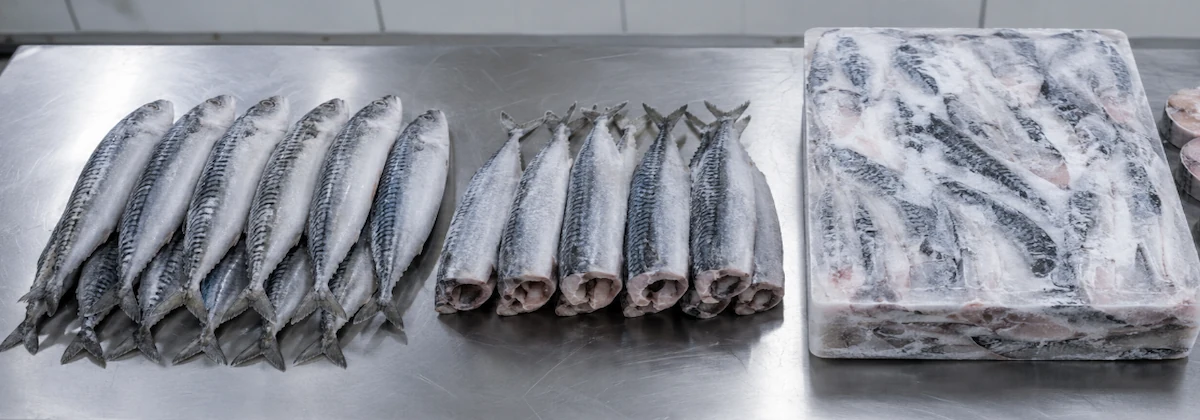
Format Matrix — Every Frozen Mackerel Format by Species, Availability and Primary Market
The table below maps every commercially available format to the species on this site. "Standard" = routinely available in commercial volumes. "Limited" = available from specific origins or seasons only. "N/A" = not commercially produced. Use this table as your starting point before consulting individual species pages for sourcing detail.
| Species | WR IQF | H&G IQF | Fillet IQF | Butterfly | BQF Block | Steak IQF | Primary market |
|---|---|---|---|---|---|---|---|
| Atlantic mackerel | ✓ Std | ✓ Std | ✓ Std | ✓ Std | ◑ Ltd | — | Africa · MENA · E. Europe · Japan |
| Pacific mackerel | ✓ Std | ✓ Std | ◑ Ltd | — | ✓ Std | — | Japan · Korea · MENA · Africa |
| Blue mackerel | ✓ Std | ✓ Std | ◑ Ltd | — | ✓ Std | — | Japan · Korea · Pacific Islands |
| Horse mackerel | ✓ Std | ◑ Ltd | — | — | ◑ Ltd | — | W. Africa · MENA · E. Europe |
| Cape horse mackerel | ✓ Std | ◑ Ltd | — | — | ◑ Ltd | — | E. Africa · SADC · MENA |
| Jack mackerel | ✓ Std | ◑ Ltd | — | — | ✓ Std | — | W. Africa · MENA · CIS |
| Japanese jack mackerel | ✓ Std | ✓ Std | — | — | — | — | Japan · Korea · premium MENA |
| Indian mackerel | ✓ Std | — | — | — | ◑ Ltd | — | GCC · S. Asia · SE Asia |
| Spanish mackerel | ✓ Std | ✓ Std | — | — | — | ✓ Std | MENA · SE Asia · GCC · Pacific |
| King mackerel | ✓ Std | ✓ Std | ◑ Ltd | — | — | ✓ Std | USA · Caribbean |
| Japanese Spanish mackerel | ✓ Std | ✓ Std | — | — | — | ◑ Ltd | Japan · Bangladesh · GCC |
| ✓ Std = routinely available in commercial volumes · ◑ Ltd = available from specific origins or seasons · — = not commercially produced | |||||||
Format Definitions — What WR, H&G, IQF, BQF, Butterfly and Steak Mean in Frozen Mackerel Trade
These are the definitions as used in international frozen mackerel trade and in Global Mackerel purchase orders and shipping documents. They are not manufacturer marketing labels — they are the commercial standards that govern what a buyer receives at the receiving inspection dock.
Whole Round
The fish as caught — ungutted, head on, tail on. No processing beyond chilling or freezing. The dominant format for all schooling mackerel species (Scomber, Trachurus, Rastrelliger) in bulk trade. The belly cavity contains the viscera at delivery — cavity integrity and enzymatic softening risk are primary receiving checks for frozen mackerel whole round lines.
Yield loss vs WR
0% — reference format
Standard carton
10kg or 20kg gross
Species available
All 11 species on this site
Headed and Gutted
Head and viscera removed, tail retained. Body cavity washed. Yield loss vs WR: 20–28% depending on species and head size (Trachurus loses more than Scomber due to proportionally larger head). Typical application: Eastern European retail, Japanese foodservice portioning, value-added processing input. Carton standard: 10kg or 20kg gross. H&G mackerel must be inspected at receiving for clean cavity — blood residue in the cavity is a common quality issue from lower-tier processors.
Individually Quick Frozen
Each fish (or piece) frozen individually on a belt or plate freezer to a core temperature of −18°C, then glazed and packed loose in carton. IQF describes the freezing method — applicable to WR, H&G, fillet, steak or any other format. Key distinction: IQF product can be dispensed piece by piece without thawing the full carton. Glazing: typically applied post-freeze, 8–15% by weight (see glazing section). Carton: 10kg or 20kg loose-pack. "IQF" on a label does not guarantee separation — verify pieces separate freely; clumping indicates a temperature break.
Block Quick Frozen
Fish packed in a mould and frozen as a solid block on a plate freezer — the entire carton weight is one frozen mass. BQF is cheaper to produce than IQF (no individual glazing), denser per cubic metre (better freight economics), but requires full block thaw before separation. Typical application: West African bulk market, reduction-plant input, institutional catering with batch thawing. Species: primarily jack mackerel and horse mackerel; Scomber japonicus in bulk; Scomberomorus species are not commercially traded as BQF blocks. Carton: 20kg standard; some 10kg half-blocks.
IQF Fillet — skin-on or skin-off
Two lateral fillets removed, frozen individually. Skin-on (SO) or skin-off (SKO); pin-bone in (BI) or pin-bone out (BO). Yield loss vs WR: roughly 42–52% depending on species and trim. Carton: 10kg IQF loose typical. Species: primarily Atlantic and Pacific mackerel; Trachurus fillets exist but in limited commercial volume.
Butterfly Fillet
Two fillets joined at the belly, opened flat, bone-in, skin-on — spine down the centre. This frozen mackerel butterfly fillet presentation is common in Japan and Korea and premium GCC foodservice. Yield loss vs WR: ~25%. Species: primarily Atlantic and Pacific mackerel; not commercially produced for Trachurus, Rastrelliger or Scomberomorus. Quality gate: poor cavity condition at landing prevents an acceptable butterfly presentation — specify raw-material grade on the PO.
Steak IQF
Cross-cut section 2–5cm thick, skin-on or skin-off, bone-in, frozen individually. Tariff chapter can shift versus whole fish — see frozen mackerel HS codes and trade documentation. Application: South Asian and GCC curry and fry lines; US Gulf and Caribbean foodservice for large Scomberomorus. Always state skin option and thickness in cm. Mackerel steak IQF is not produced from Scomber or Trachurus at commercial scale.
RSW pre-chill on vessels is a handling step, not a frozen product format — it affects landing temperature before the plant freezer, not the carton label format line.
IQF vs BQF Frozen Mackerel — Bulk Packaging Comparison for Wholesale Buyers
Every buyer of frozen whole round mackerel makes this choice, explicitly or implicitly. IQF and BQF are not quality grades — they are two production technologies with different cost structures, cold chain requirements, end-market compatibility and price-per-tonne. The wrong choice generates either unnecessary cost (paying for IQF when your plant thaws in bulk) or operational failure (receiving BQF when you cannot temper blocks). The choice is fixed in the purchase order — not at destination.
| Parameter | IQF — Individually Quick Frozen | BQF — Block Quick Frozen |
|---|---|---|
| Freezing method | Belt or plate freezer, individual pieces | Plate freezer, moulded block |
| Production cost | Higher (glazing, line time) | Lower (bulk fill) |
| Reefer space | Less dense — air gaps | Denser — stacks tight |
| Freight cost/tonne | Higher | Lower cube penalty |
| Thawing requirement | Piece by piece | Full block tempering |
| Retail compatibility | High | Low without batch thaw |
| Primary market fit | Japan · Korea · MENA retail · premium | W. Africa bulk · reduction · institution |
| Price premium vs BQF | +$80–200/tonne (indicative) | Reference |
Choosing between IQF and BQF — 3 questions
- → Does your customer thaw by the piece or by the batch? Piece = IQF. Batch = consider BQF.
- → Do you have block tempering space and labour? If no, do not book BQF.
- → Is the channel retail or plant input? Retail almost always IQF; plant input may accept BQF economics.
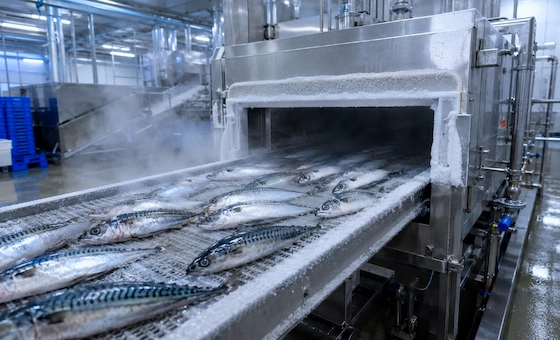
IQF tunnel belt freezer — individual fish separation
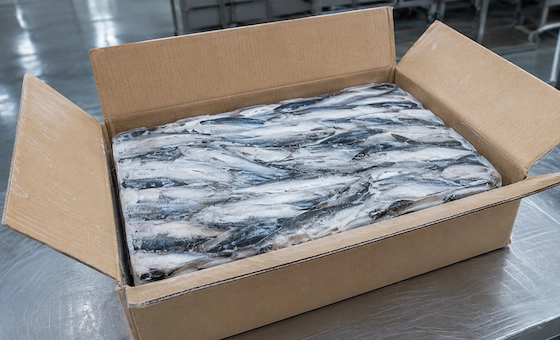
BQF block 20kg — compressed format, West Africa bulk trade
Glazing — The Most Misunderstood Specification in Frozen Mackerel Trade
Glazing is a thin water-ice layer applied to IQF product after freezing to limit dehydration and oxidation. It is expressed as a percentage of gross weight — the dominant dispute field when buyers order "10kg cartons" without defining glazing and net fish equivalence. Always cross-reference net drained weight frozen fish rules for your destination label law.
Regulatory expectations differ: GCC markets typically require net drained weight on the carton; EU labels must reflect net food weight after draining; Japanese buyers often cap glazing in the PO (supermarket-grade references commonly ≤8%).
| Market | Typical glazing spec | Label requirement | Dispute risk if unspecified |
|---|---|---|---|
| Japan / South Korea | Max 8% | Net drained weight focus | High |
| GCC | Max 10–12% | Net drained weight mandatory | High |
| European Union | Max 10% (Reg. 1169/2011) | Net weight of food (= drained) | Medium |
| West Africa bulk | 10–15% common | Often gross-trade practice | Lower |
| USA | Max 10% (FDA framing) | Net weight of food | Medium |
| South Asia | 8–12% typical | Net weight mandatory (FSSAI) | Medium |
Glazing calculation — how to verify at receiving
Net fish weight = Gross weight × (1 − glazing% / 100)
Example: 10kg carton, 10% glazing → 10 × 0.90 = 9.0kg net fish
Thaw a sample, drain 60s on a rack, weigh — compare to declared net drained weight; >3% gap triggers a non-conformity discussion.
Frozen Mackerel Size Grading and Specifications — Every Commercial Grade by Species and Market
Size grade is expressed in grams per piece for WR and H&G formats, and in grams or centimetre thickness for steaks. For buyers from African markets, size equivalents in pieces-per-kg (pcs/kg) and approximate length in centimetres are included — both units are used in purchase orders and proforma invoices depending on the buyer's region. The table lists commercially traded bands referenced across this catalogue. Pair these bands with the format matrix before you copy a grade line from one species page into another.
| Species | Grade (g/piece) | Availability | Primary destination market | Notes |
|---|---|---|---|---|
| Atlantic mackerel | 300–500g | All major origins | Africa, MENA, E. Europe | Most traded grade globally |
| 400–600g | Peak landings window | E. Europe, Asia | Premium band | |
| 600–800g | Tight seasonal window | Japan, Korea | Large-fish specification | |
| Pacific mackerel | 200–300g | Multiple origins | Korea, MENA, Japan domestic | Standard grade |
| 300–400g | Peak window | Japan, Korea premium | Higher fat band | |
| Horse mackerel | 200–300g | All origins | W. Africa, MENA | Most traded grade |
| Horse mackerel | 400g+ | NE Atlantic premium landings | E. Europe, Japan (limited) | Large-fish premium |
| Spanish mackerel | 150–300g steak | Processing plants | South Asian diaspora, GCC | Steak IQF — HS chapter differs from whole fish |
| Japanese Spanish mackerel | 500g–2kg WR | India, Bangladesh | Bangladesh, GCC, Japan | Also H&G IQF for factory lines |
Extended grade tables for individual species sit on each species page — this section keeps cross-species comparability only.
Cartons, Pallets and Cold Chain — Packaging Specifications for Frozen Mackerel
Frozen mackerel is traded in two standard carton weights: 10kg and 20kg gross. Ten-kilogram cartons suit one-person handling in retail backrooms; twenty-kilogram cartons improve cube economics for processing buyers. Polystyrene (EPS) versus double-wall kraft changes unloading resilience in hot-ambient ports — specify material when your inland cold chain has limited surge capacity.
| Parameter | 10 kg carton | 20 kg carton |
|---|---|---|
| Net fish weight (10% glazing) | ~9.0 kg | ~18.0 kg |
| Gross carton weight | 10 kg ±0.5 kg | 20 kg ±0.5 kg |
| Cartons per EUR pallet (120×80cm) | 40–60 (species dependent) | 20–30 |
| Cartons per 40' reefer (typical) | 2,200–2,400 ≈ 22–24 t | 1,100–1,200 ≈ 22–24 t |
| Primary market | GCC · Japan · Korea · retail | W. Africa bulk · processing |
Maintain −18°C core through production, storage and delivery. Excursions above −12°C damage texture; shelf life is typically 18–24 months for high-oil Scomber at stable temperature, shorter for some large Scomberomorus presentations — always quote production date on the PO, not an open-ended best-before.
Mandatory carton label fields — all frozen mackerel exports
- → Species common name + scientific name
- → Format (WR / H&G / IQF / BQF / steak)
- → Size grade (g/piece or kg/piece)
- → Gross / net / net drained weight
- → Glazing percentage
- → Country of origin
- → Production date
- → Lot number
- → Storage temperature (−18°C)
- → Exporter registration
How to Write a Frozen Mackerel Purchase Order — The 9 Fields That Prevent Every Common Dispute
Most delivery disputes — wrong size band, ambiguous format, glazing shock, missing certificates — trace to a PO that left a field implicit. The nine blocks below are the minimum specification set for any frozen mackerel line item. Blank fields are filled at the exporter's discretion, not yours.
- 1
Species + scientific name
Never write "mackerel" alone.
Wrong
Frozen mackerel WR IQF
Correct
Frozen Atlantic mackerel (Scomber scombrus) WR IQF
- 2
Format
State WR / H&G / IQF fillet (skin-on or skin-off) / BQF block / steak (skin, thickness cm) / butterfly. IQF alone is a freezing method, not a cut.
- 3
Size grade
Use grams per piece with bounds. For steaks add thickness. Avoid subjective words like medium.
- 4
Fat content minimum (if applicable)
For Scomber lines where buyers care about oil content, state a Soxhlet minimum and attach lab method. Not typically specified for Trachurus, Rastrelliger or Scomberomorus in most markets.
- 5
Glazing maximum
Example: "maximum glazing 10% of gross weight". Add drained-weight label language for GCC and Japan expectations.
- 6
Carton weight and type
10kg vs 20kg gross; IQF loose vs BQF block; EPS vs kraft when ambient unloading risk is high.
- 7
Certifications required
List HACCP, EU health certificate, IUU catch certificate, halal (recognised body), MSC CoC, and national export certificates required by the destination — by name, not by assumption.
- 8
Incoterm and destination port
CIF, FOB or CNF with named port — incoterm fixes who carries temperature risk in ocean transit.
- 9
Shipment and delivery window
Latest shipment and latest arrival dates. For strongly seasonal species, add maximum age in cold store or earliest acceptable production date so you do not receive aged inventory masked as fresh landings.
Frequently Asked Questions — Frozen Mackerel Formats and Specifications
- What is the difference between IQF and BQF frozen mackerel?
- IQF (Individually Quick Frozen) means each fish or piece is frozen separately on a belt or plate freezer and packed loose in the carton — pieces can be taken out one at a time without thawing the whole carton. BQF (Block Quick Frozen) means the fish are packed in a mould and frozen together as a solid block — the entire block must thaw before individual fish can be separated. IQF costs more to produce (individual glazing step, lower pack density) but is required for retail, foodservice portioning and any end-market where individual fish are dispensed. BQF is used for bulk processing input, institutional catering with batch thawing infrastructure, and price-sensitive West African bulk trade.
- What does glazing percentage mean on a frozen mackerel carton and how do I verify it?
- Glazing percentage is the proportion of ice coating relative to the total gross weight. A 10% glazing on a 10kg carton means approximately 1kg is ice and 9kg is fish. To verify at receiving: take a sample of IQF fish, drain on a wire rack for 60 seconds, weigh. The drained weight should match the declared net drained weight within 3%. GCC markets (UAE, Saudi Arabia) and Japan require net drained weight to be declared on the carton label. The EU requires the net weight of the food (= drained).
- What is the difference between 10kg and 20kg frozen mackerel cartons for logistics?
- Ten-kilogram cartons are one-person manageable and dominate retail-facing channels; twenty-kilogram cartons improve cube efficiency and unit economics for bulk processing and institutional buyers. Reefer stow counts differ: a 40ft reefer typically loads roughly twice as many 10kg cartons by piece count as 20kg cartons for the same gross tonnes — always model net fish weight after glazing when booking space.
- How should frozen mackerel size grades be written on a purchase order?
- Always use grams per piece or kilograms per piece with explicit bounds (e.g. 300–500g/piece). Avoid subjective labels like medium or standard. For steak lines, add thickness in centimetres and skin-on or skin-off. For butterfly or fillet lines, state skin and pin-bone options explicitly.
Deep dives on oil content testing: frozen mackerel fat content specification guide. Certificate stacks and cold-chain policy: frozen mackerel quality and certifications. Are you a processor? See supplier requirements →
Ready to source frozen mackerel?
Send your specs and get a competitive quote within 24h.