
Genus Rastrelliger · Arabian Sea · MPEDA Certified · HS 0303.54
Frozen Indian Mackerel Supplier — Rastrelliger kanagurta
Global Mackerel supplies frozen Indian mackerel (Rastrelliger kanagurta) IQF whole round from India (Kerala, Karnataka) and Sri Lanka to importers across the Gulf Cooperation Council, Southeast Asia and East Africa. This is a species whose commercial availability is governed not by a quota calendar but by the southwest monsoon — the annual weather system that closes the Arabian Sea and Bay of Bengal fishing grounds for 90 to 110 days each summer. Procurement teams who understand that cycle contract in March–May, before the closure, and secure both better pricing and better quality. Every shipment from Kochi and Mangalore moves under mandatory MPEDA pre-export inspection — a government-run lot-level control that no private certification programme replicates.
Procurement window
March–May (pre-monsoon)
IQF calibres
100–150g · 150–200g · 200–300g
MPEDA
Pre-export state inspection
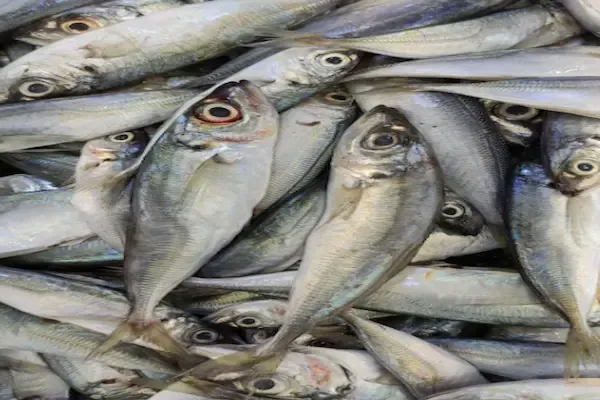
The Filter-Feeding Mouth of Rastrelliger kanagurta — What It Means for Frozen Indian Mackerel Quality
Rastrelliger kanagurta is the only Scombridae species on this site that does not hunt. It feeds by filter-feeding — swimming open-mouthed through plankton clouds and straining phytoplankton, copepods and zooplankton through long, tightly packed gill rakers. This is not a detail of academic biology. It is the single anatomical fact that most directly determines the frozen quality of frozen indian mackerel relative to every other mackerel species in international trade. In a whole round ungutted fish — the dominant format for frozen indian mackerel — belly-burn is caused by digestive enzymes from prey breaking down the stomach wall post-mortem. Atlantic mackerel (Scomber scombrus), Pacific mackerel (Scomber japonicus) and Atlantic horse mackerel (Trachurus trachurus) all hunt fish and crustaceans. Their stomach contents at landing are enzymatically aggressive. Rastrelliger kanagurta's stomach contents are planktonic — biochemically inert by comparison.
The practical consequence for buyers of frozen indian mackerel is measurable at receiving inspection. Belly-burn — the condition where the stomach wall appears softened, translucent or breached, with gut contents beginning to migrate into the body cavity — is the most common quality defect causing price deductions and commercial disputes in whole round frozen fish trade. In Rastrelliger kanagurta, the onset of belly-burn is structurally slower than in piscivorous Scomber species, even when sea-to-freezer time extends beyond 8 hours — which is common in the artisanal and semi-industrial fishing operations that supply the majority of frozen indian mackerel for export from indian mackerel Kerala and indian mackerel Sri Lanka packing plants. Buyers who receive frozen indian mackerel from MPEDA-inspected Indian facilities should still specify maximum sea-to-freezer time in their purchase order, but their baseline quality risk from belly condition is lower than with equivalent-format Scomber mackerel from comparable origins.
Rastrelliger kanagurta — Filter feeder
- → Stomach contents: phytoplankton, copepods, zooplankton
- → Digestive enzyme load: low
- → Belly-burn onset: slow (8–14h sea-to-freezer tolerance)
- → Quality risk in WR format: structurally lower
Scomber / Trachurus spp. — Active predators
- → Stomach contents: fish, crustaceans, squid
- → Digestive enzyme load: high
- → Belly-burn onset: faster (4–8h sea-to-freezer critical)
- → Quality risk in WR format: higher under equivalent handling
This biological advantage does not eliminate the need to specify handling protocols in the purchase order — it reduces the margin for error. For frozen indian mackerel destined for markets with receiving inspection (EU, Japan, GCC), buyers should specify: maximum sea-to-freezer time of 10 hours, IQF individual quick freezing rather than block freezing for premium grades, and pre-shipment belly condition inspection by MPEDA. For bulk whole round in 20kg cartons without individual IQF — the standard for East African and South Asian price-sensitive markets — the filter-feeding quality baseline means that well-handled frozen indian mackerel arrives in better belly condition than equivalent-format predatory species under the same logistics. For regulatory context on documentation that references Rastrelliger kanagurta alongside other Scombridae, read our frozen mackerel species identification guide.
The Monsoon Window — How to Buy Frozen Indian Mackerel Before the Arabian Sea Closes
Indian mackerel landing volumes relative index — Arabian Sea and Bay of Bengal combined. Monsoon closure dates vary ±10 days by year and sub-region.
The southwest monsoon — known in India as Vayu — makes landfall on the Kerala coast around June 1 each year, with a margin of ±10 days depending on the year. It brings sustained winds of 25–35 knots and wave heights of 3–5 metres across the Arabian Sea — conditions that exceed the safe operating threshold of the artisanal and semi-industrial fishing fleets responsible for 70–75% of Rastrelliger kanagurta landings in India. Processing plants in Kochi, Mangalore and Veraval reduce or cease frozen indian mackerel production from June through September. The Bay of Bengal is partially less affected than the Arabian Sea, and Sri Lanka's eastern coast (Jaffna, Trincomalee) continues partial operations through June–July — but at volumes insufficient to cover the Arabian Sea production gap for buyers requiring consistent monthly supply of frozen indian mackerel.
The commercial outcome of this annual cycle is consistent and documented: post-monsoon prices for frozen indian mackerel (October–November) have historically run 15–25% above pre-monsoon prices (March–May) for equivalent grades, origins and specifications. The mechanism is straightforward — demand resumes simultaneously with supply in October, creating a temporary seller's market. Buyers who have not secured pre-monsoon frozen indian mackerel stock pay the post-monsoon premium with no offsetting quality advantage: October fish are not better than April fish. The buyers who consistently achieve the lowest annual average cost per tonne of frozen indian mackerel are those who contract March–May production in February, using a standby letter of credit (SBLC) rather than a wire transfer, with delivery windows extending through September if needed. Route-level context for GCC discharge appears in our frozen mackerel for Gulf and Middle East markets overview.
Procurement timing — operational checklist
- → Place framework agreement: February–March
- → Confirm production lots: March–May (pre-monsoon peak)
- → Documentary instrument: Standby LC (SBLC) — not wire transfer advance
- → Delivery window: May–September (from cold storage drawdown)
- → Sri Lanka east coast as partial backup: June–July only, limited volume
Why Frozen Indian Mackerel Is an Export Surplus, Not an Export Fishery — and What That Means for Your Purchase Order
Every other mackerel species on this site — Atlantic mackerel from Norway, Pacific mackerel from Peru, horse mackerel from Mauritania, cape horse mackerel from Namibia — is produced within a fishery that is structurally oriented toward export. Quota allocations, processing infrastructure, cold storage capacity and port logistics in those origins are calibrated around the export market. Rastrelliger kanagurta is different. Between 75 and 85% of Indian mackerel landings in India are absorbed by domestic fresh fish markets — the wet markets of Kochi, Mangalore, Mumbai, Chennai and Colombo where frozen indian mackerel competes as the most-purchased white protein in the market basket of hundreds of millions of people. The export of frozen indian mackerel from India and Sri Lanka occurs when, and only when, domestic fresh market prices fall below the breakeven threshold for freezing, cold storage and export logistics.
This structure has a direct consequence that experienced importers of frozen indian mackerel learn early: an Indian exporter can legitimately — and without breach of commercial good faith — reduce available export volume or decline a spot order if domestic prices recover above the export breakeven during the contract period. This is not unreliability. It is the market structure. The protection against this risk for a buyer committing to 24 containers per year is not a fixed-price annual contract — which will be declined or repriced when domestic prices rise — but a framework agreement with a price formula indexed to the MPEDA weekly price index, combined with a standby letter of credit that activates at the buyer's option when prices enter the contracted range. Commercial clauses for frozen indian mackerel should be drafted with that domestic-first reality in mind. For HS, incoterms and documentary sequencing, use our frozen mackerel procurement and trade guide.
| Species | Production orientation | Export trigger | Recommended instrument |
|---|---|---|---|
| Rastrelliger kanagurta (India / SL) | Domestic market first | Domestic price < export breakeven | SBLC + price index framework |
| Scomber scombrus (Norway) | Export oriented | Annual quota opening | Forward contract at season |
| Trachurus murphyi (Peru) | Export oriented | SPRFMO registry + fleet cycles | Forward contract |
| Trachurus capensis (Namibia) | Export oriented | Annual Namibian quota | Annual supply agreement |
MPEDA Pre-Shipment Inspection — Why Frozen Indian Mackerel Has Fewer Import Rejections Than Any Comparable Origin
The Marine Products Export Development Authority (MPEDA) is the Indian government competent authority for seafood export. Its role is structurally different from the certification bodies that appear on the other product pages of this site. HACCP, ISO 22000, IFS and BRC are standards that a processing facility implements and a private auditor verifies — they certify the system, not the lot. MPEDA does something that no private certification body does: it physically inspects and tests every export production lot before the container is allowed to leave India. An MPEDA inspector visits the processing plant, draws samples from the specific batch destined for export, and submits them to an MPEDA-accredited laboratory for histamine testing, full microbiological profile (total viable count, E. coli, Salmonella, Staphylococcus aureus), heavy metals (mercury, cadmium, lead, arsenic) and — for markets that require it — organochlorine pesticide residues. The resulting MPEDA Certificate of Inspection references the specific lot number, production date, exporter registration number and laboratory results. A batch that fails any parameter does not receive a certificate and cannot be exported as frozen indian mackerel.
The commercial consequence of this mandatory lot-level state inspection is visible in the public import alert data published by the European Commission (RASFF portal) and the Japanese Ministry of Agriculture, Forestry and Fisheries. Indian-origin frozen fish — including frozen indian mackerel — generates a disproportionately low rate of border rejection relative to its volume of trade, compared to origins where pre-export inspection is factory self-declaration only. For a buyer importing frozen indian mackerel into the EU, the MPEDA Certificate of Inspection is the primary document that satisfies the competent authority at the border inspection post. For a buyer importing into Japan, the MPEDA certificate substantially reduces the probability of MAFF enhanced inspection, which triggers detention and testing costs of $800–2,500 per container. Request and verify the MPEDA certificate number before confirming the letter of credit — not after. Cross-read with our frozen mackerel quality and certifications hub for facility-level programmes that sit alongside MPEDA.
Documents to request on every frozen Indian mackerel shipment
- → MPEDA Certificate of Inspection — lot number, lab results, exporter reg. no.
- → EU Health Certificate — issued by MPEDA as EU-recognised competent authority
- → Catch Registration Certificate — vessel-level traceability
- → Halal Certificate (lot-specific) — OIC-recognised body, mandatory for GCC
- → GSP Form A or EUR.1 — depending on destination duty preference
Frozen Indian Mackerel in Malaysia and Indonesia — The Kembung Species Risk
In Malaysian and Indonesian seafood trade, the word kembung does not identify a species. It identifies a commercial category that covers three distinct Rastrelliger species with different sizes, different fat profiles and different market prices. Rastrelliger kanagurta — frozen indian mackerel — is sold as kembung lelaki (literally "male kembung" — a trade convention, not a biological distinction). Rastrelliger brachysoma — the shortbody mackerel — is sold as kembung perempuan ("female kembung"). Rastrelliger faughni — the island mackerel — appears in some Indonesian regional markets under local names. An exporter who ships Rastrelliger kanagurta and labels it "kembung" without species specification creates immediate liability at Malaysian and Indonesian inspection: if the receiving buyer specified kembung perempuan and receives kembung lelaki, they have received a different species regardless of whether quality is equivalent.
The commercial differences between R. kanagurta and R. brachysoma are real and buyer-visible at receiving. R. kanagurta reaches 100–300g commercial weight, with a more elongated body, firmer flesh and fat content of 6–12%. R. brachysoma rarely exceeds 80–120g commercial weight, has a rounder, deeper body and lower average fat content. At equivalent size ranges, Malaysian wet market buyers consistently pay a premium of 8–15% for R. kanagurta over R. brachysoma — a premium driven by consumer preference for the firmer texture in grilled, fried and curry applications that dominate Malaysian kembung consumption. When your tender references frozen indian mackerel, attach the same words to the commercial invoice line.
Every commercial invoice, MPEDA health certificate and packing list for frozen indian mackerel destined for Malaysia or Indonesia must carry the scientific name Rastrelliger kanagurta — not "kembung", not "Indian mackerel", not "chub mackerel". The FAMA (Federal Agricultural Marketing Authority of Malaysia) inspects species identification on documentation at the port of entry. The scientific name is also the mandatory field in the Malaysian MYSTICS import registration system. Global Mackerel includes the scientific name on all commercial documents as standard for Southeast Asian shipments of frozen indian mackerel. For cross-checking labels against catch paperwork, bookmark our frozen mackerel species identification guide and compare with all frozen mackerel products in the catalogue when you diversify genus-level programmes.
Frequently Asked Questions — Frozen Indian Mackerel (Rastrelliger kanagurta)
- Why does frozen Indian mackerel (Rastrelliger kanagurta) have lower belly-burn rates than Scomber mackerel?
- Rastrelliger kanagurta is a filter-feeder with long, dense gill rakers adapted to straining plankton. Its stomach contents at landing are phytoplankton and zooplankton — not fish or crustaceans. In ungutted whole round frozen fish, belly-burn is caused by digestive enzymes from prey breaking down the stomach wall. Because R. kanagurta's digestive load is planktonic rather than piscivorous, enzymatic activity in the belly is significantly lower, producing structurally better belly condition even when sea-to-freezer time exceeds 8 hours — a quality advantage that matters for buyers in warm-climate markets with extended cold-chain transit. This is why many procurement teams treat frozen indian mackerel as a lower belly-risk line item than predatory Scomber lines at the same format.
- When is the best time to buy frozen Indian mackerel and why?
- The optimal procurement window for frozen indian mackerel is March–May, before the southwest monsoon (Vayu) closes the Arabian Sea and Bay of Bengal fishing grounds from approximately June 1 to September 15. The monsoon can reduce Indian mackerel landings by 60–75% for 90–110 days. Buyers who contract in March–May secure pre-monsoon pricing (typically 15–25% below post-monsoon levels), guaranteed supply through the gap period, and better quality — fish caught before the monsoon are in peak pre-spawning condition. The correct instrument is a standby letter of credit (SBLC) against a framework agreement, not a spot purchase after the monsoon closes.
- What is the MPEDA Certificate of Inspection for frozen Indian mackerel and why does it reduce import rejection risk?
- The Marine Products Export Development Authority (MPEDA) Certificate of Inspection is a mandatory pre-export document issued by the Indian government competent authority after physical inspection and laboratory testing of each production lot. Unlike a factory's own quality control report, the MPEDA certificate is a third-party state document certifying histamine levels, microbiological counts (E. coli, Salmonella, total coliforms), heavy metal residues and pesticide residues for the specific batch being shipped. Lots that fail MPEDA testing are physically prevented from export. This institutional filter — which has no equivalent in most competing origins — is the structural reason why Indian-origin frozen indian mackerel has a lower import rejection rate at EU border inspection posts and Japanese MAFF inspection compared to origins without mandatory pre-export state inspection.
- What is the difference between kembung lelaki and kembung perempuan for frozen Indian mackerel buyers in Malaysia?
- In Malaysian and Indonesian trade, 'kembung' covers two distinct Rastrelliger species with different commercial values. Kembung lelaki is Rastrelliger kanagurta — the Indo-Pacific species traded internationally as frozen indian mackerel, typically 100–300g, with higher fat content (6–12%) and firmer flesh. Kembung perempuan is Rastrelliger brachysoma — a smaller, rounder coastal species native to the shallow Strait of Malacca, rarely exceeding 100–150g. Malaysian wet market buyers pay a premium of 8–15% for R. kanagurta over R. brachysoma at equivalent weight. Exporters must specify 'Rastrelliger kanagurta' by scientific name on all commercial documents — the generic label 'kembung' is insufficient for Malaysian FAMA inspections and creates liability at delivery if the species received differs from the species on the invoice.
Ready to source frozen mackerel?
Send your specs and get a competitive quote within 24h.