
Genus Scomber · HS 0303.54 · Norway · Iceland · Morocco
Frozen Atlantic Mackerel Supplier — Scomber scombrus
Frozen Atlantic mackerel (Scomber scombrus) is the single most important species in global frozen mackerel trade. With annual commercial landings of approximately 911,000 tonnes, it is the reference product against which all other mackerel species are benchmarked for price, quality and specification. Global Mackerel supplies frozen Atlantic mackerel whole round, headless and gutted, IQF fillet and butterfly fillet formats from Norway, Iceland and Morocco — the three principal origins of the Northeast Atlantic stock — to importers, distributors and processors across Africa, the Middle East, Eastern Europe and East Asia. All shipments are fully documented and sourced from HACCP and MSC-certified processing facilities.
911,000 t
Annual FAO landings
Up to 30%
Peak fat content
3 origins
Norway · Iceland · Morocco
What Is Atlantic Mackerel — Scomber scombrus
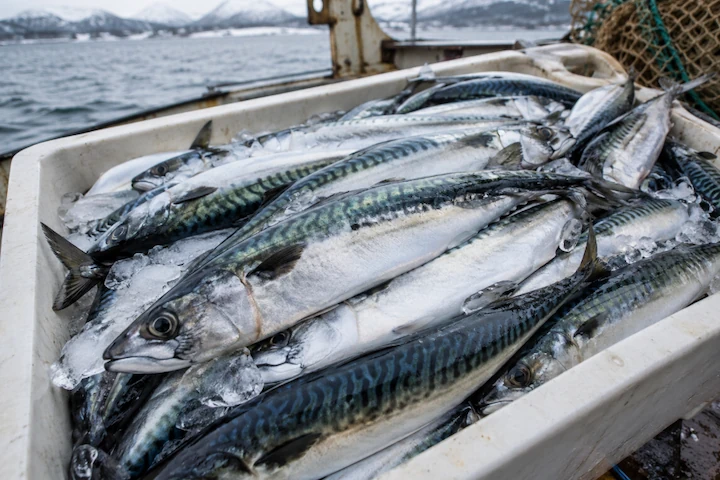
Atlantic mackerel (Scomber scombrus) is a pelagic schooling fish belonging to the family Scombridae. It is also commercially known as Boston mackerel in North America, Norwegian mackerel in Scandinavia and Scottish mackerel in the United Kingdom. The species is distributed throughout the Northeast Atlantic Ocean, from Norway and Iceland in the north to Morocco and the Canary Islands in the south, and across the Northwest Atlantic from Newfoundland to Cape Hatteras.
Atlantic mackerel is an oily fish with a fat content that varies significantly by season and fishing ground — a characteristic that makes it one of the most specification-sensitive products in frozen seafood trade. Peak fat content, which can reach 25–30% of body weight, is achieved after the summer feeding period, making Norwegian and Icelandic mackerel caught between August and November the most prized for export markets requiring high fat specification. Understanding the fat content cycle is essential for buyers — see our detailed guide on frozen mackerel fat content for full seasonal data by origin.
The flesh of Atlantic mackerel is firm, dark and intensely flavoured, with one of the highest concentrations of omega-3 fatty acids (EPA and DHA) of any commercially traded fish. Atlantic mackerel contains approximately 1,000–2,500mg of omega-3 per 100g of edible flesh depending on season, making it a nutritionally premium product that commands strong consumer demand across all major import markets.
Family
Scombridae
Omega-3 (EPA+DHA)
1,000–2,500 mg / 100g
Also known as
Boston · Norwegian · Scottish mackerel
HS Code
0303.54
Atlantic Mackerel Fishing Grounds & Seasonality
The Northeast Atlantic mackerel stock — managed jointly by Norway, Iceland, the Faroe Islands and the European Union — is the source of the vast majority of frozen Atlantic mackerel traded globally. The stock migrates seasonally between feeding grounds in the Norwegian Sea and overwintering grounds further south, creating a well-defined seasonal availability pattern that directly determines product quality and pricing.
Norwegian mackerel fishing opens in August and reaches peak intensity between September and November when fish returning from the Norwegian Sea summer feeding grounds carry their highest annual fat content. Norwegian processing plants — primarily located in Ålesund, Tromsø and Kristiansund — produce IQF whole round and headed and gutted product during this peak window. Norway is the world's largest exporter of frozen Atlantic mackerel, with annual export volumes typically exceeding 300,000 tonnes. For full details on Norwegian mackerel sourcing, see our origin page on frozen mackerel from Norway.
Icelandic Atlantic mackerel has emerged as a significant commercial product since mackerel expanded its range northward into Icelandic waters in the 2000s, driven by changing ocean temperatures. Icelandic mackerel is typically caught between July and October and is known for its premium quality and consistency. Iceland's strict quota management system and MSC-certified fisheries make Icelandic frozen mackerel a preferred option for buyers in markets with sustainability requirements. See our page on Icelandic frozen mackerel supplier for full sourcing details.
Moroccan Atlantic mackerel is caught along the Atlantic coast of Morocco, particularly around Agadir and Dakhla, and provides year-round availability that complements the seasonal Norwegian and Icelandic supply. Moroccan mackerel tends to be smaller in size (200–400g range) and carries lower fat content than Norwegian fish, making it well-suited for Sub-Saharan African and MENA markets where price-competitiveness is the primary purchasing criterion. Global Mackerel maintains active sourcing relationships in Morocco to ensure supply continuity outside the Norwegian peak season. See our full page on frozen mackerel from Morocco.

Norway
Aug – Nov
14–28% fat
Iceland
Jul – Oct
14–24% fat
Morocco
Year-round
8–16% fat
Atlantic Mackerel Fat Content — The Critical Specification
No other quality parameter is more important in frozen Atlantic mackerel trade than fat content. Buyers in Japan, South Korea and premium European markets routinely specify minimum fat content of 16%, 18% or even 20% in their purchase orders. Failure to meet fat content specification is one of the most common causes of commercial disputes in frozen mackerel trade.
Fat content in Atlantic mackerel follows a predictable annual cycle driven by the species' feeding and spawning behaviour. Fish are at their leanest (6–12% fat) immediately after spawning in spring (April–June). Fat content builds progressively through the summer feeding season and peaks between September and November when Norwegian and Icelandic fish reach 20–30% fat. Moroccan mackerel caught year-round typically shows fat content of 8–16% depending on season.
Global Mackerel provides fat content test reports (Soxhlet method) from accredited laboratories on request. We strongly recommend buyers specify minimum fat content in all Atlantic mackerel purchase orders to ensure the product meets their market requirements. For full seasonal fat content data by origin and detailed guidance on how to specify fat content in a purchase order, see our frozen mackerel fat content specification guide.
Fat content benchmarks — international trade grades
Frozen Atlantic Mackerel — Available Formats
Global Mackerel supplies frozen Atlantic mackerel in all standard international trade formats. Available formats depend on origin and processing facility capability — Norwegian and Icelandic processors offer the widest range of formats, while Moroccan product is primarily available as whole round.
| Format | Code | Description | Typical size grades | Pack format |
|---|---|---|---|---|
| Whole Round | WR | Frozen in natural state, ungutted | All grades | 10kg / 20kg carton |
| Headless & Gutted | H&G | Head and viscera removed, tail on | 300g+ | 10kg / 20kg carton |
| IQF Fillet | IQF FL | Individually quick frozen, skin-on | 300–600g source fish | 10kg carton |
| Butterfly Fillet | BF | Bone-in butterfly cut, skin-on | 400g+ source fish | 10kg carton |
| IQF Portion | IQF P | Cut portions, skin-on | Variable | 10kg carton |
For full technical specifications on each format including glazing options, packaging requirements and labelling standards, see our complete page on frozen mackerel formats and specifications.
Bulk Frozen Atlantic Mackerel — Size Grades and Carton Specifications
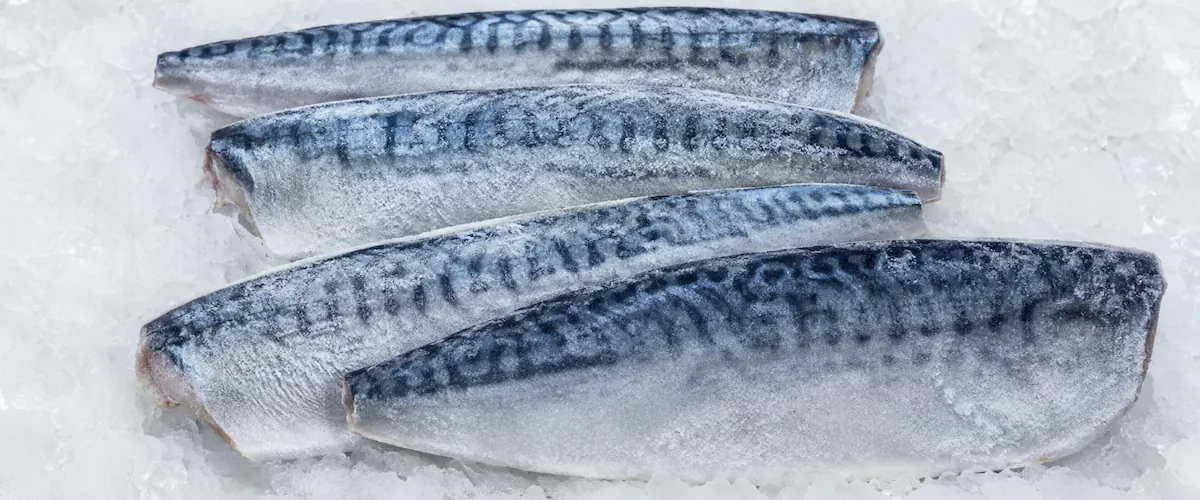
Bulk frozen Atlantic mackerel (Scomber scombrus) is traded in standardised size grades expressed in grams per piece, packed in 10kg or 20kg cartons on IQF loose or BQF block format. Size grade directly affects FOB and CIF price per metric ton — larger fish carry a significant premium in East Asian and Eastern European markets. Norwegian autumn catch pelagic trawlers (September–November) typically produce the largest size distribution, with a significant proportion in the 500g+ grades suited to Japanese and Korean wholesale buyers. The most commonly traded grades for bulk export are:
Buyers should note that size grade distribution varies significantly by fishing date and origin. Norwegian mackerel caught in October typically yields a much higher proportion of 400–600g and 500–700g fish than Moroccan mackerel, which predominantly yields 200–400g. Global Mackerel can provide pre-shipment sampling and size distribution reports on request.
Atlantic Mackerel Export Markets
Frozen Atlantic mackerel is consumed across all major global seafood markets, with demand driven by different factors in each region.
Sub-Saharan Africa
Sub-Saharan Africa is the largest volume destination for frozen Atlantic mackerel by container count. Countries including Ghana, Nigeria, Benin, Democratic Republic of Congo, Ivory Coast and Cameroon import large quantities of frozen whole round Atlantic mackerel as an affordable protein source. The dominant specifications in African markets are 200–400g whole round from Morocco and 300–500g whole round from Norway, packed in 20kg cartons. Price sensitivity is high in this market and buyers typically prioritise cost over fat content specification.
Frozen mackerel for Africa →Middle East & North Africa
The Middle East and North Africa region is a major importer of frozen Atlantic mackerel, with Egypt, Turkey, UAE and Saudi Arabia among the top buyers. Egyptian buyers are among the largest importers of frozen Atlantic mackerel globally, typically purchasing 300–500g whole round in 20kg cartons on CIF Alexandria or CIF Port Said terms.
Frozen mackerel for the Middle East →Eastern Europe
Eastern Europe — particularly Ukraine, Poland and Romania — has historically been one of the most important markets for Norwegian frozen Atlantic mackerel. Eastern European buyers typically specify 400–600g and 500–700g whole round or headed and gutted product with fat content above 14%.
Frozen mackerel for Eastern Europe →East Asia
East Asian markets — Japan, South Korea and China — import frozen Atlantic mackerel under strict specifications for fat content (minimum 18%), size (400–600g or 500–700g) and glazing. Japanese buyers in particular are known for the most demanding specifications in global mackerel trade.
Frozen mackerel supplier for East Asia →HS Code — Frozen Atlantic Mackerel
Harmonised System code
0303.54
Frozen Atlantic mackerel (Scomber scombrus) is classified under HS code 0303.54 in the Harmonised System of tariff nomenclature. This code covers frozen mackerel of the species Scomber scombrus, Scomber australasicus and Scomber japonicus — the three species of the genus Scomber. Import duties applicable to HS 0303.54 vary by destination country. For a full list of HS codes and applicable duties by destination market, see our frozen mackerel import and trade guide.
Certifications & Compliance
All frozen Atlantic mackerel supplied by Global Mackerel is sourced from processing facilities holding current food safety certifications. Norwegian and Icelandic processing plants operate under EU-approved status and hold MSC Chain of Custody certification for certified sustainable mackerel. Moroccan facilities are HACCP and ISO 22000 certified with EU export approval.
Standard documentation provided on every shipment: EUR.1 or GSP certificate of origin, EU health certificate, catch certificate (mandatory for EU imports under IUU Regulation 1005/2008), packing list, commercial invoice and bill of lading. Additional documentation (halal certificate, radiation certificate, certificate of analysis) available on request depending on destination market requirements.
View full certification details →Standard shipment documents
- — EUR.1 or GSP certificate of origin
- — EU health certificate
- — Catch certificate (IUU Regulation 1005/2008)
- — Packing list & commercial invoice
- — Bill of lading
Frozen Atlantic Mackerel FOB and CIF Price Indications per Metric Ton
Frozen Atlantic mackerel prices are quoted per metric tonne (MT) on CIF or FOB basis and fluctuate based on fishing season, annual quota allocations, fat content, size grade and origin. Norwegian mackerel at peak season (October–November) commands a significant premium over Moroccan year-round product due to larger size and higher fat content. For current price benchmarks by origin and size grade, see our frozen mackerel price per ton updated monthly.
Frequently Asked Questions — Frozen Atlantic Mackerel
- What is the difference between Norwegian and Moroccan frozen Atlantic mackerel?
- Norwegian Atlantic mackerel (Scomber scombrus) is generally larger (300–800g+), carries higher fat content (14–28% depending on season) and commands a higher price per tonne than Moroccan mackerel. Norwegian mackerel is caught primarily between August and November during the peak feeding season. Moroccan mackerel is smaller (200–400g), available year-round, carries lower fat content (8–16%) and is primarily traded to Sub-Saharan African and MENA markets where competitive pricing is the priority.
- What fat content can I expect from frozen Atlantic mackerel?
- Fat content varies significantly by origin and fishing date. Norwegian mackerel caught in October–November typically shows 20–28% fat. Icelandic mackerel from the same period shows 18–25%. Moroccan mackerel shows 8–16% depending on season. We provide fat content test certificates (Soxhlet method) from accredited laboratories on request. We strongly recommend specifying minimum fat content in your purchase order.
- What is the HS code for frozen Atlantic mackerel?
- Frozen Atlantic mackerel (Scomber scombrus) is classified under HS code 0303.54. This code covers all three Scomber species. Applicable import duties vary by destination country. See our trade guide for full tariff details by market.
- What are the standard payment terms for frozen Atlantic mackerel?
- We accept payment by irrevocable Letter of Credit (L/C) at sight and Telegraphic Transfer (T/T) with advance payment or against documents. Available incoterms: CIF (Cost, Insurance and Freight), FOB (Free on Board) and CNF (Cost and Freight). Minimum order: one 20-foot reefer container. Most buyers order 40-foot containers for cost efficiency.
Ready to source frozen mackerel?
Send your specs and get a competitive quote within 24h.