
Family Carangidae · Atlantic Horse Mackerel · HS 0303.55
Frozen Horse Mackerel Supplier — Trachurus trachurus
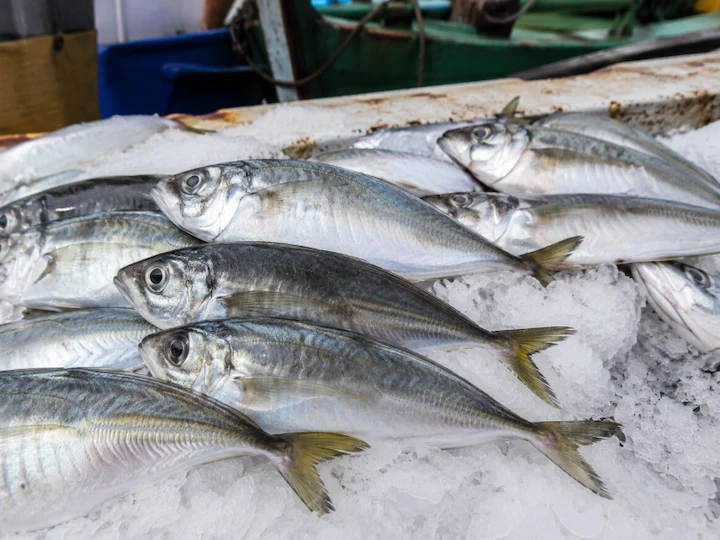
Frozen horse mackerel (Trachurus trachurus) is not a mackerel. It never was. Despite its trade name, Trachurus trachurus belongs to the family Carangidae — the jacks and scads — and is biologically unrelated to any species of the genus Scomber. This is the first piece of commercial intelligence a buyer of frozen horse mackerel must possess, because the taxonomic distinction has direct consequences on HS code classification (0303.55, not 0303.54), on processing yield, on fat content expectations, and on the import documentation requirements of several destination markets that differentiate between Carangidae and Scombridae in their veterinary certification frameworks. Global Mackerel supplies frozen horse mackerel whole round from Morocco, Mauritania and the Northeast Atlantic — the three commercial origins that together supply the vast majority of global frozen horse mackerel trade — to importers across Sub-Saharan Africa, the Middle East and Eastern Europe.
HS 0303.55
Carangidae — not Scombridae
206,000t
Annual FAO landings
4–12%
Fat content range
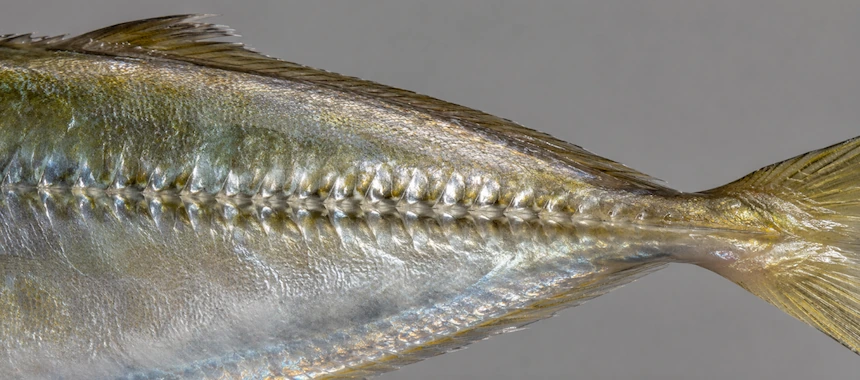
The Scutes — The Anatomical Feature That Defines Trachurus in Trade
The feature that immediately identifies any Trachurus species and distinguishes it from all Scomber mackerel is the lateral line scutes — enlarged, keeled bony plates that armour the lateral line from the operculum (gill cover) to the base of the tail. In Trachurus trachurus, there are approximately 69–79 of these scutes, each overlapping the next in a rigid sequence that gives the fish a distinctly rough, almost rasping texture along its flanks when stroked from tail to head. The scutes are absent in every species of Scomber, Rastrelliger and Scomberomorus — making them the single fastest identification test for distinguishing frozen horse mackerel from all true mackerel species in a mixed cold store or at point of delivery inspection.
The scutes have three commercially significant consequences that buyers of frozen horse mackerel must understand before they take delivery of their first container. First, yield loss: in processing operations that produce filleted or skinned horse mackerel product, the scutes must be removed before or after skinning — a step not required for Scomber species — which adds processing time and reduces yield by approximately 2–4% compared to equivalent-weight Scomber mackerel processed to the same output format. Buyers who are purchasing frozen horse mackerel for processing and value-added applications (smoked, marinated, canned) should factor this additional yield loss into their cost-per-kilogram calculations. Second, net weight accuracy: the scutes add hard mineral mass to the whole fish body weight that does not contribute to edible flesh yield. On a cost-per-kilogram-of-edible-flesh basis, frozen horse mackerel is more expensive than its headline per-tonne price suggests relative to Scomber species with comparable protein content. Third, consumer experience: in markets where frozen horse mackerel is sold whole and cooked without processing — the dominant consumption pattern in West Africa — the scutes can cause mouth injury if the fish is eaten without proper filleting at the table. In some West African preparation traditions, the fish is scored along the flanks with a knife before cooking specifically to address this characteristic.
The second anatomical identification marker for Trachurus trachurus — and for all Carangidae versus all Scombridae — is the dorsal fin configuration. Horse mackerel has two distinctly separate dorsal fins: the first is spiny (8 hard, stiff rays that can cause minor puncture injuries to handling personnel — a practical consideration for quality control teams inspecting bulk cartons at receiving facilities) and the second is soft-rayed and positioned well back on the body. This configuration differs clearly from all Scomber mackerel, which have two closely adjacent dorsal fins with no spiny first dorsal of this character. At customs inspection or quality control receiving, the two-fin test and the scute test together provide definitive identification of Trachurus versus Scomber in under thirty seconds per fish.
Trachurus trachurus
Family Carangidae
- ✓ Lateral line scutes (69–79 keeled bony plates)
- ✓ Two clearly separate dorsal fins
- ✓ Spiny first dorsal (8 hard rays)
- ✓ HS code: 0303.55
- ✓ Fat content: 4–12%
Scomber spp.
Family Scombridae
- ✗ No scutes — smooth lateral line
- ✗ Two adjacent dorsal fins
- ✗ No spiny first dorsal
- ✓ HS code: 0303.54
- ✓ Fat content: 6–28% (species dependent)
Keta School Boys, Sawa, Chinchard — The Trade Names That Move Markets
Frozen horse mackerel is sold under different local names in every major West African import market, and understanding these names is not a trivial exercise in cultural curiosity — it is a commercial necessity. A Ghanaian importer who receives a proforma invoice listing 'frozen horse mackerel WR 200–300g' will immediately translate this as keta school boys in their internal documentation and their conversations with downstream distributors. The same product described to a Nigerian buyer becomes sawa or ojojo. A Beninese or Togolese buyer knows it as chinchard or chinchards. A Congolese buyer in DRC calls it makayabu ya poisson (distinguishing it from the dried/smoked version). These names are not interchangeable in marketing to end-consumers in these markets — each has local connotations, price expectations and quality associations that differ by country.
The name keta school boys in Ghana has a specific origin: the product was historically unloaded in large volumes at Keta, a fishing town in the Volta Region of Ghana, and the small whole fish packed tightly in cartons reminded traders of schoolboys packed into a classroom — a vivid and enduring metaphor that has survived the complete transition of Ghana's frozen fish trade from artisanal to containerised industrial supply. Today, keta school boys refers specifically to frozen horse mackerel or horse mackerel-type small whole round fish in the 100–300g range, and any Ghanaian importer quoting the product will use this term in their CIF offer to downstream buyers regardless of what the carton says in English.
In Nigeria, sawa is the dominant trade name and refers primarily to frozen horse mackerel in the 200–300g whole round specification. The Nigerian market for sawa operates through a distinct distribution channel from the Lagos main market (Mile 12) to regional cold stores across the southwest, and from Apapa port through Onitsha traders to the southeast and north. Understanding this distribution geography is relevant for sellers calculating the implied landed cost at final point of sale — a container cleared at Apapa adds approximately $0.15–0.25 per kilogram of distribution cost before it reaches Mile 12 wholesale prices, a margin that compresses the price a CIF importer can offer and that directly affects the price ceiling a Norwegian or Moroccan exporter can achieve for a given specification.
Ghana
Keta school boys
100–300g WR
Nigeria
Sawa / Ojojo
200–300g WR
Benin / Togo
Chinchard
200–300g WR
DRC Congo
Makayabu ya poisson
200–300g WR
Ivory Coast
Chinchard atlantique
200–300g WR
Cameroon
Maquereau
200–300g WR
The Harmattan Risk — Why November–February Shipments to West Africa Need Special Handling
Seasonal cold chain advisory
The Harmattan wind season (November–February) creates elevated frozen fish spoilage risk at West African destination ports. This is the single most common cause of quality disputes in frozen horse mackerel trade to West Africa. Read this section before placing winter shipments.
The Harmattan is a dry, dusty trade wind that blows from the Sahara Desert southward across West Africa between November and mid-February, bringing sharp drops in humidity, elevated ambient temperatures in the interior and a characteristic fine dust haze that reduces visibility and increases heat absorption on exposed surfaces. For frozen fish trade, the Harmattan creates a thermal stress environment at the destination end of the cold chain — at port cold stores, in transit trucks, and at last-mile distribution points — that has no equivalent in Northern Hemisphere destination markets or in non-Harmattan months.
The specific risk in frozen horse mackerel trade during the Harmattan season is this: containers cleared from Apapa (Lagos), Tema (Accra), Lomé or Cotonou during November–February enter a distribution environment where ambient temperatures at truck loading docks regularly exceed 38–42°C, cold store door seals fail more frequently due to dust ingress, and power outages at secondary cold stores in up-country distribution points are more common than during the wet season. Frozen horse mackerel with 4–8% fat content — the lower end of the Trachurus trachurus range — is relatively resistant to oxidative rancidity compared to high-fat Scomber mackerel, but partial thaw-refreeze cycles that occur during Harmattan distribution cause the flesh to soften and the belly cavity (which is ungutted in whole round product) to develop fermentation-related off-odours that are detectable to end consumers even when the product has been refrozen.
Experienced traders to West African markets apply three standard mitigation measures for Harmattan-period frozen horse mackerel shipments. First, specify minimum glazing of 14–16% for Harmattan-period shipments — compared to the standard 10–12% for non-Harmattan months — to provide additional thermal buffering during transit. Second, route shipments to arrive at destination port before January 15 or after February 28, avoiding the peak Harmattan window when port congestion and cold store stress are at their highest. Third, confirm cold storage capacity and power backup arrangements at the destination cold store before shipment — a basic due diligence step that is frequently skipped by inexperienced exporters and that accounts for a disproportionate share of quality dispute claims in West African frozen fish trade. Global Mackerel applies these protocols as standard on all winter-period shipments to West African ports.
Frozen at Sea — The Mauritanian Production Model and Why It Produces Superior Quality
The majority of frozen horse mackerel sold to West African buyers as 'Mauritanian origin' is not processed in Mauritania. It is frozen on board large pelagic trawlers operating in the Mauritanian Exclusive Economic Zone (EEZ) under bilateral fishing access agreements between Mauritania and the European Union — agreements that grant EU member state fishing companies (primarily Spanish, Dutch, Irish and Lithuanian operators) the right to fish in Mauritanian waters in exchange for access fees paid to the Mauritanian government. These vessels — which range in length from 60 to 120 metres and carry on-board plate freezers with daily freezing capacity of 100–300 tonnes — freeze the horse mackerel catch within 2–6 hours of hauling, producing what the trade calls FAS product: Frozen At Sea.
The quality advantage of FAS frozen horse mackerel over land-processed product is specific and measurable. Horse mackerel caught by pelagic trawl in Mauritanian waters and processed on shore at a Mauritanian or Moroccan land-based facility typically spends 12–36 hours between capture and freezing — chilled in the vessel hold but not frozen. During this period, histamine formation begins (Trachurus trachurus is a histamine-sensitive species), muscle softening occurs from enzyme activity, and belly-burn — the enzymatic breakdown of the belly wall by gut contents — begins in ungutted whole round fish. FAS product, frozen within 6 hours of capture, largely avoids these deterioration processes. Histamine levels in FAS frozen horse mackerel are consistently lower than in shore-processed product from the same fishing ground, which is relevant for buyers exporting to markets with strict histamine controls — the EU (maximum 100mg/kg for Scombridae and Scombresocidae, with Trachurus subject to the same limit), Japan and the United States.
A practical note on FAS product documentation: Mauritanian-EEZ-caught, EU-vessel-frozen horse mackerel may carry either a Mauritanian certificate of origin (if the fish was landed in Mauritania for transshipment) or an EU flag-state health certificate (if the vessel is EU-registered and the product was transshipped in an EU port before onward export). Buyers should specify which documentation chain they require at order placement, as the two routes produce different paperwork packages with different import procedure requirements in the destination market. Global Mackerel can supply both Mauritanian-origin documentation and EU-flag-vessel FAS documentation depending on buyer requirements.
The Price Arbitrage — Frozen Horse Mackerel vs Frozen Pacific Mackerel in West Africa
In the Sub-Saharan African import market, frozen horse mackerel (Trachurus trachurus) from Morocco and frozen Pacific mackerel (Scomber japonicus) from Peru compete directly for the same buyer, the same budget, and the same end-consumer. The two products are sold in the same size grades (200–300g whole round), packed in similar carton formats (20kg bulk), shipped on the same CIF routes (CIF Lomé, CIF Cotonou, CIF Lagos), and consumed in largely the same manner (grilled or fried whole). African importers who buy both species do so on the basis of one criterion: which product costs less per kilogram landed at destination port this week. This creates a real-time price arbitrage between Moroccan horse mackerel and Peruvian Pacific mackerel that plays out in continuous negotiation between exporters on both sides.
The price differential between the two species is not stable — it fluctuates based on five variables that move independently of each other: Moroccan horse mackerel quota allocation and fishing season intensity; Peruvian Pacific mackerel (chub mackerel) fishing season and El Niño/La Niña cycle effects on the Humboldt Current; freight rates on the North Africa–West Africa versus Peru–West Africa container lanes; EUR/USD exchange rate movements that affect the pricing of Moroccan product quoted in Euros; and competitive demand from other markets — Eastern Europe for Moroccan horse mackerel, East Asia for Peruvian Pacific mackerel — that tightens or loosens supply available for West Africa. A sophisticated African importer monitors all five variables and switches sourcing between the two species dynamically, sometimes within the same week, based on the current CIF price differential.
Global Mackerel supplies both frozen horse mackerel and frozen Pacific mackerel and can provide simultaneous CIF price indications for both species to the same destination port, allowing buyers to make the most informed sourcing decision without approaching multiple suppliers. This dual-species capability is commercially significant in a market where the buyer's advantage lies entirely in price intelligence speed — the importer who receives a competitive CIF indication for Moroccan horse mackerel and Peruvian Pacific mackerel in the same email, from the same supplier, with the same documentation package, closes faster and at better margin than the importer who makes sequential enquiries to separate Morocco and Peru suppliers. For current price benchmarks on both species to West African ports, see our frozen mackerel price per ton updated monthly.
Frozen Horse Mackerel
Trachurus trachurus · Morocco
- Origin Morocco / Mauritania
- Typical size 200–300g WR
- HS code 0303.55
- Fat content 4–12%
- Transit to Lomé ~7–10 days
- Price driver Morocco quota + EUR/USD
Frozen Pacific Mackerel
Scomber japonicus · Peru
See full page →
- Origin Peru (Humboldt Current)
- Typical size 200–300g WR BQF
- HS code 0303.54
- Fat content 10–15%
- Transit to Lomé ~18–22 days
- Price driver Peru chub quota + El Niño cycle
Global Mackerel supplies both species. Contact us for simultaneous CIF indications to your destination port.
Halal Certification for Frozen Horse Mackerel — The Batch Problem Buyers Miss
Halal certification for frozen fish is required for import into all GCC markets (Saudi Arabia, UAE, Kuwait, Qatar, Bahrain, Oman) and by a significant proportion of buyers in Egypt, Libya, Algeria, Tunisia, Morocco, Nigeria, Senegal and other Muslim-majority markets across Africa and the Middle East. In the case of frozen horse mackerel, the majority of Moroccan and Mauritanian processing facilities that export to these markets hold halal certification from one or more recognised certification bodies — ONSSA in Morocco, or internationally recognised bodies such as Intertek, SGS or Bureau Veritas.
The critical commercial point that a significant number of first-time buyers of frozen horse mackerel for MENA markets fail to understand is this: halal certification in frozen fish processing is applied at the batch level within a certified facility, not uniformly to all production from that facility. A Moroccan plant may process frozen horse mackerel on a halal-protocol line on Tuesdays and Thursdays, and on a non-halal line for European export on other days. The production batches are separated by equipment cleaning, water change and in some certifications by a complete line restart — but the non-halal batches that run on other days carry the same facility certification number on the factory documentation. Buyers who specify 'halal-certified facility' without specifying 'halal-certified batch production' risk receiving product that was processed at a certified facility but not under active halal supervision. The halal certificate that matters is the batch halal certificate — issued for a specific lot number, production date and batch quantity — not the facility certificate. Global Mackerel specifies batch halal certification on all purchase orders for MENA-destined frozen horse mackerel and provides lot-specific halal certificates as part of the standard documentation package for these markets.
A related practical point: the mixing of halal-certified and non-halal-certified product in a single container is not permitted under any halal certification standard recognised by GCC authorities. This seems obvious but creates operational complications when buyers request partial containers or when container loads are assembled from multiple production batches spanning different days. Global Mackerel assembles all MENA-destined frozen horse mackerel containers exclusively from halal-certified production batches and provides batch segregation documentation on request. For full certification documentation requirements by destination market, see our certified frozen mackerel supplier page.
Frozen Horse Mackerel Bulk Wholesale — Origins, Formats and Size Reference
Full format specifications, size grade details and HS code guidance are available on dedicated pages — linked from each card below. This section provides concise reference data for buyers who are already familiar with the category.
Fishing Origins
-
Morocco
Atlantic coast · year-round · 100–300g
-
Mauritania
FAS pelagic trawl · EU vessels · 200–300g
-
NE Atlantic
Dutch/Spanish/Portuguese · 300–400g · EU certified
Morocco origin details · Mauritania origin details
Available Formats
- WR — Whole round 20kg carton — all origins (bulk human consumption)
- IQF WR — 10kg carton — Morocco, NE Atlantic
- H&G — 10kg/20kg carton — NE Atlantic
- BQF block — 10kg — Mauritania FAS sea frozen
Full specifications →
Size Grades
HS code: 0303.55 (Trachurus spp.) — not 0303.54
EU IUU Catch Certificates for Frozen Horse Mackerel — Morocco vs Mauritania vs Northeast Atlantic
The European Union's IUU (Illegal, Unreported, Unregulated) Fishing Regulation 1005/2008 requires a catch certificate for every consignment of frozen fish imported into the EU — and the catch certificate format and issuing authority for frozen Atlantic horse mackerel differs significantly between the three main commercial origins. Understanding these differences is essential for buyers who re-export Moroccan, Mauritanian or Northeast Atlantic horse mackerel into the EU market, or who supply EU-based processors and distributors who require EU-compliant catch documentation.
Moroccan frozen horse mackerel enters the EU under catch certificates issued by the Moroccan Ministry of Agriculture, Maritime Fisheries, Rural Development and Water and Forests — specifically the Department of Maritime Fisheries. Morocco has been an EU-validated flag state for catch certificate purposes since the entry into force of the EU-Morocco Fisheries Partnership Agreement, and Moroccan catch certificates are accepted at EU border inspection posts without secondary verification for established suppliers. The certificate references the Moroccan fishing vessel registration number, the FAO fishing area (typically 34.1.1 or 34.3.1 for the main Atlantic coast fishing grounds), and the species in both common name and scientific name — Trachurus trachurus must appear on the certificate, not generic horse mackerel or chinchard.
Mauritanian FAS frozen horse mackerel — caught by EU-flagged pelagic trawlers in Mauritanian EEZ waters — follows a more complex catch certificate chain that buyers regularly find confusing. The catch certificate issuing authority depends on the flag state of the fishing vessel, not on the geographical waters where the catch was taken. A Spanish-flagged vessel fishing in Mauritanian waters under the EU-Mauritania access agreement issues a Spanish catch certificate — validated by the Spanish competent authority (SEPA) — not a Mauritanian certificate. If the same catch is transshipped to a Mauritanian port and re-exported under Mauritanian documentation, the catch certificate chain must include both the original Spanish vessel catch document and the Mauritanian re-export certificate. Buyers who receive only the Mauritanian re-export certificate without the underlying Spanish vessel catch document may face EU customs rejection, because the regulation requires traceability to the catching vessel, not merely to the last port of export.
Northeast Atlantic frozen horse mackerel from Dutch, Spanish and Portuguese processors enters the EU under EU member-state catch certificates — which are effectively self-certifying within the single market — but requires full catch certificate documentation for re-export outside the EU. Buyers in MENA and East Africa who source Northeast Atlantic horse mackerel for re-export should request the original EU catch certificate from their supplier at order placement, as reconstructing the catch certificate chain after the product has left EU cold storage is significantly more complex than obtaining it at the time of original EU import. Global Mackerel provides complete catch certificate documentation for all three origins of frozen Atlantic horse mackerel — Moroccan MPMARE certificates, Mauritanian FAS dual-certificate chains, and Northeast Atlantic EU member-state certificates — as standard on all shipments.
Frequently Asked Questions — Frozen Horse Mackerel
- How do scutes on Trachurus trachurus affect processing yield compared to Scomber mackerel?
- The lateral line scutes on Trachurus trachurus — approximately 69–79 keeled bony plates per fish — must be removed in any processing operation producing skinned or filleted product, adding a processing step not required for Scomber mackerel. This increases processing time and reduces yield by approximately 2–4% compared to equivalent-weight Scomber processed to the same output format. Buyers purchasing frozen horse mackerel for value-added processing should factor this yield difference into their cost-per-kilogram calculations. For whole round product sold into West African markets and cooked ungutted, the scutes are a consumer-facing characteristic rather than a processing variable.
- What is FAS frozen horse mackerel and is it better quality than land-processed product?
- FAS stands for Frozen At Sea. FAS frozen horse mackerel is frozen on board the catching vessel within 2–6 hours of haul, primarily by EU pelagic trawlers operating in the Mauritanian EEZ under bilateral fishing access agreements. The quality advantage is specific and measurable: histamine formation — a food safety risk specific to Carangidae and Scombridae — is significantly lower in FAS product because freezing occurs before the enzymatic and bacterial processes that produce histamine begin in earnest. Belly-burn (enzymatic breakdown of the belly wall in ungutted fish) is also minimised. FAS product consistently outperforms shore-processed product in histamine testing, which is relevant for buyers exporting to the EU, Japan and the US where histamine limits are strictly enforced.
- Why is halal certification for frozen horse mackerel specified at batch level, not facility level?
- A processing facility with halal certification may run halal and non-halal production batches on different days or different lines. The facility certificate confirms that the plant is capable of halal production — it does not certify that a specific production run was conducted under halal supervision. The document that certifies a specific batch is the lot-specific halal certificate issued for a particular production date and lot number. Buyers supplying GCC and Muslim-majority African markets must specify batch halal certification at order placement — not delivery — to ensure the correct documentation accompanies the shipment. Mixing halal and non-halal batches in the same container is not permitted under any GCC-recognised halal standard.
- When should I ship frozen horse mackerel to West Africa to avoid Harmattan cold chain risk?
- The Harmattan wind season runs November–February and creates elevated cold chain stress at West African destination ports due to high ambient temperatures, dust ingress into cold store seals and increased power outage frequency at up-country distribution points. Best practice for Harmattan-period shipments: specify minimum 14–16% glazing (vs standard 10–12%), route to arrive before January 15 or after February 28, and confirm power backup arrangements at the destination cold store before shipment. For non-Harmattan months (March–October), standard glazing specifications apply. Global Mackerel applies Harmattan-specific protocols automatically on all November–February shipments to West African ports.
Ready to source frozen mackerel?
Send your specs and get a competitive quote within 24h.