
Family Carangidae · 真アジ Ma-aji · Japan & South Korea · HS 0303.55
Frozen Japanese Jack Mackerel — Trachurus japonicus
Frozen Japanese jack mackerel (Trachurus japonicus) — known in Japan as ma-aji (真アジ), the true aji — is the most culturally embedded Carangidae species in global frozen seafood trade. While Chilean jack mackerel (Trachurus murphyi) from Peru dominates by volume and Atlantic horse mackerel (Trachurus trachurus) from Morocco dominates by West African market share, Trachurus japonicus occupies the premium tier of the Carangidae category: a species where provenance, stock identity, chilling protocol and processing technique determine commercial value in ways that no other member of its genus experiences. Global Mackerel supplies frozen Japanese jack mackerel IQF whole round and H&G from Japan and South Korea — the two commercial origins of this species — to buyers in East Asia, MENA and premium foodservice importers worldwide who specify Trachurus japonicus by name rather than by price.
3 stocks
Sea of Japan · E. China Sea · Pacific coast
IQF
Primary export format
203,000t
Annual FAO landings
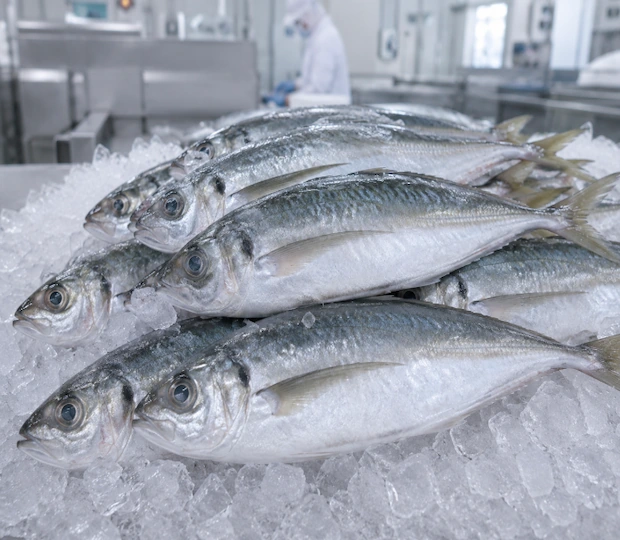
Frozen Trachurus japonicus — ma-aji — processed in Japan for export
Trachurus japonicus in Japanese Trade — Why Ma-aji Commands a Premium No Other Carangidae Achieves
No species on this site carries more cultural weight in its primary market than Trachurus japonicus in Japan. The word aji (アジ) in Japanese describes this specific species — not the genus, not a category, not a vague commercial name. When a Japanese chef says aji, they mean Trachurus japonicus and nothing else. When a Japanese supermarket prices its fish counter, aji has its own section, its own seasonality calendar and its own consumer expectation of freshness and flavour that has been refined over centuries of Japanese coastal fishing culture. This cultural specificity has direct commercial consequences for every buyer who sources frozen Japanese jack mackerel for the Japanese market or for buyers supplying Japanese restaurants outside Japan: Trachurus japonicus is not interchangeable with Trachurus murphyi (Chilean jack mackerel) or Trachurus trachurus (Atlantic horse mackerel) in any Japanese application, and attempting to substitute either in a Japanese-specification frozen product will produce immediate rejection at the buyer level.
Ma-aji Applications — What Global Mackerel's Japanese Buyers Specify
- Aji tataki (アジのたたき) Finely chopped raw aji with ginger, spring onion and ponzu — requires freshest possible freeze, minimum fat content 12%, IQF only, max glazing 8%. This is the application that drives the highest-specification frozen Japanese jack mackerel orders from Japanese restaurant chain buyers outside Japan.
- Aji no hiraki (アジの開き) Butterfly-opened dried aji — the split-fillet format unique to this species. Requires specific body-depth-to-length ratio only achievable with Trachurus japonicus, not with Trachurus murphyi which is too shallow-bodied. Processing detail covered in Section 4.
- Aji no nanbanzuke (南蛮漬け) Marinated fried aji — a dish where the moderate fat content (10–16%) of Trachurus japonicus produces the correct texture. Higher-fat species produce an overly rich result; lower-fat species produce an unacceptably dry one.
The Frozen Aji Market Outside Japan — B2B Demand Drivers
The global demand for frozen Japanese jack mackerel outside Japan is structurally linked to the expansion of Japanese restaurant chains in international markets. The number of Japanese restaurants outside Japan has grown from approximately 24,000 in 2006 to over 187,000 by 2023 according to the Japanese Ministry of Agriculture, Forestry and Fisheries — an increase of nearly 700% in 17 years. Each of these restaurants that serves aji-based dishes requires a supply of frozen Trachurus japonicus that replicates the flavour profile their Japanese-trained chefs expect. The buyers for these restaurants — food importers, Japanese trading companies' overseas procurement divisions, specialty seafood distributors serving Japanese hospitality groups — are the primary B2B buyers of frozen Japanese jack mackerel outside Japan. They specify Trachurus japonicus by scientific name, by stock origin, by fat content and by chilling protocol. They do not accept substitutions.
The secondary buyer group for frozen Japanese jack mackerel outside Japan is the Korean diaspora community in the United States, Australia and Western Europe, where Trachurus japonicus (known as 전갱이, jeon-gaeng-i in Korean) is a staple in Korean home cooking with demand characteristics distinct from Japanese foodservice buyers — covered in detail in Section 6.
The price premium that frozen Japanese jack mackerel commands over Peruvian frozen jack mackerel (Trachurus murphyi) reflects this cultural specificity. On a CIF East Asia basis, frozen Trachurus japonicus IQF whole round from Japan trades at 25–50% above frozen Trachurus murphyi BQF block from Peru in equivalent weight grades — a premium that persists regardless of supply conditions because the two species serve different markets that do not substitute for each other. A buyer supplying Japanese restaurants in Dubai pays the Trachurus japonicus premium because their customers require it. A buyer supplying bulk whole round frozen Carangidae to West African distributors pays the Trachurus murphyi price because their customers cannot perceive or value the premium. Both are correct procurement decisions for their respective market context.
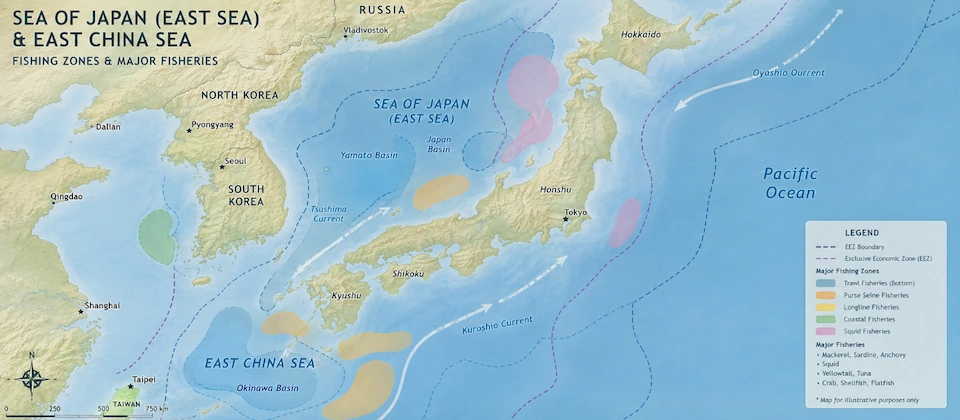
Three Stocks, Three Specifications — Why Trachurus japonicus Origin Determines Quality
Trachurus japonicus in Japanese and Korean waters is not a single homogeneous population. Fisheries scientists and commercial buyers who know the species distinguish three genetically and commercially distinct stock units, each occupying different geographic areas, peaking at different seasons and producing measurably different size and fat content profiles. Confusing the three stocks — or purchasing without specifying which stock origin is required — is the most common sourcing error made by buyers new to frozen Japanese jack mackerel procurement.
Sea of Japan Western Stock
日本海西部系群 — Nihonkai Seibu
- Peak season: May–September
- Size: 200–300g commercial
- Fat content: 10–16% (peak Aug–Sep)
- Primary ports: Nagasaki, Tsushima
- Distribution: Sea of Japan, via Tsushima Current
This stock migrates northward through the Tsushima Warm Current from the East China Sea into the Sea of Japan between April and June. It is the stock most directly shared with South Korean buyers and provides the majority of frozen Japanese jack mackerel exported from western Japanese ports to South Korea. The Tsushima Current migration makes this stock's size and fat content more variable than the Pacific coast stock.
East China Sea Stock
東シナ海系群 — Higashi Shina Kai
- Peak season: March–June
- Size: 150–250g commercial
- Fat content: 8–13%
- Primary ports: Nagasaki, Kagoshima
- Distribution: East China Sea, shared with China
The East China Sea stock is the smallest of the three in commercial terms and produces smaller fish than the other stocks. It is caught by both Japanese and Chinese vessels in the East China Sea, where overlapping fishing efforts create a shared stock dynamic managed (with limited success) under the Japan-China Fisheries Agreement. Chinese domestic processing of this stock for export competes with Japanese processing, often at lower per-unit cost.
Pacific Coast Stock
太平洋系群 — Taiheiyō
- Peak season: October–January
- Size: 250–400g commercial
- Fat content: 14–22% (peak Nov–Dec)
- Primary ports: Choshi, Kesennuma, Misaki
- Distribution: Pacific coast, Kuroshio-Oyashio zone
The Pacific coast stock feeds in the Kuroshio-Oyashio convergence zone and produces the largest, fattest Trachurus japonicus of the three stocks. This is the stock that feeds into the premium Seki Aji (関アジ) branded market and that produces the frozen aji specification most demanded by Japanese restaurant chains outside Japan. Buyers requiring minimum 16% fat content and 300g+ fish must specify Pacific coast stock from Choshi or Kesennuma processing facilities.
The practical procurement implication of the three-stock structure is this: a purchase order for frozen Japanese jack mackerel that specifies only species and size grade — without specifying stock origin or port of landing — may result in delivery of East China Sea stock fish (150–250g, fat content 8–13%) when the buyer expected Pacific coast stock (250–400g, fat content 14–22%). Global Mackerel specifies stock origin and landing port on all frozen Trachurus japonicus purchase orders as standard. Buyers who source through other channels should request this information explicitly.
The Kuroshio-Oyashio Convergence — Why Trachurus japonicus from the Pacific Coast Has Unmatched Fat Content
The Pacific coast stock of Trachurus japonicus owes its premium quality to one of the most productive marine environments in the world: the convergence zone between the Kuroshio Current (黒潮) and the Oyashio Current (親潮). The Kuroshio is a powerful warm-water current flowing northward along Japan's Pacific coast, originating in the North Equatorial Current and carrying warm, nutrient-depleted waters from tropical regions. The Oyashio is a cold, nutrient-rich current flowing southward along the Kuril Islands and Hokkaido, bringing cold sub-Arctic water dense with dissolved nitrates and phosphates. Where these two currents meet — approximately 35–38°N latitude along the Pacific coast of Honshu — an exceptional mixing zone develops where warm-water thermal stratification and cold-water nutrient density combine to produce phytoplankton blooms of extraordinary richness.
Trachurus japonicus migrates northward along the Pacific coast of Japan in spring and summer, following the leading edge of the Kuroshio Current where water temperatures of 16–22°C provide optimal foraging conditions. As the fish approach the Kuroshio-Oyashio convergence in summer, they encounter prey concentrations — primarily copepods, euphausiid krill and juvenile anchovies — that exceed anything available in the Sea of Japan or East China Sea stocks' feeding grounds. The result: Pacific coast Trachurus japonicus that have fed in the convergence zone through August–October enter the autumn season with fat content levels of 18–22% — values that match or exceed peak-season Norwegian Atlantic mackerel and that are fundamentally out of reach for the other two Japanese jack mackerel stocks. This is the physiological basis of the Pacific coast stock premium.
The Kuroshio-Oyashio convergence zone is not stable year to year. The position and intensity of the convergence shifts with the Pacific Decadal Oscillation (PDO) — a climate cycle operating on 20–30-year timescales that modulates the Kuroshio's strength and the Oyashio's southward extent. In PDO warm phases, the Kuroshio pushes further north, compressing the convergence zone; in PDO cool phases, the Oyashio dominates and the convergence zone shifts south. These multi-year shifts affect the feeding grounds available to the Pacific coast Trachurus japonicus stock and, over long periods, the average fat content achievable at peak season. Commercial buyers who track the PDO alongside the annual ENSO cycle — which also affects the Kuroshio — are better positioned to anticipate year-to-year variations in premium frozen Japanese jack mackerel quality than buyers who rely solely on seasonal expectations. For current price indications reflecting seasonal quality variations, see our frozen mackerel price per ton updated monthly.
Kuroshio-Oyashio Convergence System
Warm · 22–28°C · ↑ North
Cold · 4–12°C · ↓ South
Convergence Zone
35–38°N · Honshu Pacific
Peak nutrient density
Fat content: 18–22%
- Sea surface temp (convergence) 14–18°C
- Chlorophyll-a concentration High (>2mg/m³)
- Primary prey species Copepods, euphausiids
- Peak Trachurus fat content 18–22% (Nov–Dec)
- Stock feeding migration Apr–Oct northward
Schematic representation — not to scale. PDO modulates annual position.
氷締め Koori-jime — How Japan's Ice-Slurry Protocol Produces the Highest-Quality Frozen Trachurus japonicus
The quality of frozen Japanese jack mackerel at the top of the premium market is determined less by species identity than by what happens to the fish in the first three minutes after capture. The Japanese ice-slurry chilling protocol — called koori-jime (氷締め) or sometimes misojime (味噌締め) in quality-focused aji processing — involves the immediate immersion of live or newly caught Trachurus japonicus into a slurry of seawater and crushed ice maintained at −1°C to 0°C within moments of landing on deck or at the quayside. The ice slurry achieves rapid full-body temperature reduction from the fish's living body temperature (approximately 18–22°C in summer Pacific coast waters) to near-freezing in under three minutes — faster than any RSW tank system, and incomparably faster than the air-cooling and ambient-temperature quayside handling that characterises processing in higher-volume origins.
The commercial consequences of the koori-jime protocol are measurable at multiple levels. At the biochemical level: histamine formation in Trachurus japonicus — as in all Carangidae — begins when the fish's core temperature exceeds 10°C. Koori-jime reduces core temperature below 10°C within minutes of capture, effectively halting histamine formation before it begins rather than managing it after the fact. Commercial histamine test results on koori-jime processed Trachurus japonicus consistently register below 5mg/kg — well below the EU maximum of 100mg/kg and the Japanese Food Sanitation Law standard of 200mg/kg. At the texture level: the rapid thermal shock triggers rigor mortis uniformly throughout the muscle, producing a firm, dense flesh texture that is characteristic of premium Japanese aji and that is absent in fish processed more slowly. Sashimi-grade Trachurus japonicus — sold in Japan at premium sashimi counters — is exclusively koori-jime processed; no other chilling method produces the flesh texture and histamine profile required for raw consumption application.
For buyers sourcing frozen Japanese jack mackerel for the premium Japanese restaurant sector outside Japan, the koori-jime question is not a technicality — it is the first qualification criterion. Japanese chefs who grew up cooking and eating aji in Japan will detect the absence of koori-jime processing in frozen product by the texture of the cooked flesh. Global Mackerel sources frozen Trachurus japonicus exclusively from Japanese and Korean processing facilities that document their chilling protocol, and provides chilling method certification on request for buyers supplying premium Japanese foodservice applications. For buyers supplying less specification-sensitive markets — bulk frozen Carangidae for MENA institutional buyers, for example — the koori-jime premium is not commercially necessary, and standard RSW-processed Trachurus japonicus is the appropriate specification. For the full context of histamine management across all mackerel and horse mackerel species, see our frozen mackerel histamine regulations guide.
Chilling Protocol Quality Ladder — Trachurus japonicus
Premium
氷締め Koori-jime — Ice slurry within 3 minutes of capture
Core temp: −1°C in <3 min · Histamine: <5mg/kg · Texture: premium sashimi-grade · Application: Japanese restaurant chains, sashimi, tataki, hiraki
Standard
RSW Tank — Refrigerated Sea Water at 0°C to −1°C
Core temp: 0°C in 30–90 min · Histamine: <20mg/kg · Texture: good · Application: retail frozen, general foodservice, MENA bulk
Unacceptable (export)
Ambient chilling — unrefrigerated or air-cooled only
Core temp: slow reduction · Histamine: unpredictable · Texture: soft, compromised · Not accepted for EU, Japan, US frozen fish export
Seki Aji (関アジ) — The Brand That Sets the Price Ceiling for All Frozen Trachurus japonicus
In the port town of Saeki (佐伯市) in Oita Prefecture, on the northeast coast of Kyushu, Japan, Trachurus japonicus is sold under the brand name Seki Aji (関アジ). The brand is protected by the Saeki Fishing Cooperative Association and applies exclusively to aji caught by pole-and-line or hook-and-line methods in the Bungo Channel — the narrow strait between Kyushu and Shikoku where the Kuroshio Current creates exceptionally fast-flowing, cold water that stresses the fish into unusually dense, firm musculature. Seki Aji is live-transported to market in oxygenated tanks and sold at fresh fish counters in Kyushu and Tokyo at prices that regularly exceed ¥3,000–5,000 (approximately $20–35) per fish — 15 to 25 times the commodity price for standard frozen Trachurus japonicus of equivalent weight.
Why Seki Aji Matters for Global Mackerel's Buyers — The Halo Effect
No buyer outside Japan will source Seki Aji for their frozen product supply chain — the brand is explicitly tied to the specific fishing method (pole-and-line, Bungo Channel only) and marketing channel (live transport to premium counters) that preclude industrial frozen processing. But the Seki Aji brand matters to Global Mackerel's buyers for a precise reason: it establishes the quality ceiling for Trachurus japonicus in the Japanese consumer imagination and creates a halo effect that elevates the entire category. The existence of Seki Aji at ¥3,000–5,000 per fish means that Japanese consumers are aware that aji can be a premium product — more expensive than Scomber japonicus (Pacific mackerel), more prestigious than any other Carangidae. This consumer-level quality awareness translates directly into the B2B buyer's specification requirement: when a Japanese restaurant chain's procurement team specifies frozen Trachurus japonicus for their aji dishes, they are not buying a commodity — they are buying into the quality continuum of which Seki Aji is the apex.
The practical consequence for buyers is specification discipline. A buyer who sources frozen Trachurus japonicus for a Japanese restaurant chain outside Japan and delivers Trachurus murphyi (Chilean jack mackerel) or Trachurus trachurus (Atlantic horse mackerel) instead — whether through ignorance or deliberate substitution — will lose the account permanently when the client's kitchen identifies the incorrect species. The Seki Aji brand has trained Japanese-market buyers to detect species-level differences in aji that buyers in other markets have no reason to develop. This is the commercial reality that justifies the Trachurus japonicus price premium over all other Carangidae species.
Price comparison
Seki Aji (fresh, branded)
¥3,000–5,000/fish
Frozen Trachurus japonicus (premium IQF)
~$2,200–2,800/tonne CIF
Frozen Trachurus murphyi (Peru BQF)
~$800–1,100/tonne CIF
CIF East Asia indicative values. See price index for current benchmarks.
For buyers who do not supply Japanese-specification markets — who purchase frozen Carangidae for West African bulk trade, MENA institutional buyers or general foodservice — the Seki Aji halo and the Trachurus japonicus premium are irrelevant to their procurement decision, and frozen Chilean jack mackerel (Trachurus murphyi) from Peru at competitive BQF prices is the correct specification. The decision about which Trachurus to source is a market context decision, not a species preference. Global Mackerel advises buyers on the appropriate species specification for their end market before any purchase order is placed. For current price benchmarks across all Trachurus species, see our frozen mackerel price per ton updated monthly.
South Korea and Frozen Trachurus japonicus — The 전갱이 (Jeon-gaeng-i) Market Beyond Japan
South Korea is the second-largest market for frozen Japanese jack mackerel outside Japan and the second-largest commercial fishing nation for Trachurus japonicus. Korean buyers and Japanese buyers source and use frozen Trachurus japonicus in fundamentally different ways — a distinction that affects specification, format, processing protocol and price expectations in ways that buyers must understand before they can supply both markets efficiently from the same product range. Full South Korea origin details →
Japan — How Global Mackerel Supplies the Japanese Specification
- Trade name Ma-aji (真アジ) — Trachurus japonicus only
- Preferred format IQF whole round or H&G · no BQF block
- Size grade 250–400g (Pacific coast stock preferred)
- Fat content Minimum 14% specified for restaurant use
- Chilling protocol Koori-jime preferred for premium; RSW acceptable for general
- Primary application Aji tataki, hiraki, nanbanzuke, sashimi
- Substitution tolerance Zero — species-specific buyers
- Price sensitivity Low — premium paid for correct spec
South Korea — A Different Specification and a Different Market Logic
- Trade name 전갱이 (Jeon-gaeng-i) — generic aji
- Preferred format IQF whole round · semi-dried whole (guun-aji)
- Size grade 200–300g (Sea of Japan stock acceptable)
- Fat content Not typically specified — 10%+ acceptable
- Chilling protocol RSW standard — koori-jime not required
- Primary application Gui (grilled), jeon (pan-fried), jorim (braised)
- Substitution tolerance Moderate — Trachurus japonicus strongly preferred, Sea of Japan stock accepted
- Price sensitivity Moderate — quality premium accepted but smaller than Japan
The key commercial difference between Japanese and Korean buyers of frozen Trachurus japonicus is the fat content specification. Japanese buyers specify minimum fat content — typically 14–18% for premium applications — because the fat content of aji is a known quality variable in Japanese culinary tradition and because the restaurants they supply are staffed by chefs who can taste the difference. Korean buyers do not typically specify fat content on their purchase orders, relying instead on the general quality implied by species identity. This means that Sea of Japan stock frozen Trachurus japonicus — which produces 10–16% fat at peak season, lower than Pacific coast stock — is accepted by Korean buyers but may not meet Japanese buyers' specifications for premium applications. Global Mackerel advises buyers to specify both stock origin and minimum fat content when ordering frozen Japanese jack mackerel for Japanese-market end use.
Frozen Trachurus japonicus vs Fresh Aji — The B2B Buyer's Market Reality
In Japan, aji (Trachurus japonicus) is one of the few fish species where the fresh vs frozen debate is commercially unresolved — not in favour of frozen as with most imported seafood, and not decisively in favour of fresh as with sashimi-grade tuna. The Japanese domestic market for fresh aji — sold daily at fish markets, supermarket counters and direct-from-vessel outlets in coastal towns — is very large and very competitive. Consumers who live within an hour of major Japanese fishing ports (Choshi, Nagasaki, Misaki) have access to same-day-caught fresh aji that is simply incomparable to any frozen product. For these consumers, frozen aji is a compromise specification, accepted when fresh is unavailable but preferred only when price or convenience requires it.
The B2B buyer's reality is different from the domestic consumer's reality, and this distinction is where frozen Trachurus japonicus finds its strongest commercial case. Japanese restaurant chains that operate across multiple prefectures — izakaya chains, casual dining groups, hotel F&B divisions — cannot guarantee same-day fresh aji supply to 50 or 150 or 500 locations simultaneously. The logistics of fresh fish distribution in Japan — which operates on 24-hour cycles from fish market auctions to restaurant kitchens — breaks down at scale and at distance from coastal fishing ports. A chain that runs aji dishes on its menu 365 days per year in locations across Japan, and in its international locations in Singapore, Dubai and New York, requires a frozen specification that can be stored, planned and deployed with supply chain reliability that fresh aji cannot provide. This is the structural demand that sustains Japan's premium frozen Trachurus japonicus market and that creates the export opportunity Global Mackerel serves.
When to specify fresh vs frozen Trachurus japonicus
| Application | Fresh aji | Frozen Trachurus japonicus | Verdict |
|---|---|---|---|
| Single-location Japanese restaurant (coastal city) | ✓ Optimal | ✗ Unnecessary | Fresh |
| Multi-location chain — Japan domestic | ✓ For flagship | ✓ For network | Mixed |
| Japanese restaurant outside Japan | ✗ Unavailable | ✓ Only option | Frozen |
| Retail ready-meal production | ✗ Shelf-life | ✓ Optimal | Frozen |
| MENA bulk protein market | ✗ Not applicable | ✓ But over-specified | Other Trachurus |
The conclusion for Global Mackerel's buyers is clear: frozen Trachurus japonicus serves a specific demand that no other species can fill — Japanese restaurant chains outside Japan, Japanese-market retail production, and Japanese diaspora community distribution. It does not compete with fresh aji for domestic Japanese coastal restaurant applications, and it does not compete with Trachurus murphyi or Trachurus trachurus for bulk price-sensitive markets. Buyers who fall into the first category — Japanese restaurant supply outside Japan — should work with Global Mackerel to specify Pacific coast stock, minimum 14% fat content, koori-jime or RSW chilling, IQF whole round, and complete stock origin documentation. For buyers in the second category, we will advise on the most cost-effective Trachurus specification for their market. For East Asia market intelligence across all mackerel species, see our page on frozen mackerel supplier for East Asia.
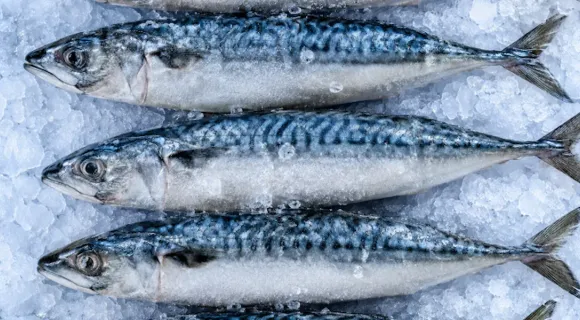
Japan Pacific coast — Trachurus japonicus fishing grounds, Kuroshio-Oyashio convergence
Choshi port, Japan — primary landing and processing point for Pacific coast Trachurus japonicus
Quick Reference — Global Mackerel's Frozen Japanese Jack Mackerel (Trachurus japonicus) Specifications
Full format specifications, HS code guidance and certification details are on dedicated pages — linked below.
Global Mackerel Supply Formats
- IQF WR — 10kg carton — Japan & Korea · Primary format
- H&G IQF — 10kg carton — Japan premium processors
- Hiraki (butterfly) — Japan specialty · limited volumes
- Size grades: 200–300g · 250–350g · 300–400g
- Stock origin on all documents
Full specifications →
HS Classification
0303.55
Trachurus japonicus — same HS as Trachurus trachurus and Trachurus capensis. Species identified by scientific name on all documents. Japan-EU bilateral health certification available.
Global Mackerel Certification Standards
Koori-jime certification and raw material histamine testing documentation available for EU, Japan and US-destined shipments.
Frequently Asked Questions — Frozen Japanese Jack Mackerel Trachurus japonicus
- What is the difference between frozen Trachurus japonicus and frozen Trachurus murphyi for Japanese restaurant buyers?
- Trachurus japonicus (ma-aji, Japanese jack mackerel) is the species required by all Japanese restaurant applications — aji tataki, aji no hiraki, aji no nanbanzuke. It is culturally and culinarily non-substitutable with Trachurus murphyi (Chilean jack mackerel from Peru) in any Japanese application. Japanese-trained chefs detect the species difference at the point of cooking by flesh density, fat distribution and flavour profile. Trachurus murphyi is a high-volume commodity product priced for bulk African and MENA markets; Trachurus japonicus is a premium specification product priced for Japanese and Korean premium markets. CIF price differential: 25–50% higher for Trachurus japonicus.
- What is the Kuroshio-Oyashio convergence zone and why does it produce the best frozen Trachurus japonicus?
- The Kuroshio-Oyashio convergence is the mixing zone where the warm Kuroshio Current (22–28°C) meets the cold, nutrient-rich Oyashio Current (4–12°C) along Japan's Pacific coast at approximately 35–38°N. The nutrient density of the convergence zone supports exceptional prey density. Pacific coast Trachurus japonicus feeding here accumulates 18–22% fat content by November–December — unachievable by Sea of Japan or East China Sea stocks of the same species. Pacific coast stock from Choshi or Kesennuma is the correct specification for buyers requiring minimum 16% fat content.
- What is koori-jime and which buyers need to specify it for their frozen Trachurus japonicus orders?
- Koori-jime (氷締め) is the Japanese ice-slurry chilling protocol — immediate immersion of live or newly caught Trachurus japonicus in seawater-and-crushed-ice slurry at −1°C to 0°C within 3 minutes of capture. It reduces core temperature to near-zero before histamine-forming bacteria can begin significant activity, producing histamine levels below 5mg/kg and a premium flesh texture required for sashimi and tataki applications. Buyers who supply Japanese restaurant chains, sashimi-grade retail products or any application where the fish is eaten raw or lightly cooked should specify koori-jime processing. Buyers supplying general frozen retail or MENA bulk applications can specify RSW-processed product at standard pricing.
- What are the three stocks of Trachurus japonicus and which should I specify?
- Japan's Trachurus japonicus comprises three commercial stocks: (1) Sea of Japan western stock — peaks May–September, 200–300g, fat 10–16%, primarily Korean market; (2) East China Sea stock — peaks March–June, 150–250g, fat 8–13%, shared with Chinese fleet; (3) Pacific coast stock — peaks October–January, 250–400g, fat 14–22%, premium Japanese market. For Japanese restaurant chain supply requiring minimum 14% fat content and 300g+ fish, specify Pacific coast stock from Choshi or Kesennuma. For Korean retail and general East Asian supply with flexible fat content specification, Sea of Japan stock is cost-effective. Always specify stock origin and landing port on purchase orders — Global Mackerel provides this on all documentation as standard.
Ready to source frozen mackerel?
Send your specs and get a competitive quote within 24h.