
Northeast Atlantic · Two species · Year-round · ONSSA certified
Frozen Mackerel from Morocco — Scomber scombrus & Trachurus trachurus Year-Round
Morocco is the only origin on this site that supplies two commercially distinct frozen mackerel species from the same coastline, the same processing infrastructure and the same export documentation framework. Frozen mackerel Morocco programmes combine frozen Atlantic mackerel (Scomber scombrus) from Agadir mackerel and Dakhla mackerel corridors with frozen horse mackerel Morocco volumes centred on Trachurus trachurus landings through Agadir and Tan-Tan. Product moves through ONSSA-certified processing plants to buyers across Sub-Saharan Africa, the Middle East, Eastern Europe and the European Union under a preferential trade framework that no other mackerel-producing country outside Norway holds with the EU in the same form. Global Mackerel sources Moroccan mackerel with Morocco mackerel year-round continuity — the one origin that closes seasonal gaps left by Norwegian and Icelandic quota calendars without pretending that every month delivers the same lipid profile. Moroccan frozen horse mackerel is the reference bulk export product for West African importers in Senegal, Ivory Coast and Ghana — traded CIF Dakar and CIF Abidjan in 20kg cartons year-round.
If your brief says frozen mackerel from Morocco supplier consolidation, you are usually optimising for dual-HS documentation, shared cold storage and a single Morocco mackerel season narrative that is procurement-led, not biology-only. Pair this page with frozen Atlantic mackerel — Scomber scombrus, frozen horse mackerel — Trachurus trachurus and request a Moroccan mackerel quote when you are ready to name ports, species split and certificate stack line by line.
Availability
Year-round
Species
Scomber scombrus · Trachurus trachurus
Primary ports
Agadir · Dakhla · Tan-Tan
Morocco's Unique Position — The Only Origin Supplying Both Frozen Atlantic Mackerel and Horse Mackerel at Scale
Every other major mackerel-producing origin on this site is defined by a single dominant commercial species at export scale. Norway and Iceland produce Scomber scombrus exclusively. Peru lands Trachurus murphyi for jack programmes. Namibia concentrates on Trachurus capensis. Japan mixes Scomber japonicus and Trachurus japonicus, but typically across geographically distinct grounds and parallel supply chains. Morocco is structurally different. The Moroccan Atlantic coast from Tan-Tan northward through Agadir to Dakhla sits at the southern edge of the Northeast Atlantic mackerel stock footprint while remaining inside the core range of Northeast Atlantic horse mackerel. Both species school inside the same coastal upwelling driven by the Canary Current, are targeted by overlapping semi-industrial purse-seine and trawl fleets, pass through the same ONSSA-approved freezing halls, and leave on the same container strings — which is why frozen Scomber scombrus Morocco and frozen Trachurus trachurus Morocco can share a bill of lading narrative that no Nordic-only programme can replicate.
For a buyer who sources both frozen Atlantic mackerel and frozen horse mackerel — a common structure for importers feeding West African or MENA channels where the two species substitute in smokehouses, grills and informal retail — Morocco is the only origin here that allows full procurement consolidation. One framework agreement with a Moroccan exporter, one set of banking lines, one annual third-party audit scope, one logistics corridor covering both HS 0303.54 and 0303.55. That consolidation is not available elsewhere on this site without splitting lanes: Norwegian Scomber scombrus and Mauritanian Trachurus flows imply separate counterparties, separate catch-certificate chains and often separate booking priorities on north–south shipping. The administrative cost of that split rarely appears in a one-dimensional CIF comparison — yet it is precisely what category managers under-count when they equate headline prices across origins.
Programme designers who need traceable dual-species tenders should still read species pages for lab limits, glazing bands and retail wording — frozen mackerel formats and specifications remains the canonical format dictionary — but the origin decision starts here when the RFQ explicitly pairs Atlantic and horse mackerel under one supplier umbrella.
| Parameter | Atlantic mackerel — Scomber scombrus | Horse mackerel — Trachurus trachurus |
|---|---|---|
| HS code | 0303.54 | 0303.55 |
| Commercial size range | 200–400g dominant | 100–300g dominant |
| Fat content range | 8–16% (seasonal variation) | 4–10% (lower — Trachurus lean species) |
| Primary format | WR IQF 10–20kg · H&G limited | WR IQF 10–20kg · BQF 20kg |
| Primary market | W. Africa · MENA · Eastern Europe | W. Africa · MENA · EU (NW Europe) |
| Certification body | ONSSA + MPMARE catch cert. | ONSSA + MPMARE catch cert. |
| EU tariff preference | Association Agreement quota | Association Agreement quota |
| Availability | Year-round from cold storage | Year-round from cold storage |
frozen Atlantic mackerel — Scomber scombrus frozen horse mackerel — Trachurus trachurus
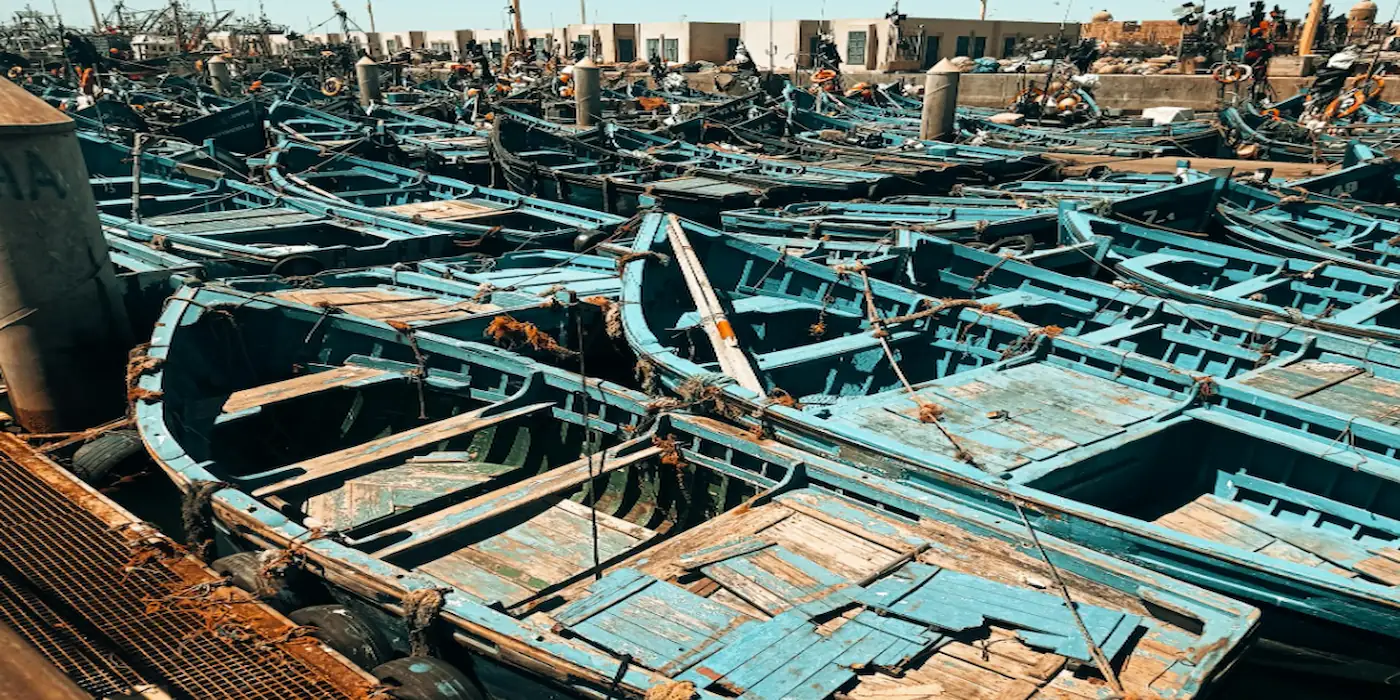
Sea Frozen Pelagic Fish Suppliers from Morocco — Agadir, Dakhla and Tan-Tan Compared
Morocco's mackerel and horse mackerel industry is concentrated in three Atlantic ports, each with a distinct commercial fingerprint. Port choice shapes expected size and Moroccan mackerel fat content bands because latitude and upwelling intensity shift within a few hundred miles, and it shapes the catch-area lines that appear on IUU catch certificates — which is why EU compliance teams increasingly ask for sub-area detail before approving vendor adds.
Agadir — Principal hub, both species, full format range
Agadir is Morocco's largest fishing port and the primary processing hub for both frozen Atlantic mackerel and frozen horse mackerel destined for export. Modern ONSSA-approved processing facilities in the Agadir industrial zone handle both species through continuous-operation IQF and BQF freezing lines, with cold storage depth suited to multi-container programmes. The fishing grounds serviced by the Agadir fleet sit on the coastal Atlantic banks between 29°N and 32°N — relatively shallow, productive water where year-round upwelling from the Canary Current supports both Scomber scombrus and Trachurus trachurus biomass. Container shipping from Agadir connects weekly to Algeciras, Rotterdam and Dakar, with direct reefer strings into West African discharge ports (Abidjan, Lomé, Cotonou, Lagos) typically inside a 7–12 day transit band depending on rotation and transshipment choices.
Dakhla — Colder waters, higher potential fat content, documentary complexity
Dakhla sits in the Western Sahara near 24°N, where Canary Current upwelling intensifies relative to Agadir because the shelf interacts more directly with the Northwest African upwelling centre. Sea temperatures on grounds south of Cap Juby are typically one to two degrees Celsius lower than equivalent Agadir grounds in the same calendar week, which can translate into marginally higher fat in Scomber scombrus caught October–February — often 10–16% versus 8–14% on comparable Agadir lots. Buyers with fat floors above 12% who still want a Moroccan lane may therefore bias specifications toward Dakhla landings in that autumn–winter window, always backed by lot certificates rather than origin reputation alone.
Documentary note — Dakhla fishing grounds
Fish caught in waters south of 27°28'N (the administrative boundary of the Western Sahara territory) may appear on catch certificates with references that intersect the CJEU October 2024 ruling on the EU-Morocco SFPA. EU buyers with sustainability or sanctions-style supply-chain policies should verify the ICES statistical sub-area referenced on the Moroccan catch certificate for Dakhla-origin product and seek legal counsel where the import programme is sensitive to territorial fishing rights.
Tan-Tan — Horse mackerel volume, BQF dominant, West Africa routing
Tan-Tan is Morocco's primary port for semi-industrial horse mackerel fishing, with a fleet of mid-water trawlers targeting Trachurus trachurus in the 150–250g size range across the calendar. BQF 20kg block frozen is the dominant format from Tan-Tan processors — the specification many West African bulk buyers prefer when they intend to reprocess blocks at destination instead of dispensing individual IQF fish. Transit from Tan-Tan to Mauritanian and Senegalese ports (Nouadhibou, Dakar) is typically two to five days shorter than from Agadir, which matters when demurrage sensitivity or just-in-time cold-store slots drive routing decisions for the Mauritania–Senegal–Guinea corridor.
Moroccan Mackerel Seasonality — Year-Round Availability, Variable Fat Content
The commercial strength of Morocco as a frozen mackerel origin is genuine Morocco mackerel year-round availability: processing plants produce continuously and cold stores hold inventory twelve months a year without the hard seasonal shutdown that defines Norwegian and Icelandic supply. That availability is commercially decisive when a buyer needs frozen Atlantic mackerel in May or June — when Nordic seasons are closed or not yet open — and still needs a competitive CIF band. But year-round availability is not the same as year-round constant lipid quality. The Moroccan Atlantic experiences two distinct fat cycles tied to Canary Current temperature swings: a relative peak in autumn through early winter (October–December, with premium Agadir lots reaching roughly 14–16% on strong years) and a lean spring–summer window (May–August, frequently 8–10% on Scomber scombrus) when warmer shelf water suppresses energy storage. Treating Moroccan mackerel as a single static spec is the fastest route to a quality dispute.
Indicative ranges — Agadir origin. Fat content by Soxhlet method. Verify with certificate per lot. Dakhla origin typically 1–2% higher in equivalent period.
Peak window — how to write the PO
When internal targets demand 14%+ fat, specify October–December landing months, name Agadir or Dakhla explicitly, and attach Soxhlet certificate language to the contract. That single paragraph prevents most spring–summer margin erosion disputes without abandoning Morocco's structural advantage: you can still book volume in lean months — you simply market it to channels that accept 8–12% fat honestly.
The practical procurement recommendation is direct. Buyers whose channels accept 8–12% fat — typical for many West African and price-sensitive MENA programmes — can treat frozen mackerel Morocco as the correct year-round origin. Buyers whose channels require 12%+ fat — Eastern European retail, Northeast Asian specifications, premium MENA — should restrict Moroccan Scomber scombrus bookings to October–January and insist on per-lot fat certificates. Adding Moroccan mackerel, minimum fat 12%, Soxhlet certificate required
to the purchase order costs nothing and removes the single most repeated arbitration theme in North African frozen pelagic trade.
frozen mackerel fat content specification guide
The EU–Morocco Trade Framework — Association Agreement Tariffs and SFPA Access
Morocco and the European Union are linked by an Association Agreement signed in 1996 and in force since March 2000, which progressively built a free-trade relationship between the parties. For frozen fish — including both frozen Atlantic mackerel (HS 0303.54) and frozen horse mackerel (HS 0303.55) — the agreement schedules annual tariff-rate quotas at preferential (reduced or zero) duty. Inside quota, landed EU duty is materially lower than the standard MFN column; outside quota, MFN applies in full and the landed cost curve jumps overnight. That mechanism is why Morocco mackerel EU quota monitoring belongs in the same workbook as CIF offers: two Moroccan quotes at identical specification can carry different landed economics if one clears customs in week 48 with quota headroom and the other arrives in week 52 after the annual preferential volume has been exhausted.
EU buyers should bake quota-status checks into their standard operating procedure before issuing binding nominations. The European Commission publishes tariff-quota utilisation through the TARIC service; procurement teams or their customs brokers can read remaining volume by CN line before locking incoterms. A contract signed in August for October–November discharge can face a different effective duty than a January nomination if earlier quarters burned preferential volume on unrelated Moroccan pelagic lines that share quota mechanics. Building a duty-at-MFN sensitivity row beside every Moroccan CIF comparison is simply disciplined buying — not pessimism.
Parallel to tariff preferences sits the EU-Morocco SFPA — the fisheries access agreement that historically allowed EU-flagged fleets to operate in Moroccan waters against financial compensation. Part of the catch from those access arrangements has been frozen at sea (FAS) under EU documentation chains and re-entered Europe without ever touching a Moroccan shore plant, while Moroccan domestic fleets supplied the land-based freezing sector. EU fishing pressure on shared stocks also influences how quickly Moroccan quota appears on offer — official landings tables do not always reveal the full competitive picture for a buyer timing tenders. In October 2024 the CJEU held that the SFPA cannot lawfully extend to Western Sahara waters without consent of the Sahrawi people, shifting legal risk for certain fishing-zone declarations. Practical takeaway: verify the area line on the MPMARE catch certificate before you commit Dakhla-origin volume into an EU discharge port, and involve counsel when your policy bar is low.
EU tariff — practical checklist for Moroccan mackerel buyers
- → Check TARIC quota utilisation before contracting: ec.europa.eu/taxation_customs/dds2/taric
- → Confirm preferential rate applicable to your HS code (0303.54 or 0303.55)
- → Request EUR.1 or Form A certificate of origin from the Moroccan exporter
- → Verify fishing zone on catch certificate if product from Dakhla area
- → Build a duty-inclusive CIF scenario for late-season contracts
Moroccan Mackerel Export Documentation — ONSSA, MPMARE and EU Catch Certificates
Morocco operates a two-authority export certification model for frozen fish. ONSSA (Office National de Sécurité Sanitaire des Produits Alimentaires) is the food-safety competent authority that inspects processing facilities, audits HACCP systems and issues the health certificate recognised by the EU, Japan and many GCC markets as the primary hygiene document. MPMARE — the Department of Maritime Fisheries within the Ministry of Agriculture — issues the catch certificate required under EU IUU Regulation 1005/2008, referencing the Moroccan vessel registration number, catch date, statistical area and quota accounting line under the national fishing plan. Both documents are required for EU imports; for several non-EU destinations, ONSSA evidence alone may satisfy the receiving authority, but importers should never assume parity without checking the destination's latest import circular.
Buyers auditing ONSSA certified mackerel programmes should cross-read frozen mackerel quality and certifications for how Global Mackerel describes third-party and customer-specific audit language, then map those clauses onto Moroccan establishment approval numbers and lot-level traceability references. For HS coding and documentary sequencing, keep frozen mackerel HS codes and trade documentation — full guide open beside this origin sheet so finance, logistics and compliance share one vocabulary.
Frozen Moroccan mackerel — documents by destination
European Union
- → ONSSA EU Health Certificate
- → MPMARE IUU Catch Certificate (vessel + zone + quota ref.)
- → EUR.1 or Form A (Association Agreement preference)
- → Commercial invoice · Packing list · B/L
GCC (UAE, Saudi, Qatar…)
- → ONSSA Health Certificate
- → Halal Certificate (OIC-recognised certification body)
- → Certificate of Origin (legalised by Moroccan CCIS)
- → Arabic carton label (net drained weight)
West Africa (bulk)
- → ONSSA Health Certificate
- → Certificate of Origin (standard)
- → Phytosanitary cert. where locally required
- → Halal cert. for Muslim-majority markets
Eastern Europe
- → ONSSA EU Health Certificate
- → MPMARE IUU Catch Certificate
- → EUR.1 (Association Agreement)
- → Radiation certificate (some markets)
Frequently Asked Questions — Frozen Mackerel from Morocco
- Can I source both frozen Atlantic mackerel and frozen horse mackerel from Morocco in one contract?
- Yes. Morocco is the only origin on this site that produces both frozen Atlantic mackerel (Scomber scombrus, HS 0303.54) and frozen horse mackerel (Trachurus trachurus, HS 0303.55) in commercial volumes from the same coastal infrastructure. A single framework agreement with a Moroccan ONSSA-certified exporter can cover both species, with separate lot references and catch certificates for each. This consolidation reduces banking complexity, logistics costs and audit requirements compared to sourcing the two species from separate Norwegian and Mauritanian origins.
- What fat content can I expect from Moroccan frozen mackerel and when should I buy?
- Moroccan frozen Atlantic mackerel (Scomber scombrus) from Agadir typically shows fat content of 8–10% in spring–summer (May–August) and 12–16% in the October–January window when coastal water temperatures drop. Dakhla-origin product in the same October–January window can run 1–2% higher than Agadir equivalent. Moroccan horse mackerel (Trachurus trachurus) runs lean year-round at 4–10%, peaking modestly at 7–10% in October–November. Buyers with fat content minimum specifications of 12%+ should restrict Moroccan mackerel sourcing to October–January and require a Soxhlet method fat content certificate per production lot.
- Does Morocco have preferential tariff access to the European Union for frozen mackerel?
- Yes. Under the EU-Morocco Association Agreement in force since 2000, frozen Atlantic mackerel (HS 0303.54) and frozen horse mackerel (HS 0303.55) from Morocco benefit from annual tariff rate quotas at preferential (reduced or zero) duty. When within quota, the effective import duty at EU border is lower than the standard MFN rate. Quota availability varies by year and product — buyers should check TARIC quota utilisation before contracting and build a duty-at-MFN sensitivity scenario for late-season contracts when quota may be partially or fully exhausted.
- What documents are required for EU import of Moroccan frozen mackerel?
- EU imports of Moroccan frozen mackerel require: an ONSSA health certificate from an EU-approved processing establishment; an MPMARE catch certificate under EU IUU Regulation 1005/2008, referencing the vessel registration, catch date, catch area and national quota line; and an EUR.1 or Form A certificate of origin to claim the Association Agreement preferential tariff. For Dakhla-origin product, buyers should verify the fishing zone declared on the MPMARE catch certificate in light of the CJEU October 2024 ruling on the EU-Morocco SFPA, and consult their customs counsel on implications for their specific import programme.
Moroccan Mackerel — Related Pages
Ready to source frozen mackerel?
Send your specs and get a competitive quote within 24h.