
Genus Scomberomorus · Spotted Seer Fish · India & Bangladesh · HS 0303.54
Frozen Japanese Spanish Mackerel Supplier — Scomberomorus guttatus
Frozen Japanese Spanish mackerel (Scomberomorus guttatus) is the least-documented commercially traded Scomberomorus species in the world — and that obscurity creates specific commercial risks for buyers that this page addresses directly. Known as spotted spanish mackerel in international trade, surmai in India, indo-sawara in Japanese import nomenclature, and vanjaram alongside S. commerson in Tamil Nadu, frozen Scomberomorus guttatus is traded in significant volumes from India (Gujarat, Maharashtra, Tamil Nadu, Kerala, Andhra Pradesh) and Bangladesh, yet remains statistically invisible in most FAO and national export databases that do not distinguish it from S. commerson. Global Mackerel supplies frozen Scomberomorus guttatus IQF whole round and H&G from MPEDA-certified Indian facilities and Bangladesh processing plants to buyers across Japan, South and Southeast Asia, and the Middle East.
Spots
Distinctive dorsal row — species ID marker
Format
IQF WR · H&G · commercial portions
HS Code
0303.54
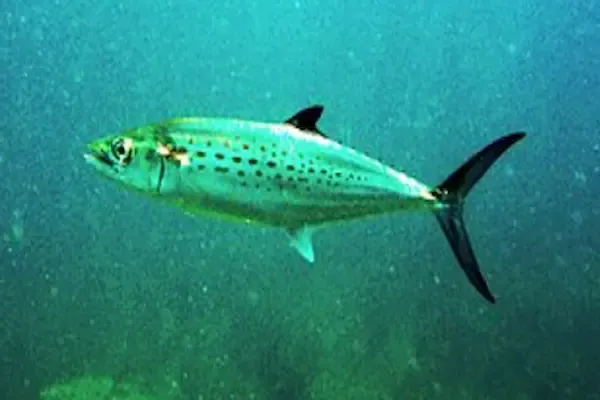
Scomberomorus guttatus vs Scomberomorus commerson — The Spotted Seer Fish That Statistics Don't Count
India is the world's largest producer of Scomberomorus guttatus by volume, but its export statistics do not say so. The category "seer fish" in India's MPEDA export database aggregates Scomberomorus commerson, Scomberomorus guttatus and, in some coastal states, Scomberomorus lineolatus under a single export line. The FAO's global capture production database follows the same aggregation for most Indian reporting years. A buyer researching the global market for frozen Japanese Spanish mackerel who relies on FAO FIGIS data or UN Comtrade seer fish export figures will find a number that represents a blend of three species in unknown proportions — not a S. guttatus-specific volume. The only institution that publishes species-disaggregated production data for Indian Scomberomorus catches is the CMFRI through its annual Marine Fisheries Census and its ICAR-CMFRI stock assessment reports, available in English from the CMFRI digital repository. For buyers building supply security analysis on spotted mackerel frozen programmes, CMFRI data is the starting point — not FAO alone.
Scomberomorus guttatus is visually distinct from S. commerson at delivery for a trained receiver: the species is named for the row of rounded spots along its lateral line — a pattern absent in S. commerson, which shows irregular wavy dark bars on a silver body. Commercial sizes overlap: S. guttatus reaches 90cm and 7kg in large individuals, compared to S. commerson's 240cm and 70kg maximum — meaning that in the 1–3kg commercial range where both species are traded IQF whole round, the size grade is not a distinguishing criterion. The flesh profile also differs: S. guttatus is slightly softer and more strongly flavoured than S. commerson at equivalent size, a difference detectable by experienced Japanese buyers who use the two species for different applications — a fact with direct commercial consequences covered in the section on indo-sawara Japan positioning.
European Union border inspection posts require the scientific species name on health certificates — "seer fish" alone is not accepted as a species identification under EC Regulation 1169/2011 on food information to consumers. An EU buyer who imports a container labelled "frozen seer fish" without the MPEDA health certificate specifying Scomberomorus guttatus risks a hold at the EU border inspection post pending species clarification. For Japan, the mandatory import declaration under the Food Sanitation Act requires the scientific name for Scomberomorus species. In both cases, the obligation to secure species-specific documentation rests on the buyer at order placement — not at loading. For a parallel supplier page on the larger narrow-barred congener, use frozen Spanish mackerel Scomberomorus commerson supplier — then insist on separate Latin-name lines for each RFQ.
Scomberomorus guttatus — visual identification at receiving
- → Lateral spots: row of rounded dark spots along the lateral line — distinctive, absent in S. commerson
- → Body depth: deeper body relative to length than S. commerson — more rounded cross-section
- → Max size: commercial fish 500g–5kg — S. commerson at equivalent size is less common in IQF WR format
- → Dorsal fin: first dorsal fin more rounded at tip than S. commerson's sharper profile
- → On document: require "Scomberomorus guttatus" by scientific name on MPEDA certificate — not "seer fish"
Buyers who tender frozen japanese spanish mackerel IQF under a blended "seer" description should expect EU and Japanese customs to push back: the fix is always Latin-name alignment on the health certificate, invoice and outer carton. Supplier diligence on Scomberomorus guttatus starts with that three-line match, not with a generic product photo.
Frozen Japanese Spanish Mackerel in Japan — The Indo-Sawara Market and the Sawara Substitution Risk
In Japan, Scomberomorus niphonius — the native sawara — is among the most culturally significant fish in the Japanese gastronomic calendar. It is a seasonal delicacy prized in kaiseki cuisine, sold as sashimi in premium establishments, and featured in regional culinary traditions from Osaka (the sawara of the Seto Inland Sea) to Kyushu. It commands wholesale prices on the Toyosu market typically in the range of ¥1,500–4,000/kg depending on season and size — historically 5 to 8 times the price of imported frozen S. guttatus. This premium creates persistent commercial pressure: Japanese importers who supply mid-range restaurant chains and supermarket chains use frozen Scomberomorus guttatus imported from India under the trade name "indo-sawara" (インドサワラ) as an economical alternative to domestic sawara in cooked applications — nimono (simmered), teriyaki, and processed fish products — where the species difference is masked by sauce and heat treatment. That is the legitimate commercial lane for indo-pacific spanish mackerel packs landed in Kobe or Yokohama.
The indo-sawara market in Japan is legitimate when the species is correctly identified on the product label and menu. The risk emerges at two points in the distribution chain. First, at the import level: some Japanese importers have been found filing customs declarations listing S. guttatus under the broader commercial category "sawara" without the qualifier "indo" — a labelling ambiguity that misrepresents the species to the end buyer. The Japanese MHLW requires the scientific name on import declarations; an import filed as "sawara / Scomberomorus" without species-level identification is technically incomplete and may trigger enhanced inspection. Second, at the restaurant level: cases of deliberate substitution — serving S. guttatus as premium sawara (S. niphonius) — have been documented in industry press in Japan and are covered by Japan's Act against Unjustifiable Premiums and Misleading Representations (景品表示法).
An Indian exporter supplying frozen Scomberomorus guttatus to Japan must provide documentation that closes the species identification gap at every point in the chain. The MPEDA health certificate must state Scomberomorus guttatus — not "seer fish", not "king mackerel", not "sawara". The commercial invoice must carry the same scientific name plus the Japanese trade designation "indo-sawara" in parentheses. The packing carton must label the species in both English and Japanese (インドサワラ / Scomberomorus guttatus). An exporter who provides these three documents consistently builds a compliance record with Japanese MHLW that reduces the probability of enhanced inspection on subsequent shipments. Cross-check nomenclature with our frozen mackerel species identification and documentation guide before you lock carton artwork.
| Parameter | S. guttatus — Indo-sawara | S. niphonius — Sawara |
|---|---|---|
| Origin | India, Bangladesh (imported) | Japan — domestic catch only |
| Toyosu wholesale price | ¥300–600/kg (imported frozen) | ¥1,500–4,000/kg (domestic fresh) |
| Primary Japanese use | Teriyaki · nimono · surimi · processed | Sashimi · kaiseki · grilled premium |
| Substitution risk | Used as economic substitute — legal if labelled correctly | Cannot be substituted without labelling violation |
| MHLW import declaration | Requires "Scomberomorus guttatus" — not "sawara" | Domestic — no import declaration required |
| Lateral marking | Rounded spots along lateral line | Irregular dark wavy bars — similar to S. commerson |
Procurement managers comparing surmai export lanes for Japan should split tenders: domestic sawara for sashimi-grade programmes is a different SKU family from frozen Japanese Spanish mackerel for cooked-line factories — never merge them on one specification sheet.
The Scomberomorus guttatus Aquaculture Horizon — What Buyers With Long-Term Contracts Must Know Now
Scomberomorus guttatus is the only species on this site for which an active government-funded aquaculture domestication programme exists targeting the same species for commercial production at scale. The ICAR-CMFRI in Kochi announced in 2021 successful induced spawning of S. guttatus in captivity — the first validated proof of concept for this species — and published a larviculture protocol demonstrating survival rates sufficient to consider pilot-scale hatchery production viable. The programme's public roadmap targets commercial fingerling availability for cage aquaculture by 2026–2028, contingent on resolving feed conversion efficiency at the juvenile stage, which remains the primary technical bottleneck. Simultaneously, Japan's Kindai University — the institution responsible for domesticating Pacific bluefin tuna (Thunnus orientalis) for commercial aquaculture — has published preliminary results on Scomberomorus spp. breeding in captive marine enclosures off the Wakayama coast. No commercial aquaculture production of S. guttatus exists as of this page's publication date — verify with CMFRI for current status before you rely on this timeline in a board memo.
No other species on this site faces this specific combination: a wild-caught supply that is statistically underreported, traded under a shared species name with a more commercially recognised congener, and exposed to a credible aquaculture substitution within a foreseeable commercial horizon. For buyers who are structuring multi-year procurement agreements for frozen Scomberomorus guttatus — particularly for the Japanese processing market and the South Asian institutional food sector — this aquaculture trajectory has two direct implications. First, wild-caught S. guttatus with verified provenance documentation (CMFRI-verifiable landing data, vessel logbook, MPEDA certificate with scientific name) will likely command a premium over unlabelled mixed seer fish product as aquaculture supply enters the market and creates a quality bifurcation. Second, buyers whose contracts do not specify "wild-caught Scomberomorus guttatus" by name may find that their supplier substitutes farmed product — from a different origin, different feed profile, different fat profile — without triggering a contractual breach.
Buyers who wish to ensure wild-caught Scomberomorus guttatus supply in their long-term agreements should include three specific clauses now, before aquaculture supply reaches commercial scale: (1) species designation: Scomberomorus guttatus, wild-caught, MPEDA health certificate with scientific name; (2) origin restriction: marine capture fishery only — not pond, cage or RAS production; (3) provenance documentation: CMFRI landing data or vessel logbook reference traceable to a named fishing ground in the Arabian Sea or Bay of Bengal. These clauses add zero cost today. They protect supply quality if the aquaculture transition accelerates faster than current ICAR-CMFRI projections suggest.
Aquaculture status — Scomberomorus guttatus (as of this page's knowledge date)
- → ICAR-CMFRI: induced spawning validated 2021 · larviculture protocol published
- → Commercial fingerling target: 2026–2028 (contingent on feed conversion breakthrough)
- → Kindai University (Japan): preliminary Scomberomorus spp. captive breeding results published
- → No commercial aquaculture production of S. guttatus currently available (verify with CMFRI for current status)
- → Buyer action: add wild-caught provenance clause to all multi-year S. guttatus supply agreements now
Aquaculture S. guttatus remains a forward risk, not a present substitute SKU — treat farmed offers as a new category when they appear, with separate sensory and lab panels.
Bangladesh and Myanmar — The Primary Markets for Frozen Scomberomorus guttatus That No Trade Data Shows
Bangladesh is one of the largest per-capita consumers of seer fish in the world — a fact that does not appear in global frozen fish import statistics because the majority of the trade flows through informal cross-border channels and small-scale commercial imports that are underreported in Bangladesh Bureau of Statistics data. The formal import of frozen Scomberomorus guttatus from India enters Bangladesh primarily through Chittagong (sea freight from Indian east coast ports — Haldia, Paradip, Visakhapatnam) and through Benapole land border crossing (refrigerated truck from West Bengal fish markets). The dominant specification in the Bangladesh formal import channel is frozen S. guttatus whole round or H&G in 10–15kg cartons, sizes 500g–2kg per fish, at price points competitive with locally caught seer fish during the wet-season closure window when domestic landings drop. Formal import volumes increase significantly between June and September — the same calendar window that tightens Indian domestic landings and makes frozen stock from processing plants in Gujarat and Tamil Nadu the primary supply source for the Dhaka and Chittagong retail market.
Myanmar's internal fish consumption market is among the least-documented in Asia from a frozen import perspective. Scomberomorus guttatus is consumed domestically in Myanmar as a premium fish — sold fresh in Yangon's Chinatown wet markets as "kyar" — but also increasingly as frozen portions through cold chain infrastructure. The frozen S. guttatus that reaches Mandalay originates primarily from two routes: direct import from Bangladesh (re-export of Indian frozen product through Chittagong and the Chittagong–Mandalay freight corridor) and import from Thailand (Thai-processed S. guttatus of Indian-origin raw material). Myanmar does not publish species-specific seafood import data — buyers who wish to evaluate this market must commission primary research through local trade brokers.
The Gulf Cooperation Council states — particularly the UAE (Dubai and Abu Dhabi), Qatar and Kuwait — have significant South Asian diaspora communities from Kerala, Tamil Nadu, Andhra Pradesh and Bangladesh for whom seer fish is a cultural staple. Frozen Scomberomorus guttatus imported from India under MPEDA documentation serves this diaspora retail market through Indian grocery chains. The GCC seer fish retail market is price-sensitive and does not distinguish S. guttatus from S. commerson at the consumer level — both are sold as "seer fish" — but import documentation must carry the scientific name for Dubai Municipality food safety compliance. Route density and margin structure for this lane sit in our frozen mackerel South and Southeast Asia market guide.
| Market | Segment | Dominant spec | Key doc requirement |
|---|---|---|---|
| Japan | Foodservice processing / surimi | H&G IQF 1–3 kg | MHLW: "Scomberomorus guttatus" scientific name mandatory |
| Bangladesh | Retail / wet market institutional | WR IQF 500g–2kg · 10–15kg carton | MPEDA health cert · Bangladesh SPS certificate |
| Myanmar | Premium retail / cold chain | WR or H&G IQF 800g–2kg | No formal spec — Thai or Bangladeshi re-export docs |
| GCC — UAE · Qatar · Kuwait | South Asian diaspora retail | WR IQF 500g–1.5kg · halal cert | Dubai Municipality: scientific name + halal certificate (recognised body) |
| India domestic export deficit | Processed / institutional | WR bulk 20kg BQF | MPEDA cert with S. guttatus + FSSAI compliance |
For Rastrelliger-dominated programmes that sometimes sit on the same distributor P&L as seer fish, read frozen Indian mackerel Rastrelliger kanagurta supplier — then keep purchase orders species-pure so warehouse barcodes do not merge genera.
Species Documentation for Frozen Japanese Spanish Mackerel — Closing the MPEDA Seer Fish Gap
The MPEDA export certificate system for seer fish was designed for a market in which the species distinction between Scomberomorus commerson and Scomberomorus guttatus was commercially irrelevant — both were "seer fish", both commanded similar prices, both went to the same buyers. That is no longer true. Japan's MHLW species-specific import declaration requirements, the EU's mandatory scientific species name on health certificates, and the growing buyer demand for provenance-specific frozen S. guttatus (particularly for the indo-sawara Japan market and for buyers who wish to position against the future aquaculture supply) have created a documentation requirement that the legacy MPEDA "seer fish" category does not automatically satisfy. An MPEDA health certificate that lists the species as "Seer Fish (Scomberomorus spp.)" — the historically common formulation — does not satisfy EU Regulation 1169/2011 or Japanese MHLW import declaration requirements. The certificate must specify Scomberomorus guttatus.
Obtaining an MPEDA health certificate that specifies Scomberomorus guttatus by scientific name requires explicit instructions at three points in the export process. First, at purchase order placement: the PO must specify "Scomberomorus guttatus (spotted Spanish mackerel / Japanese Spanish mackerel)" — not "seer fish" — as the product description. Second, at the processing plant: the HACCP processing record and the factory's MPEDA registration must show S. guttatus as the raw material species identity for the specific production lot. Third, at MPEDA pre-export inspection: the inspector's sample must be submitted with the species name, and the resulting certificate must carry the scientific name on the species field. Processing plants in Kerala and Tamil Nadu that regularly export to Japan and the EU have this protocol established — plants that have not exported to these markets before may require guidance. Global Mackerel verifies species-specific MPEDA certification as standard for all EU and Japanese-destined frozen S. guttatus shipments.
The complete document set for frozen Scomberomorus guttatus export — by destination — is the most variable of any seer fish species, because the receiving country's requirements differ more sharply than for species with a single dominant market. Buyers who need seer fish India export paperwork that survives Tokyo or Rotterdam inspection should treat Latin-name consistency as the master data field across invoice, certificate and carton.
Frozen Scomberomorus guttatus — documentation by destination
Japan (MHLW)
- → MPEDA cert: "Scomberomorus guttatus" scientific name
- → Commercial invoice: "indo-sawara / Scomberomorus guttatus"
- → Carton label: インドサワラ + scientific name
- → Lot-level laboratory certificate aligned to current MHLW testing notices for the product category
EU (BIP inspection)
- → MPEDA EU health certificate: "Scomberomorus guttatus"
- → Catch certificate (IUU Reg 1005/2008)
- → EUR.1 or GSP Form A
- → Species name on label per Reg. 1169/2011
GCC — Dubai / Saudi
- → MPEDA cert with scientific name
- → Halal certificate from an OIC-recognised certification body
- → Arabic label: net drained weight declared
- → Dubai Municipality: scientific name mandatory
Bangladesh
- → MPEDA health certificate
- → Bangladesh SPS import permit (seafood)
- → Certificate of origin (SAARC Form B preferred)
- → Phytosanitary certificate not required for fish
frozen mackerel quality certifications and MPEDA compliance — audit naming conventions before your QA team signs the vendor file. For HS chapter notes and catch certificate alignment, pair that review with frozen mackerel species documentation and trade guide.
Frozen Japanese Spanish Mackerel — Related Origins and Product Index
Frozen Japanese Spanish mackerel moves from Arabian Sea and Bay of Bengal landings into Japan-surimi factories, Bangladesh retail cold chains and GCC diaspora shelves. Keep vessel-to-plant traceability aligned with the Latin name on every hop. When you rebalance the basket, return to the all frozen mackerel and seer fish products index and re-open only the SKUs your documentation can defend.
- → Japan fishing and import documentation context — comparator for Toyosu-grade domestic sawara versus indo-sawara import lanes.
- → Indian Ocean pelagic sourcing overview — landing geography behind Indian and Bangladesh-seer supply.
- → East Asia frozen seafood distribution — onward logistics from Japanese ports to food plants.
Frequently Asked Questions — Frozen Japanese Spanish Mackerel (Scomberomorus guttatus)
- How do I distinguish Scomberomorus guttatus (Japanese Spanish mackerel) from Scomberomorus commerson (Spanish mackerel) at receiving inspection?
- Use the lateral spot row versus wavy bars, body depth and dorsal-fin outline — then confirm with the MPEDA species field. Size overlap in the 1–3kg IQF band means paperwork, not eyeball alone, closes the file for EU and Japan.
- What is indo-sawara and why does the Japanese market for frozen Scomberomorus guttatus carry labelling risks?
- Indo-sawara is the trade name for imported Indian S. guttatus. Risks arise when "sawara" appears without "indo" or without the scientific name on customs and carton lines — that is where MHLW scrutiny and consumer-law exposure concentrate.
- Why can't I find reliable global trade volume data for frozen Scomberomorus guttatus?
- Public trade statistics aggregate seer fish lines. Use CMFRI disaggregated catch and production publications for India, add broker-led field counts for Bangladesh and Myanmar, and treat FAO totals as an upper bound shared across congeners — not as a S. guttatus volume line.
- Should I include an aquaculture exclusion clause in my frozen Scomberomorus guttatus supply agreement?
- Yes for contracts crossing the mid-2020s: specify wild marine capture, MPEDA Latin-name certificates, and CMFRI-traceable landings so a future farmed stream cannot silently satisfy a loosely worded "seer fish" clause.
Ready to source frozen mackerel?
Send your specs and get a competitive quote within 24h.